
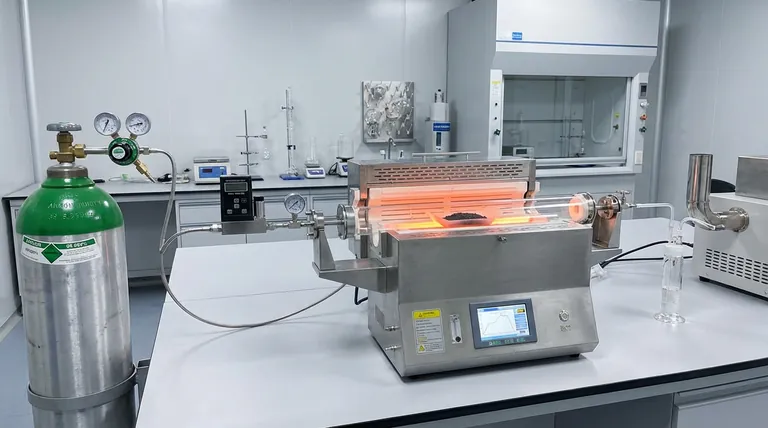
High-purity argon acts as a critical protective shield against combustion. By continuously flowing through the tube furnace, argon creates an inert atmosphere that actively displaces atmospheric oxygen, preventing the graphite oxide from undergoing violent oxidative combustion at temperatures as high as 800 degrees Celsius.
The presence of argon ensures that the heating process triggers a controlled thermal reduction rather than destructive burning, allowing for the successful restoration of electrical properties while maintaining the structural integrity of the nanodevices.
The Physics of Protection
Preventing Oxidative Combustion
At annealing temperatures (often around 800°C), carbon-based materials like graphite oxide are highly reactive with oxygen. Without a protective atmosphere, the presence of oxygen would cause the carbon lattice to react violently. This results in the material burning away completely rather than transforming into the desired reduced state.
Ensuring Controlled Deoxidation
The goal of annealing is to remove oxygen functional groups from the graphene oxide structure, known as deoxidation or reduction. High-purity argon creates a stable, non-reactive environment where this chemical transformation can occur. This allows the carbon lattice to heal and restore its electrical conductivity without external interference.
Preserving Nanostructure Integrity
For nanodevices, maintaining the physical architecture of the material is just as important as chemical reduction. By preventing uncontrolled oxidation, argon flow ensures that the nanostructures remain intact throughout the thermal stress of the process.
The Role of Continuous Flow
Maintaining Positive Pressure
A static volume of argon is often insufficient; a continuous flow is required to maintain a slight positive pressure within the tube. This pressure acts as a barrier, preventing ambient air (and oxygen) from leaking back into the furnace chamber through seals or connections.
Flushing Desorbed Contaminants
As the graphite oxide heats up, it releases various gases and byproducts. A steady flow of argon acts as a carrier gas, sweeping these desorbed species out of the reaction zone to prevent re-deposition or localized contamination.
Common Pitfalls to Avoid
Insufficient Purity Levels
Using standard or industrial-grade argon can be a fatal error in sensitive experiments. Even trace amounts of oxygen in the gas supply can degrade the quality of the reduction. Always utilize high-purity argon to ensure the atmosphere is truly inert.
Inadequate Initial Purging
Simply turning on the flow is not enough to guarantee a pure environment immediately. As noted in vacuum tube protocols, it is critical to pre-pump a vacuum and refill with argon multiple times before heating. This cycle effectively removes residual air trapped in the tube and porous insulation.
Flow Rate Fluctuations
Inconsistent gas flow can lead to variations in the local atmosphere around the sample. Similar to how hydrogen flow must be regulated for chemical reduction, argon flow must be stabilized using a precision mass flow controller. Fluctuations can cause uneven heating or inconsistent protection across the sample surface.
Optimizing Your Annealing Process
To ensure the highest quality results for your graphite oxide reduction, apply the following principles based on your specific objectives:
- If your primary focus is Structural Integrity: Prioritize the "pump and refill" pre-cycling method to eliminate every trace of oxygen before the temperature ramps up.
- If your primary focus is Consistency: Invest in a high-precision gas mass flow controller to eliminate variables caused by pressure drops or flow spikes.
Success in annealing lies in the rigorous exclusion of oxygen to allow the material to rebuild itself.
Summary Table:
| Feature | Role of Argon in Annealing | Impact on Graphite Oxide |
|---|---|---|
| Atmosphere Control | Displaces atmospheric oxygen | Prevents violent combustion and material loss |
| Chemical Environment | Provides an inert, non-reactive space | Enables controlled deoxidation and lattice healing |
| Continuous Flow | Maintains positive pressure | Blocks oxygen leaks and flushes desorbed contaminants |
| Pressure Barrier | Sustains constant gas movement | Ensures consistent protection across the sample surface |
Elevate Your Material Research with KINTEK Precision
Achieving perfect thermal reduction of graphite oxide requires more than just high temperatures; it demands a flawlessly controlled environment. KINTEK provides industry-leading Tube, Vacuum, and CVD systems designed to maintain the rigorous high-purity atmospheres your research deserves.
Why choose KINTEK?
- Expert R&D & Manufacturing: Our furnaces are engineered for stability and precision.
- Fully Customizable: We tailor systems to your unique lab high-temp needs, including integrated gas delivery.
- Uncompromising Integrity: Ensure structural and electrical restoration of your nanodevices with our reliable heating solutions.
Ready to optimize your annealing process? Contact our technical experts today to find the perfect furnace solution for your laboratory.
References
- Chuan Tang, Linmao Qian. Influence of Film Thickness on Nanofabrication of Graphene Oxide. DOI: 10.1007/s41871-024-00226-9
This article is also based on technical information from Kintek Furnace Knowledge Base .
Related Products
- 2200 ℃ Graphite Vacuum Heat Treat Furnace
- Custom Made Versatile CVD Tube Furnace Chemical Vapor Deposition CVD Equipment Machine
- Multi Heating Zones CVD Tube Furnace Machine for Chemical Vapor Deposition Equipment
- Slide PECVD Tube Furnace with Liquid Gasifier PECVD Machine
- Vertical Laboratory Quartz Tube Furnace Tubular Furnace
People Also Ask
- Why are vacuum heat treating furnaces essential for aerospace? Ensure Superior Material Integrity for High-Stakes Applications
- What is the primary application of vacuum heat treating furnaces in aerospace? Enhance Component Performance with Precision
- What is the process of vacuum heat treating? Achieve Superior Metallurgical Properties
- How does a vacuum heat treating furnace improve the condition of metal alloys? Achieve Superior Metal Performance
- How does vacuum heat treating work in terms of temperature and time control? Master Precise Material Transformations



















