
In essence, the primary advantage of a vacuum tube furnace is its ability to create a chemically pure, tightly controlled environment. This prevents unwanted reactions like oxidation and contamination, enabling the processing of high-performance and reactive materials to achieve superior quality, strength, and surface finish that are unattainable in a standard atmospheric furnace.
A vacuum tube furnace is not just a tool for heating; it is a precision instrument for material transformation. By removing the unpredictable variable of air, it gives you absolute control over the thermal and chemical environment, which is the key to unlocking advanced material properties.
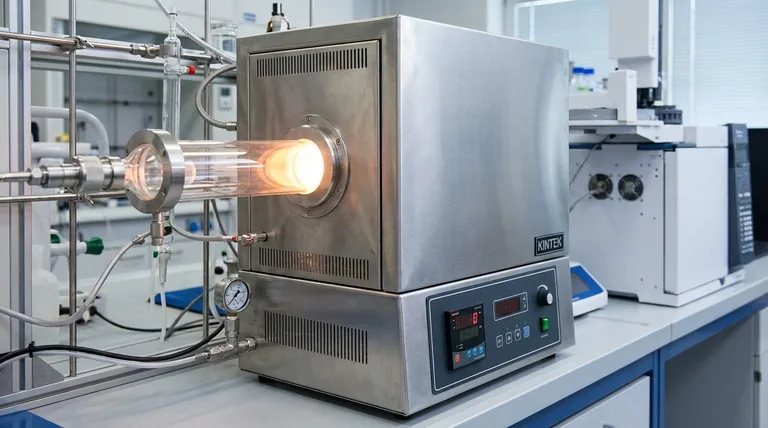
The Foundation: Absolute Atmospheric Control
The defining feature of a vacuum furnace is the vacuum itself. This controlled environment is the source of its most critical advantages for high-fidelity material processing.
Preventing Oxidation and Contamination
By evacuating air from the heating chamber, you eliminate oxygen and other reactive gases. This prevents oxidation and decarburization, which can degrade material integrity at high temperatures.
The result is a chemically pure process that ensures the material's inherent properties are preserved or enhanced, free from the contamination that plagues atmospheric heating.
Enabling Work with Reactive Materials
Many advanced materials, such as titanium, tungsten, molybdenum, and superalloys, are highly reactive with oxygen, especially at elevated temperatures.
A vacuum environment is not just beneficial but essential for processing these materials. It allows for heat treatment, sintering, and brazing without forming brittle oxide layers, ensuring the final product is strong and reliable.
Achieving Superior Surface Finish
Because oxidation is eliminated, materials processed in a vacuum furnace emerge with an exceptionally clean, bright surface finish.
This often removes the need for post-processing steps like acid cleaning or grinding, saving both time and resources while producing a higher-quality component.
Unmatched Thermal Performance and Precision
Beyond the atmosphere, vacuum tube furnaces offer a level of thermal control that is fundamental to achieving repeatable, high-quality results.
Exceptional Temperature Uniformity
These furnaces are engineered to provide a highly uniform temperature zone along the length of the tube, often with deviations of just a few degrees.
This uniformity ensures that the entire workpiece is processed under identical conditions, leading to consistent grain structure, density, and performance across the component. Many can achieve stable uniformity in ranges from 1100°C to over 1500°C.
Precise Control and Repeatability
Modern vacuum furnaces feature advanced computer controls that allow for precise management of the entire process, from pump-down to heating ramps and cooling. Temperature accuracy can be as tight as ±1°C.
This automation ensures that every process is perfectly repeatable, a critical requirement for production environments and scientific research where consistency is paramount.
Rapid Heating and Cooling Cycles
Many designs incorporate rapid heating rates to minimize process time. More importantly, they often feature accelerated or quenching cooling capabilities.
Fast cooling can lock in desirable metallurgical phases and reduce thermal stresses in the material, preventing warping and improving the final product's mechanical properties.
Understanding the Trade-offs
While powerful, a vacuum furnace is a specialized tool. Understanding its limitations is key to making a sound investment decision.
The Cost Factor
The primary drawback is cost. The complexity of the vacuum pumps, control systems, and chamber construction makes these furnaces significantly more expensive than their atmospheric counterparts.
This initial investment must be weighed against the value derived from superior material quality and the ability to process otherwise impossible materials.
When is a Vacuum Necessary?
A vacuum furnace is not always required. For simple heat treatment of non-reactive metals where surface oxidation is not a critical concern, a standard furnace may be sufficient.
The necessity is dictated by your material and your goal. If you require maximum purity, superior mechanical properties, or are working with reactive metals, the advantages of a vacuum environment become non-negotiable.
Making the Right Choice for Your Application
Selecting the right furnace requires a clear understanding of your end goal.
- If your primary focus is material purity and processing reactive metals: A vacuum tube furnace is the only choice to prevent catastrophic oxidation and ensure product integrity.
- If your primary focus is high-volume production with tight tolerances: The process repeatability and superior surface finish delivered by a computer-controlled vacuum furnace can justify the cost by reducing rework and scrap.
- If your primary focus is research and development: The furnace's versatility in controlling atmosphere, temperature, and cycle times provides the experimental freedom needed to develop new materials and processes.
Ultimately, choosing a vacuum tube furnace is an investment in control, empowering you to achieve material outcomes that are simply not possible otherwise.
Summary Table:
| Advantage | Key Benefit |
|---|---|
| Absolute Atmospheric Control | Prevents oxidation and contamination for chemically pure processing |
| Reactive Material Handling | Essential for working with titanium, tungsten, and superalloys |
| Superior Surface Finish | Eliminates post-processing needs with clean, bright results |
| Exceptional Thermal Uniformity | Ensures consistent temperature for repeatable quality |
| Precise Control and Repeatability | Achieves ±1°C accuracy for reliable outcomes |
| Rapid Heating/Cooling | Reduces process time and prevents material warping |
Ready to elevate your material processing with precision and purity? At KINTEK, we leverage exceptional R&D and in-house manufacturing to provide advanced high-temperature furnace solutions tailored for your lab's unique needs. Our product line includes Muffle, Tube, Rotary Furnaces, Vacuum & Atmosphere Furnaces, and CVD/PECVD Systems, all backed by strong deep customization capabilities. Whether you're handling reactive materials or requiring superior thermal control, we can help you achieve unmatched quality and efficiency. Contact us today to discuss how our furnaces can transform your experiments and production processes!
Visual Guide

Related Products
- Vacuum Hot Press Furnace Machine Heated Vacuum Press Tube Furnace
- High Pressure Laboratory Vacuum Tube Furnace
- Vacuum Sealed Continuous Working Rotary Tube Furnace Rotating Tube Furnace
- Laboratory Vacuum Tilt Rotary Tube Furnace Rotating Tube Furnace
- Magnesium Extraction and Purification Condensing Tube Furnace
People Also Ask
- Why use Vacuum Hot Press (VHP) for ZnS Ceramics? Achieve Superior IR Transparency and Mechanical Strength
- What safety features are incorporated in vacuum hot press furnaces? Ensure Operator and Equipment Protection
- What are the benefits of the vacuum environment system in a vacuum hot press furnace? Unlock High-Density Sintering
- What is the primary function of the vacuum environment in a vacuum hot press furnace during titanium alloy processing? Prevent Embrittlement for Superior Ductility
- How does a vacuum hot press furnace promote densification in the manufacturing of graphite flake/copper composites? Achieve Superior Composite Materials



















