
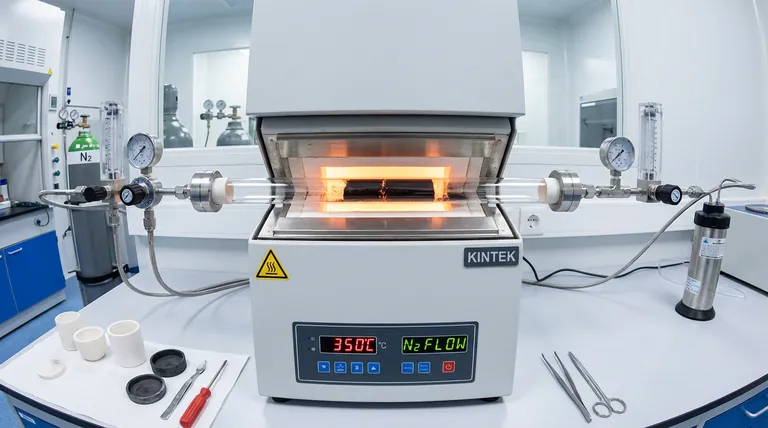
The primary function of an inert atmosphere during the carbonization of sulfurized polyacrylonitrile (SPAN) is the absolute exclusion of oxygen. By maintaining a constant flow of an inert gas, typically nitrogen, within a tube resistance furnace, you effectively prevent the oxidation of the polyacrylonitrile (PAN) and sulfur precursors at high temperatures. This specific environmental control is the only way to ensure the synthesis process yields a usable material rather than degraded byproducts.
The inert atmosphere acts as a chemical shield, blocking oxidation that would otherwise destroy the precursor materials. It forces the reaction chemistry down a specific path, enabling the critical transformation into a stable, high-quality SPAN cathode material.
The Chemistry of Controlled Carbonization
Preventing Material Degradation
At the elevated temperatures required for this process (such as 350 degrees Celsius), both polyacrylonitrile and sulfur are highly reactive with oxygen.
Without an inert barrier, these materials would undergo rapid oxidation. This would fundamentally degrade the chemical composition before the desired synthesis could occur.
Enabling Target Reaction Pathways
The goal of this heat treatment is not merely to heat the material, but to induce specific chemical changes.
The inert environment ensures that dehydrogenation, cyclization, and sulfurization reactions proceed without interference. These distinct chemical pathways are required to transform the raw ingredients into the final active material.
Forming the Cyclic Structure
The quality of SPAN is defined by its molecular architecture.
By excluding oxygen and allowing the intended reactions to proceed, the process results in a material with a characteristic cyclic structure. This structure is the defining marker of high-quality SPAN cathode materials.
The Role of the Tube Resistance Furnace
Maintaining Constant Flow
The furnace does more than simply generate heat; it acts as a flow controller.
It provides a constant flow of nitrogen throughout the heating cycle. This dynamic flow continuously purges the chamber, ensuring that any residual air or evolved gases are removed immediately.
Ensuring Uniform Heat Treatment
The furnace creates a controlled heat treatment environment essential for consistent results.
By combining precise temperature regulation with a regulated atmosphere, the furnace guarantees that the entire batch undergoes the same rate of cyclization and sulfurization.
Critical Process Considerations
The Risk of Incomplete Purging
The "inert" atmosphere is only effective if the nitrogen flow is strictly maintained.
If the flow is interrupted or insufficient to displace all oxygen, partial oxidation will occur. This results in structural defects within the SPAN material, compromising its electrochemical performance.
Temperature-Atmosphere Dependency
The temperature setting (e.g., 350°C) is intrinsically linked to the atmosphere.
You cannot achieve the necessary reaction kinetics at this temperature in an aerobic environment. The success of the thermal treatment is entirely dependent on the integrity of the nitrogen blanket.
Optimizing Your Synthesis Strategy
To ensure you produce high-performance SPAN materials, align your process controls with your specific goals:
- If your primary focus is preventing material loss: Ensure the nitrogen flow is established and stabilized before the heating elements ramp up to prevent early-stage oxidation.
- If your primary focus is maximizing electrochemical performance: Prioritize the precision of the thermal profile (350°C) alongside the inert flow to drive complete dehydrogenation and cyclization.
The inert atmosphere is not a passive safety feature; it is an active component of the chemical synthesis required to build the SPAN cyclic structure.
Summary Table:
| Process Component | Role in SPAN Carbonization | Key Benefit |
|---|---|---|
| Inert Atmosphere | Excludes oxygen via Nitrogen flow | Prevents material degradation and oxidation |
| Thermal Profile | Controlled heating to ~350°C | Drives dehydrogenation and cyclization |
| Tube Furnace | Integrated flow and temp control | Ensures uniform cyclic structure formation |
| Chemical Shielding | Blocks reactive interference | Forces synthesis of active SPAN material |
Elevate Your Advanced Material Synthesis with KINTEK
Precise atmospheric control is the difference between high-performance SPAN and degraded byproducts. Backed by expert R&D and manufacturing, KINTEK offers high-precision Tube, Muffle, Vacuum, and CVD systems tailored for your specific carbonization and sulfurization needs. Whether you require customizable flow rates for nitrogen purging or exact thermal profiling at 350°C and beyond, our lab high-temp furnaces provide the reliability your research demands.
Ready to optimize your synthesis process? Contact our technical experts today to find the perfect customizable furnace solution for your laboratory.
References
- Krishna Kumar Sarode, Vibha Kalra. Solid–liquid–solid mediated artificial SEI coated stable lithium and high-sulfur percentage SPAN for high performance Li–S batteries. DOI: 10.1039/d3ya00423f
This article is also based on technical information from Kintek Furnace Knowledge Base .
Related Products
- Vertical Laboratory Quartz Tube Furnace Tubular Furnace
- Multi Zone Laboratory Quartz Tube Furnace Tubular Furnace
- Slide PECVD Tube Furnace with Liquid Gasifier PECVD Machine
- Electric Rotary Kiln Small Rotary Furnace for Activated Carbon Regeneration
- High Pressure Laboratory Vacuum Tube Furnace
People Also Ask
- What are the key differences between single-zone and multi-zone vertical tube furnaces? Choose the Right Furnace for Your Lab
- What is a vertical tube furnace and how does it function? Optimize Material Processing with Precision
- How are wafers loaded and unloaded in a vertical tube furnace? Achieve Precision and Purity in Wafer Processing
- What physical conditions does a vertical tube furnace provide for desulfurization experiments? Precision Heat Control
- How do heat treatment processes influence the configuration of a vertical tube furnace? Optimize for Quenching, Annealing, and More














