
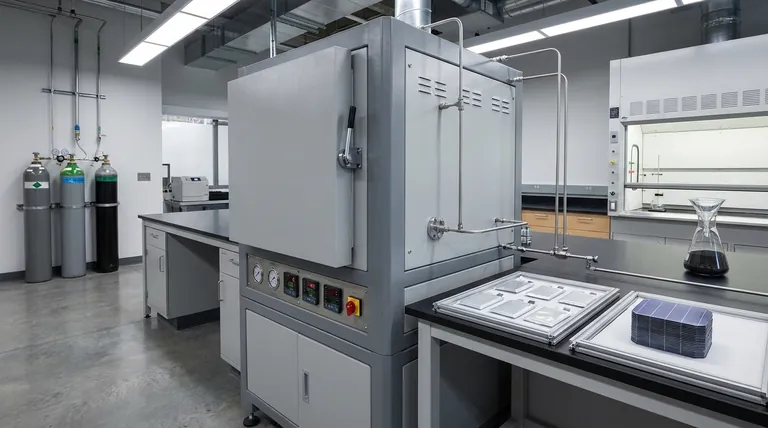
In environmental protection and new energy, an atmosphere box furnace is a critical tool for creating highly controlled, high-temperature environments. It is used for tasks ranging from the safe thermal decomposition of hazardous waste to the precision synthesis of advanced materials for lithium-ion batteries and solar cells. The furnace's value lies in its ability to manipulate chemical reactions by controlling both heat and the surrounding gas atmosphere.
The primary function of an atmosphere box furnace is not just heating, but precise environmental control. By managing the gaseous atmosphere, it prevents unwanted chemical reactions like oxidation and enables the specific transformations required to render waste harmless or to synthesize next-generation energy materials with optimal performance.
The Core Function: Creating a Controlled Chemical Environment
To understand the applications, you must first understand the furnace's two primary mechanisms: a controlled atmosphere and high temperature. These work in tandem to drive desired outcomes.
The Power of a Controlled Atmosphere
An atmosphere furnace allows you to replace the ambient air with a specific gas or mixture of gases. This is the key differentiator from a standard furnace.
Common atmospheres include inert gases (like nitrogen or argon) to prevent oxidation, reactive gases (like hydrogen) to perform chemical reduction, or even pure oxygen to promote complete combustion.
The Role of High Temperature
Heat acts as the catalyst for the chemical reactions. The furnace provides the high thermal energy needed to break down stable chemical compounds or to facilitate the solid-state diffusion and reaction required for creating new crystalline materials.
Applications in Environmental Protection
In environmental protection, the goal is typically to use high heat to break down harmful substances into safer, more manageable forms. The controlled atmosphere ensures this process is efficient and complete.
High-Temperature Incineration of Waste
An atmosphere box furnace is used for the thermal decomposition of hazardous industrial waste and medical waste. The high temperatures break down complex organic molecules into simpler, less toxic compounds.
Conversion to Harmless Substances
By controlling the atmosphere, operators can ensure complete combustion, preventing the formation of dangerous byproducts. This process converts waste that is otherwise difficult to dispose of into inert, harmless, or even resourceful substances like ash that can be safely landfilled or repurposed.
Treatment of Industrial Pollutants
These furnaces can also be used to treat industrial waste gas and wastewater. The process of thermal oxidation at high temperatures effectively destroys volatile organic compounds (VOCs) and other pollutants, reducing air and water pollution.
Applications in New Energy
In new energy, the focus shifts from destruction to construction. Here, the furnace is used to meticulously build advanced materials with specific chemical and physical properties.
Synthesizing Lithium-Ion Battery Materials
The performance of a lithium-ion battery is heavily dependent on its cathode material. An atmosphere furnace facilitates high-temperature solid-state reactions to synthesize these materials, ensuring the final product has the correct crystal structure for excellent electrochemical performance and stability.
Fabricating Solar Cell Materials
To improve the efficiency of solar cells, silicon wafers undergo processes like doping and annealing. Annealing, performed in an inert atmosphere, repairs damage to the silicon's crystal lattice. Doping introduces specific impurities to alter the material's electrical properties. Both require precise temperature control in a clean, non-oxidizing environment to boost photoelectric conversion efficiency.
Developing Fuel Cell and Hydrogen Storage Materials
The furnace also supports the R&D of other energy technologies. This includes preparing the specialized electrolyte materials used in fuel cells or synthesizing novel alloys and compounds for hydrogen storage, all of which depend on formation under specific atmospheric and thermal conditions.
Understanding the Trade-offs
While powerful, an atmosphere box furnace is not a universal solution. Understanding its inherent limitations is crucial for proper application.
Batch Processing vs. Continuous Flow
A box furnace is, by its nature, a batch processing tool. Materials are loaded, processed, and then unloaded. This is ideal for research, development, and small-scale or specialized production but can be a bottleneck for high-volume manufacturing, where a continuous tunnel furnace might be more appropriate.
Cost and Complexity of Atmosphere Control
Maintaining a high-purity atmosphere is a significant operational challenge and cost. The consumption of gases like argon or hydrogen, along with the systems needed to ensure gas purity and safety, adds complexity and expense compared to running a furnace in ambient air.
Process Expertise is Required
Achieving consistent, high-quality results is not a "set and forget" operation. It requires expertise in materials science and process engineering to develop and manage the precise temperature profiles (ramps and soaks) and gas flow dynamics needed for a specific application.
Making the Right Choice for Your Goal
The decision to use an atmosphere box furnace should be driven by the specific chemical and material outcome you need to achieve.
- If your primary focus is environmental remediation: The key is using controlled thermal decomposition to ensure the complete and safe breakdown of hazardous compounds.
- If your primary focus is advanced material synthesis: Success depends on your ability to precisely control both the temperature profile and atmospheric composition to build materials with specific crystalline and chemical properties.
- If your primary focus is selecting equipment for production: You must weigh the process control benefits of a box furnace against the higher throughput capabilities of a continuous furnace and the operational costs of gas consumption.
Ultimately, leveraging an atmosphere box furnace is about mastering control over the fundamental elements of heat and chemistry to solve complex material challenges.
Summary Table:
| Application Area | Key Uses | Key Benefits |
|---|---|---|
| Environmental Protection | Thermal decomposition of waste, pollutant treatment | Safe breakdown of toxins, reduced pollution |
| New Energy | Synthesis of battery and solar cell materials | Enhanced material performance, improved efficiency |
Ready to enhance your lab's capabilities with tailored high-temperature solutions? Leveraging exceptional R&D and in-house manufacturing, KINTEK provides diverse laboratories with advanced high-temperature furnace solutions. Our product line, including Muffle, Tube, Rotary Furnaces, Vacuum & Atmosphere Furnaces, and CVD/PECVD Systems, is complemented by our strong deep customization capability to precisely meet unique experimental requirements for environmental protection and new energy applications. Contact us today to discuss how we can help you achieve superior results!
Visual Guide

Related Products
- Mesh Belt Controlled Atmosphere Furnace Inert Nitrogen Atmosphere Furnace
- 1200℃ Controlled Inert Nitrogen Atmosphere Furnace
- Controlled Inert Nitrogen Hydrogen Atmosphere Furnace
- 1700℃ Controlled Inert Nitrogen Atmosphere Furnace
- 9MPa Air Pressure Vacuum Heat Treat and Sintering Furnace
People Also Ask
- How is a controlled atmosphere furnace used in material research? Achieve Precise Material Synthesis and Heat Treatment
- What are the two main purposes of controlled atmosphere conditions in furnaces? Protect or Transform Materials for Peak Performance
- What types of gases can a controlled atmosphere furnace handle? Master Inert and Reactive Gases for Your Lab
- How does a controlled atmosphere furnace improve product quality and consistency? Master Precise Heat Treatment for Superior Results
- What types of furnaces have controlled atmosphere furnaces largely replaced? Boost Metallurgical Precision & Safety












