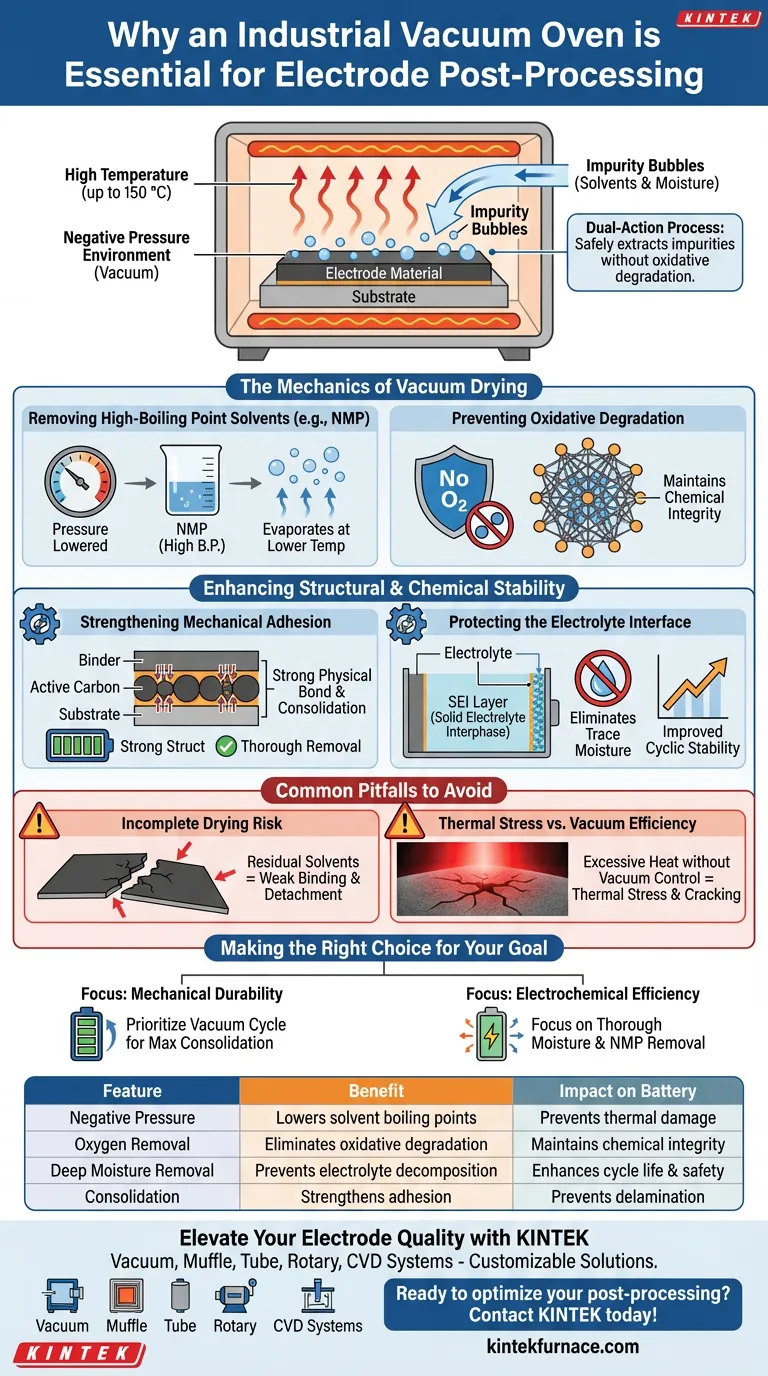
An industrial vacuum oven is essential for post-processing electrode materials because it combines high temperatures (up to 150 °C) with a negative pressure environment to safely extract stubborn impurities. This dual-action process removes residual high-boiling point solvents and trace moisture without triggering oxidative degradation, ensuring the electrode remains chemically pure and mechanically robust.
Core Takeaway The vacuum oven serves as a critical stabilization step, utilizing low pressure to lower solvent boiling points and eliminate oxygen. This prevents material degradation during drying while securing the physical bond between the active material and the substrate, directly impacting the battery's long-term cycle life and safety.
The Mechanics of Vacuum Drying
Removing High-Boiling Point Solvents
Electrode slurries often contain solvents with high boiling points, such as NMP (N-methyl-2-pyrrolidone), which are difficult to remove under standard atmospheric conditions.
The vacuum oven creates a negative pressure environment. This lowers the boiling point of these solvents, allowing them to evaporate thoroughly without requiring excessive temperatures that could damage the active materials.
Preventing Oxidative Degradation
Applying high heat to electrode materials in the presence of air typically accelerates oxidation. This chemical change can degrade the active components before the battery is even assembled.
By operating in a vacuum, the oven removes oxygen from the chamber. This ensures that the material can be dried at the necessary 120–150 °C range while maintaining its chemical integrity.
Enhancing Structural and Chemical Stability
Strengthening Mechanical Adhesion
The drying process is not just about removal; it is about consolidation. The vacuum process ensures a strong physical bond forms between the binder, active carbon, and the substrate (current collector).
This enhanced adhesion is critical for mechanical stability. It prevents the active material from detaching or delaminating during subsequent manufacturing steps, such as fluid flushing, or during the expansion and contraction of battery cycling.
Protecting the Electrolyte Interface
Residual moisture is a primary cause of electrolyte decomposition and side reactions during charge/discharge cycles.
By thoroughly eliminating trace moisture, vacuum drying enables the formation of a stable Solid Electrolyte Interphase (SEI) layer. This directly improves the battery's Coulombic efficiency and ensures long-term cyclic stability.
Common Pitfalls to Avoid
The Risk of Incomplete Drying
If the vacuum level or duration is insufficient, trace solvents remains deep within the electrode structure.
This residual solvent weakens the binding network, leading to poor adhesion and eventual material detachment under mechanical stress.
Thermal Stress vs. Vacuum Efficiency
Relying solely on temperature to speed up the process is a mistake.
Excessive heat without adequate vacuum control can cause thermal stress or cracking in the electrode coating. The process relies on the balance of pressure and heat, not heat alone.
Making the Right Choice for Your Goal
While the vacuum oven is a standard requirement, how you optimize the parameters depends on your specific performance targets.
- If your primary focus is Mechanical Durability: Prioritize the vacuum cycle to maximize the consolidation of the binder and active carbon, ensuring the material can withstand physical handling and flushing.
- If your primary focus is Electrochemical Efficiency: Focus on the thorough removal of trace moisture and NMP to prevent side reactions and ensure a stable SEI layer formation.
Ultimately, the industrial vacuum oven is not just a drying tool; it is a prerequisite for creating a chemically stable and mechanically sound electrode.
Summary Table:
| Feature | Benefit for Electrode Processing | Impact on Battery |
|---|---|---|
| Negative Pressure | Lowers boiling points of solvents like NMP | Prevents thermal damage to active materials |
| Oxygen Removal | Eliminates oxidative degradation at high temps | Maintains chemical integrity and purity |
| Deep Moisture Removal | Prevents electrolyte decomposition | Enhances cycle life and safety (SEI stability) |
| Consolidation | Strengthens binder-to-substrate adhesion | Prevents delamination during cycling |
Elevate Your Electrode Quality with KINTEK
Maximize your battery’s cycle life and mechanical durability with precision-engineered thermal solutions. Backed by expert R&D and manufacturing, KINTEK offers high-performance Vacuum, Muffle, Tube, Rotary, and CVD systems—all fully customizable to meet your specific lab or industrial requirements. Our vacuum ovens provide the precise pressure and temperature control necessary to eliminate trace impurities without compromising material integrity.
Ready to optimize your post-processing workflow? Contact KINTEK today to discuss your custom furnace needs!
Visual Guide
References
- Belén Lobato, Ana Arenillas. Designing and Optimizing Electrode Materials for Energy Harvesting in CAPMIX Cells. DOI: 10.3390/nano14242031
This article is also based on technical information from Kintek Furnace Knowledge Base .
Related Products
- Ultra Vacuum Electrode Feedthrough Connector Flange Power Lead for High Precision Applications
- Vacuum Heat Treat Sintering Furnace Molybdenum Wire Vacuum Sintering Furnace
- CF KF Flange Vacuum Electrode Feedthrough Lead Sealing Assembly for Vacuum Systems
- Vacuum Hot Press Furnace Machine for Lamination and Heating
- Vacuum Heat Treat Sintering and Brazing Furnace
People Also Ask
- Why is a high-precision vacuum sealing system necessary for CrSb? Ensure Pure Crystal Growth & Prevent Oxidation
- Why is an Ultra-High Vacuum (UHV) System Required for In2Se3? Achieving Atomic-Level Ferroelectric Clarity
- What is the function of quartz vacuum encapsulation in RhSeCl CVT? Mastering Pure Crystal Growth
- Why is vacuum sealing technology essential for K2In2As3 synthesis? Master High-Purity Solid-State Reactions
- What role do vacuum-sealed high-purity silica ampoules play in phase equilibrium experiments? Enhance Sample Integrity