
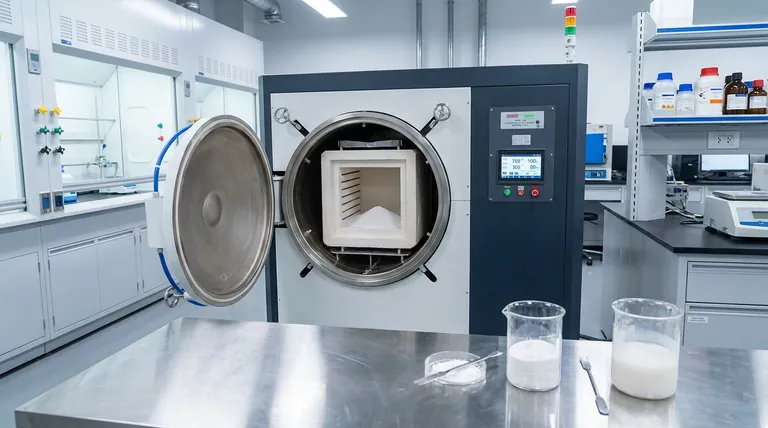
The primary role of a vacuum drying oven in processing hydroxyapatite (HAp) powder is to rigorously remove adsorbed water and volatile impurities prior to mixing. By utilizing a negative pressure environment, the oven allows moisture to evaporate at lower temperatures, preventing the thermal damage or structural alteration that might occur with standard high-heat drying.
The effective removal of moisture is not just a cleaning step; it is the fundamental prerequisite for preventing particle agglomeration, ensuring the HAp powder can achieve the high solid content and low viscosity necessary for high-performance ceramic slurries.
The Critical Impact on Particle Physics
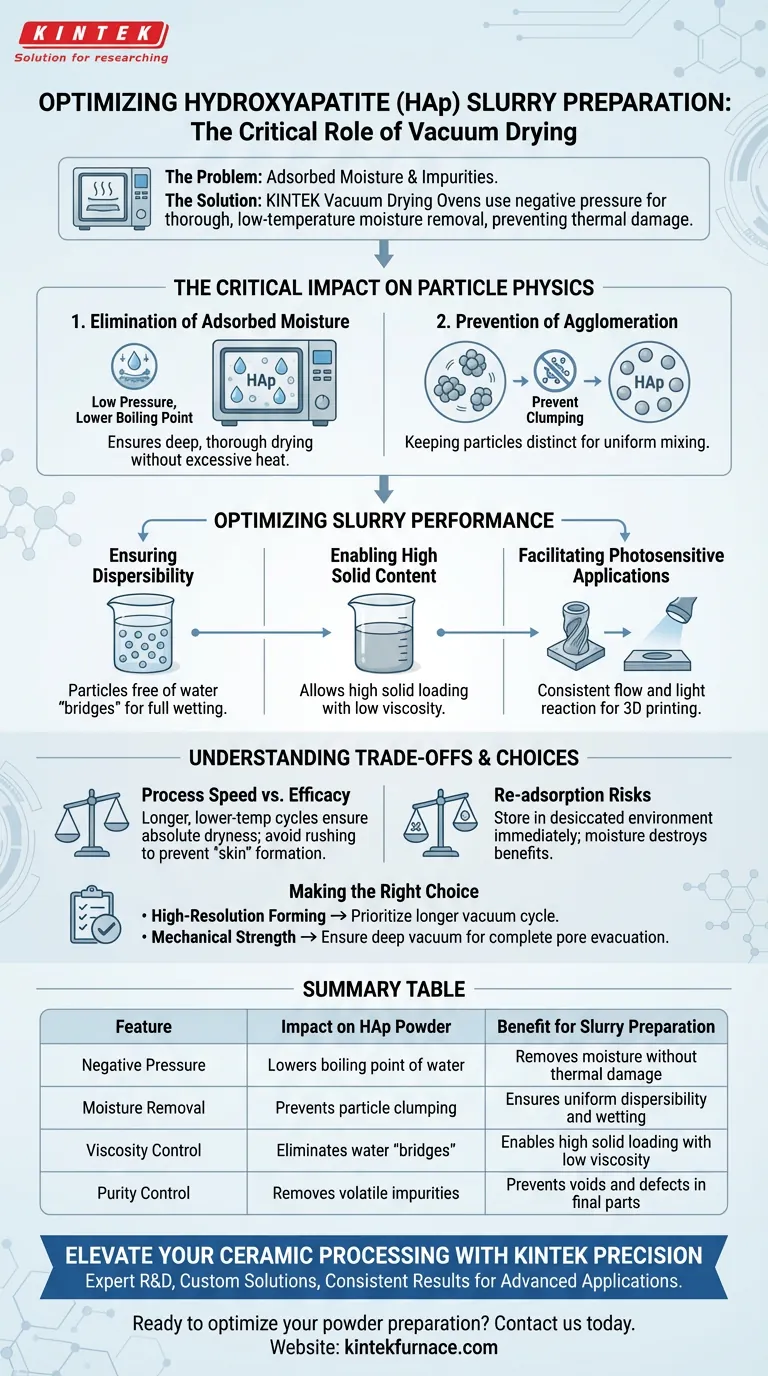
Elimination of Adsorbed Moisture
Hydroxyapatite powders often retain moisture within their porous structures or on their surfaces. The vacuum drying oven creates a low-pressure environment that significantly lowers the boiling point of water. This ensures deep, thorough drying of the powder without requiring excessive heat, which preserves the material's fundamental properties.
Prevention of Agglomeration
Moisture acts as a binding agent that causes fine powders to stick together. By removing this moisture, the vacuum process prevents nano-scale and micro-scale particles from clumping. Keeping particles distinct and separate is essential for achieving a uniform mixture in later stages.
optimizing Slurry Performance
Ensuring Dispersibility
For HAp powder to function correctly in a slurry, it must disperse evenly throughout the liquid medium. Vacuum drying ensures the individual particles are free of water "bridges," allowing them to be fully wetted and dispersed by the slurry's solvent and resin components.
Enabling High Solid Content
To produce high-density ceramic parts, the slurry requires a high ratio of solid powder to liquid. Residual moisture artificially increases viscosity, making high loading impossible. Vacuum drying allows for high solid content formulations that maintain low viscosity and excellent flow properties.
Facilitating Photosensitive Applications
In the specific context of photosensitive ceramic slurries (often used in 3D printing or lithography), consistency is paramount. The vacuum drying step removes variables caused by humidity, ensuring the slurry flows predictably and reacts consistently to light curing during the forming process.
Understanding the Trade-offs
Process Speed vs. Efficacy
While vacuum drying is highly effective, it is generally a slower process than standard convection drying. Users must balance the duration of the cycle against the strict moisture-content requirements of their specific application. Rushing this step often leads to "skin" formation where the surface is dry, but internal moisture remains.
Re-adsorption Risks
HAp powder can be hygroscopic (water-absorbing). A common pitfall is drying the powder effectively but exposing it to humid air immediately afterward. The benefits of vacuum drying are negated instantly if the powder is not stored in a desiccated environment or processed immediately after removal from the oven.
Making the Right Choice for Your Goal
To maximize the effectiveness of your slurry preparation, consider your specific manufacturing targets:
- If your primary focus is high-resolution forming: Prioritize a longer, lower-temperature vacuum cycle to ensure absolute dryness, which guarantees the low viscosity needed for detailed photosensitive applications.
- If your primary focus is mechanical strength: Ensure the vacuum level is deep enough to evacuate pores completely, as any residual moisture can create voids or defects in the final sintered ceramic part.
Success in ceramic processing relies not just on the quality of the powder, but on the absolute purity of its preparation environment.
Summary Table:
| Feature | Impact on HAp Powder | Benefit for Slurry Preparation |
|---|---|---|
| Negative Pressure | Lowers boiling point of water | Removes moisture without thermal damage |
| Moisture Removal | Prevents particle clumping | Ensures uniform dispersibility and wetting |
| Viscosity Control | Eliminates water 'bridges' | Enables high solid loading with low viscosity |
| Purity Control | Removes volatile impurities | Prevents voids and defects in final sintered parts |
Elevate Your Ceramic Processing with KINTEK Precision
Don't let residual moisture compromise your material integrity. At KINTEK, we understand that high-performance hydroxyapatite applications require absolute purity and precise environmental control.
Backed by expert R&D and manufacturing, KINTEK offers advanced Vacuum Drying Ovens, along with Muffle, Tube, Rotary, and CVD systems—all customizable to meet your unique lab requirements. Whether you are developing 3D-printed photosensitive slurries or high-strength bio-ceramics, our equipment ensures consistent results and superior material properties.
Ready to optimize your powder preparation? Contact us today to find the perfect drying solution for your lab!
Visual Guide
References
- Ali Arab, Chunwei Zhang. Influence of Cell Geometry on the Mechanical and Failure Characteristics of 3D Voronoi Hydroxyapatite Through the Stereolithography Technique. DOI: 10.3390/ceramics8010004
This article is also based on technical information from Kintek Furnace Knowledge Base .
Related Products
- High Temperature Muffle Oven Furnace for Laboratory Debinding and Pre Sintering
- Electric Rotary Kiln Pyrolysis Furnace Plant Machine Small Rotary Kiln Calciner
- Dental Porcelain Zirconia Sintering Ceramic Vacuum Press Furnace
- Vacuum Heat Treat Sintering and Brazing Furnace
- Vacuum Hot Press Furnace Machine Heated Vacuum Press
People Also Ask
- What thermal phenomena occur during polymer binder burnout in ceramic green bodies? Lab Furnace Guide
- What role does a high-temperature muffle furnace play in STFO synthesis? Achieve Pure Perovskite Results
- Why is controlled heat treatment in a muffle furnace necessary for calcined clay? Achieve Optimal Pozzolanic Activity
- How does a high-temperature muffle furnace facilitate the formation of LaNbxAl1−xO3+δ perovskite structures? Key Roles
- What role does a high-temperature muffle furnace play in the multi-stage synthesis of Li0.5MnFe1.5O4? Key to Pure Spinel



















