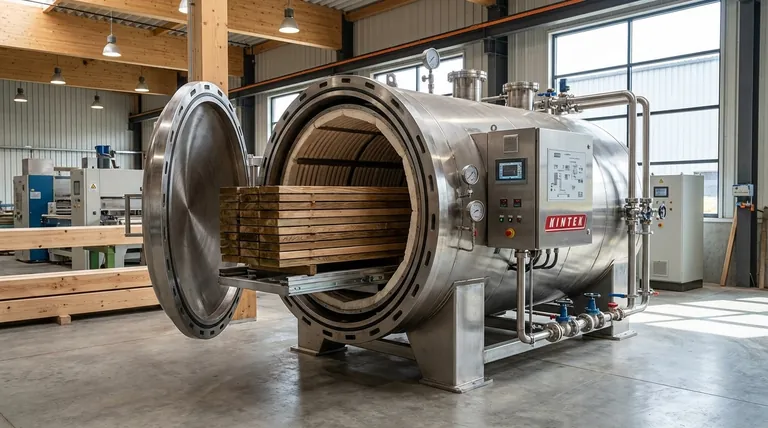
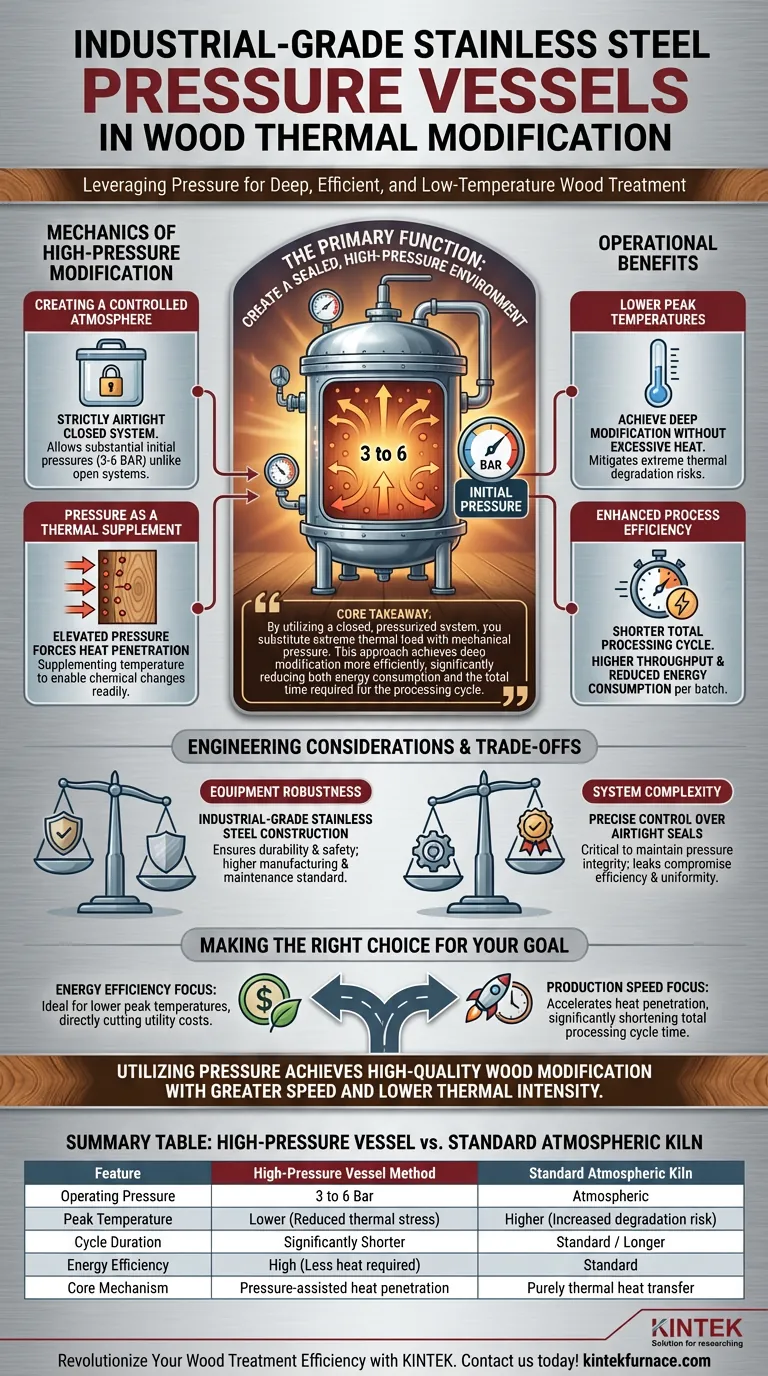
The primary function of industrial-grade stainless steel pressure vessels in wood thermal modification is to create a sealed, high-pressure environment that fundamentally alters how heat interacts with the wood. By maintaining an initial pressure between 3 and 6 bar, these vessels allow pressure to act as a catalyst, enabling deep thermal modification to occur at lower peak temperatures than standard atmospheric kilns.
Core Takeaway By utilizing a closed, pressurized system, you substitute extreme thermal load with mechanical pressure. This approach achieves deep modification more efficiently, significantly reducing both energy consumption and the total time required for the processing cycle.
The Mechanics of High-Pressure Modification
Creating a Controlled Atmosphere
The vessel provides a strictly airtight environment essential for the modification process.
Unlike open systems, this closed system allows operators to introduce and maintain substantial initial pressures, typically in the range of 3 to 6 bar.
Pressure as a Thermal Supplement
In this environment, pressure serves as a critical supplement to temperature.
Rather than relying solely on heat transfer to penetrate the wood, the elevated pressure forces heat into the material more effectively. This synergy allows the chemical changes associated with thermal modification to occur more readily.
Operational Benefits
Lower Peak Temperatures
The primary advantage of adding pressure is the ability to achieve deep thermal modification without subjecting the wood to excessive heat.
By lowering the peak temperature required for the process, you mitigate the risks associated with extreme thermal degradation while still altering the wood's properties to the desired depth.
Enhanced Process Efficiency
The combination of pressure and heat accelerates the modification reaction.
This results in a noticeably shorter total processing cycle, allowing for higher throughput. Additionally, because lower temperatures are required to achieve the same results, the overall energy consumption for each batch is reduced.
Engineering Considerations and Trade-offs
Equipment Robustness
Implementing a system capable of sustaining 3 to 6 bar requires industrial-grade stainless steel construction.
While this ensures durability and safety, it necessitates a higher standard of manufacturing and maintenance compared to non-pressurized thermal kilns.
System Complexity
The "closed system" nature of these vessels demands precise control over the airtight seals.
Maintaining the integrity of the pressure environment is critical; any leaks can compromise the efficiency gains and the uniformity of the wood treatment.
Making the Right Choice for Your Goal
Adopting pressure vessel technology shifts the modification process from a purely thermal challenge to a thermo-mechanical one.
- If your primary focus is energy efficiency: This system is ideal because it achieves deep modification results at lower peak temperatures, directly cutting utility costs.
- If your primary focus is production speed: The pressurized environment accelerates heat penetration, significantly shortening the total processing cycle time.
Utilizing pressure as a process variable allows you to achieve high-quality wood modification with greater speed and lower thermal intensity.
Summary Table:
| Feature | High-Pressure Vessel Method | Standard Atmospheric Kiln |
|---|---|---|
| Operating Pressure | 3 to 6 Bar | Atmospheric |
| Peak Temperature | Lower (Reduced thermal stress) | Higher (Increased degradation risk) |
| Cycle Duration | Significantly Shorter | Standard / Longer |
| Energy Efficiency | High (Less heat required) | Standard |
| Core Mechanism | Pressure-assisted heat penetration | Purely thermal heat transfer |
Revolutionize Your Wood Treatment Efficiency with KINTEK
Are you looking to achieve deep thermal modification while cutting energy costs and production time? KINTEK provides high-performance, industrial-grade stainless steel pressure vessels engineered to withstand rigorous thermal cycles.
Backed by expert R&D and world-class manufacturing, we offer customizable Vacuum, Pressure, and Lab High-Temp Furnace systems tailored to your specific wood modification requirements. Our technology allows you to substitute extreme thermal loads with precise mechanical pressure, ensuring superior material properties and faster throughput.
Ready to upgrade your thermal processing? Contact us today to discuss your unique needs with our specialist engineering team!
Visual Guide
References
- Guntis Sosins, Jānis Zicāns. Water-Related Properties of Wood after Thermal Modification in Closed Process under Pressure in Nitrogen. DOI: 10.3390/f15010140
This article is also based on technical information from Kintek Furnace Knowledge Base .
Related Products
People Also Ask
- What role do vacuum-sealed high-purity silica ampoules play in phase equilibrium experiments? Enhance Sample Integrity
- What is the function of quartz vacuum encapsulation in RhSeCl CVT? Mastering Pure Crystal Growth
- What role does a closed pressure vessel play during the carbonation of gamma-C2S? Unlock Rapid Mineralization
- What type of pump is used in water circulating vacuum pumps and how is it installed? Discover Robust Fluid-Based Vacuum Solutions
- What is the specific function of the water circulation cooler in zirconium sponge processing? Key for Purity & Safety