
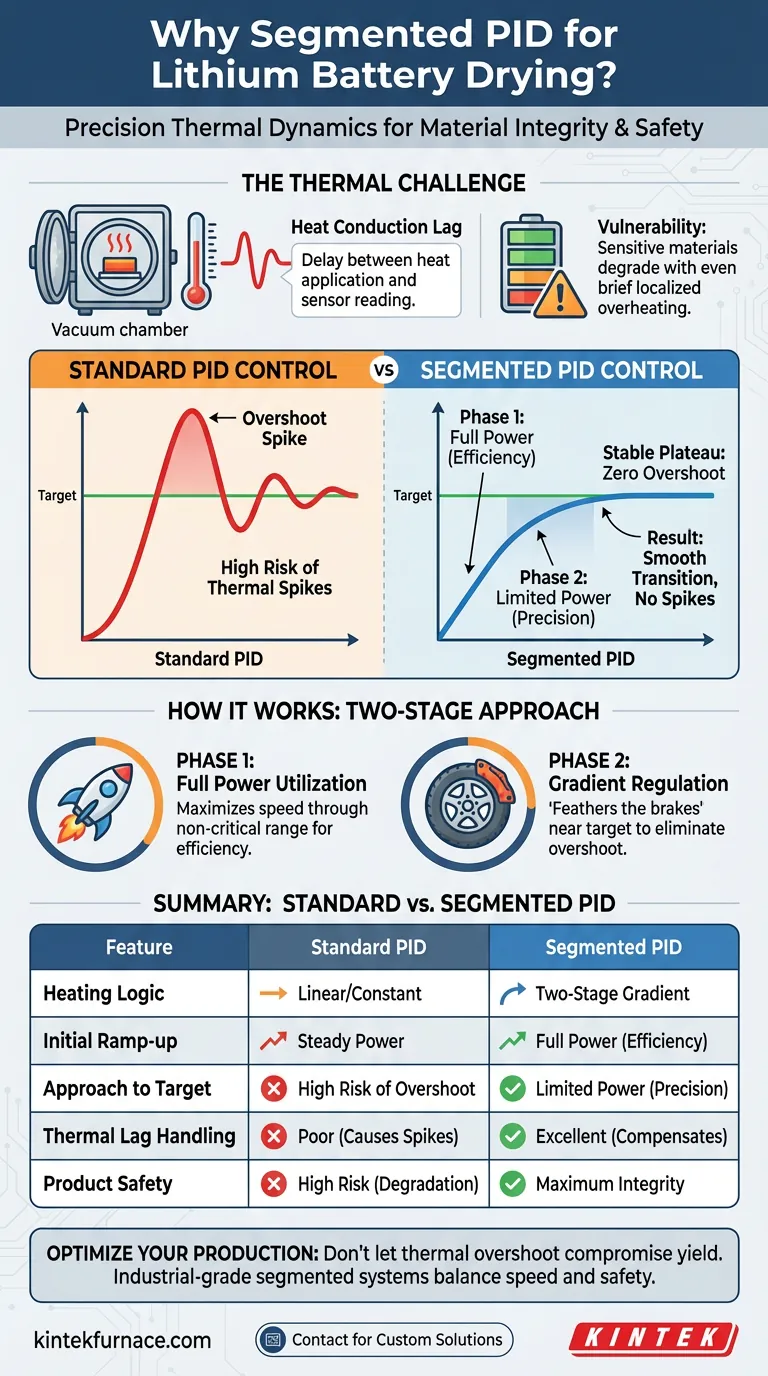
A segmented PID control system is strictly necessary to manage the critical thermal dynamics of drying lithium batteries without damaging them. It operates by precisely regulating the heating power gradient, utilizing full power for the initial ramp-up and then automatically switching to limited power as the temperature nears its target. This two-stage approach counteracts heat conduction lag, preventing the temperature spikes that destroy sensitive battery chemistry.
The core function of this system is to decouple heating speed from thermal precision. By throttling power before the target is reached, it eliminates temperature overshoot, ensuring the battery materials are dried efficiently without being subjected to destructive localized overheating.
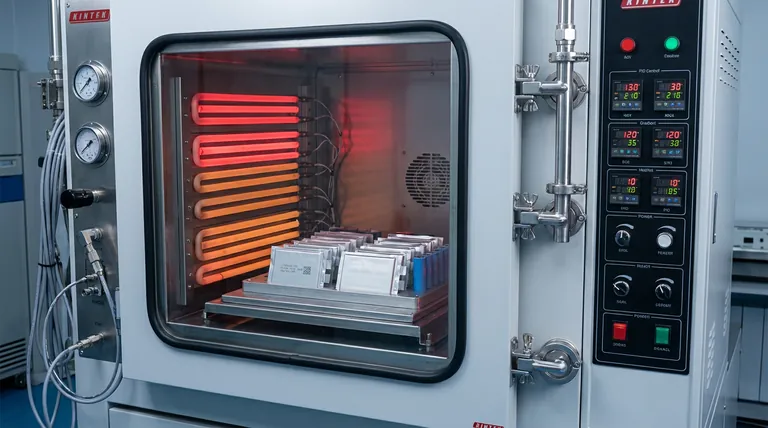
The Thermal Challenge in Vacuum Drying
Understanding Heat Conduction Lag
In a vacuum drying process, there is a physical delay between applying heat and the temperature sensor registering the change.
This phenomenon, known as heat conduction lag, makes standard control systems risky. By the time a standard controller realizes the target temperature is reached, the residual heat in the heating element causes the temperature to keep rising.
The Vulnerability of Lithium Materials
Lithium battery components are highly sensitive to thermal stress.
Even brief periods of localized overheating can degrade the materials. This compromises the battery's performance and safety before it even leaves the factory.
How Segmented PID Solves the Problem
Phase 1: Full Power Utilization
During the initial phase of the cycle, the industrial-grade system applies full power.
This is essential for efficiency. It drives the temperature up quickly through the safe non-critical range to minimize total cycle time.
Phase 2: Gradient Regulation
As the temperature approaches the specific target setpoint, the system shifts to limited power.
This effectively "feathers the brakes" on the heating process. It reduces the energy input to align with the thermal inertia of the system.
Result: The Smooth Transition
This segmentation ensures a smooth entry into the constant temperature state.
Instead of oscillating around the target (overshooting and undershooting), the temperature creates a stable plateau. This stability is required to dry the battery effectively without thermal spikes.
Operational Considerations
Balancing Speed and Safety
The primary trade-off in this approach is the relationship between ramp-up speed and protection.
While keeping a system on full power until the last second might theoretically be faster, the risk of overshoot makes it non-viable for lithium batteries. The segmented approach sacrifices a fraction of ramp speed at the very end to guarantee zero damage to the product.
The Necessity of Industrial-Grade Logic
Not all PID controllers can handle this segmentation effectively.
Standard controllers often react linearly. An industrial-grade segmented system is required to define distinct power output zones based on the specific proximity to the target temperature.
Making the Right Choice for Your Process
If your primary focus is Production Throughput:
- Rely on the "Phase 1" capability of the system to maximize heating speed during the initial non-critical temperature range.
If your primary focus is Product Yield and Safety:
- Prioritize the calibration of the "Phase 2" power limitation to ensure the transition to constant temperature is completely flat with no overshoot.
Precise thermal regulation is not merely an efficiency tool; it is a fundamental requirement for preserving the integrity of lithium battery materials.
Summary Table:
| Feature | Standard PID Control | Segmented PID Control |
|---|---|---|
| Heating Logic | Linear/Constant | Two-Stage Gradient |
| Initial Ramp-up | Steady Power | Full Power (Efficiency) |
| Approach to Target | High Risk of Overshoot | Limited Power (Precision) |
| Thermal Lag Handling | Poor - Causes Spikes | Excellent - Compensates for Inertia |
| Product Safety | High Risk of Degradation | Maximum Material Integrity |
Optimize Your Battery Production with KINTEK
Don't let thermal overshoot compromise your product yield. Backed by expert R&D and manufacturing, KINTEK offers specialized Muffle, Tube, Rotary, Vacuum, and CVD systems, all customizable for your unique lithium-ion research or production needs. Our advanced thermal solutions are designed to handle the most sensitive materials with industrial-grade precision.
Ready to elevate your thermal processing? Contact us today to discuss your custom furnace requirements with our engineering team!
Visual Guide
References
- Lili Zhao, Bo Qi. Research on Temperature Field Characteristics of Lithium Battery Vacuum Drying Furnace. DOI: 10.56028/aetr.11.1.63.2024
This article is also based on technical information from Kintek Furnace Knowledge Base .
Related Products
- Vacuum Heat Treat Sintering Furnace with Pressure for Vacuum Sintering
- Vacuum Heat Treat Sintering Furnace Molybdenum Wire Vacuum Sintering Furnace
- Vacuum Induction Melting Furnace
- Molybdenum Vacuum Heat Treat Furnace
- Small Vacuum Heat Treat and Tungsten Wire Sintering Furnace
People Also Ask
- What is one of the most important uses of vacuum heat treating furnaces in aerospace? Achieve Superior Strength in Aircraft Alloys
- How does vacuum heat treating affect the grain structure of metal alloys? Achieve Precise Microstructure Control
- What are the benefits of using vacuum heat treating furnaces for metal alloys? Achieve Superior Metal Properties and Performance
- What are the key components of a vacuum sintering furnace? Essential Parts for Precision Material Processing
- What is the purpose of setting a mid-temperature dwell stage? Eliminate Defects in Vacuum Sintering



















