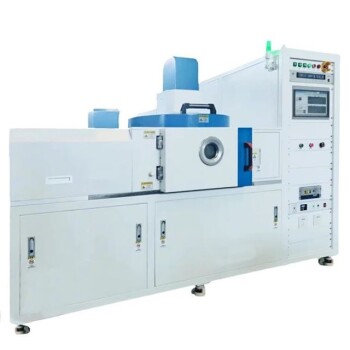
Spark Plasma Sintering (SPS) fundamentally transforms the production of MgTiO3-CaTiO3 ceramics by shifting from external radiative heating to internal resistive heating. Unlike traditional kilns that heat samples from the outside in, SPS applies a pulsed current directly through the mold and sample, enabling rapid heating rates and preventing the grain coarsening that typically degrades dielectric performance.
Core Takeaway SPS technology decouples densification from grain growth, allowing you to achieve near-theoretical density at significantly lower temperatures. For MgTiO3-CaTiO3 ceramics, this results in a denser microstructure with superior dielectric properties that traditional sintering methods struggle to replicate.
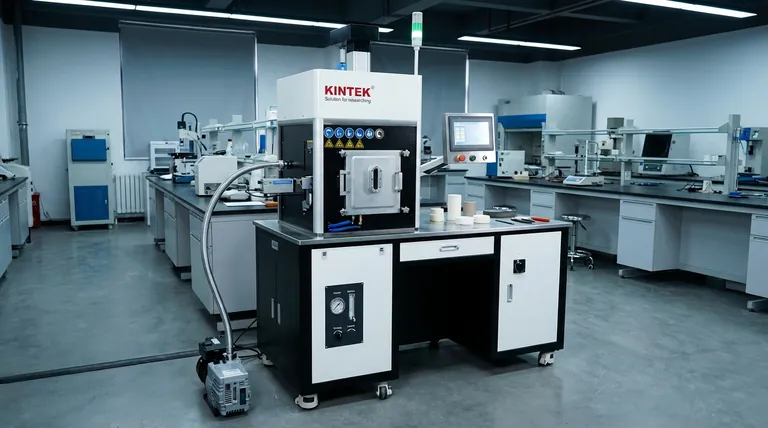
The Mechanism of Rapid Densification
Internal Heating via Pulsed Current
Traditional sintering relies on external heating elements, which creates thermal gradients and requires long soak times to reach the core of the material.
SPS generates Joule heat internally by passing a pulsed electric current directly through the graphite mold and the ceramic powder. This results in extremely high heating rates and uniform temperature distribution within the sample.
Assisted Particle Rearrangement
In addition to thermal energy, SPS utilizes a synchronous axial pressure (typically tens of megapascals).
This physical force acts as a catalyst for particle rearrangement and plastic flow. It mechanically drives the material to close micro-pores effectively, even before the material reaches the high temperatures required by pressureless sintering.
Lower Sintering Temperatures
Because of the localized heating at particle contact points and the applied pressure, the bulk material requires less overall thermal energy to bond.
This allows the ceramic to reach densification at a significantly lower bulk temperature compared to conventional methods.
Impact on Microstructure and Performance
Inhibiting Abnormal Grain Growth
The most critical advantage of SPS is the speed of the process.
Because the heating rates are fast and holding times are very short, the material spends little time in the temperature window where grains tend to coarsen. This effectively inhibits abnormal grain growth, preserving a fine, isotropic micro-nano structure.
Achieving Near-Theoretical Density
For dielectric ceramics, porosity is a performance killer.
The pressure-assisted mechanism of SPS eliminates micro-pores within the green body more effectively than heat alone. This allows MgTiO3-CaTiO3 samples to reach a density extremely close to their theoretical limit.
Optimization of Dielectric Properties
The combination of high density and fine grain size directly translates to electrical performance.
By minimizing porosity and controlling the microstructure, SPS enhances the dielectric constant and optimizes the quality factor (Q) of the ceramic, which are the primary metrics of success for MgTiO3-CaTiO3 applications.
Understanding the Trade-offs
Geometry Limitations
The SPS process relies on a graphite mold to transmit uniaxial pressure.
This generally limits part geometries to simple shapes like disks or cylinders. Producing complex, net-shape components often requires post-processing or alternative methods like Hot Isostatic Pressing (HIP), which lacks the heating speed of SPS.
Sample Size and Scalability
While SPS is superior for material quality, the reliance on high-current power supplies and specific mold configurations can limit the size of the sample.
It is typically a batch process, making it excellent for high-performance or research-grade materials, but potentially less throughput-friendly than continuous tunnel kilns used in mass production.
Making the Right Choice for Your Goal
If you are deciding between SPS and traditional sintering for your specific project, consider these factors:
- If your primary focus is Dielectric Performance: Choose SPS. The ability to eliminate micro-pores and maximize the quality factor is superior to pressureless methods.
- If your primary focus is Microstructure Control: Choose SPS. The rapid heating prevents grain growth, ensuring the mechanical and electrical consistency of the ceramic.
- If your primary focus is Mass Production of Complex Shapes: Evaluate traditional methods. The geometric constraints of the SPS mold may require expensive machining or simply be unfeasible for intricate designs.
SPS is not just a faster furnace; it is a precision tool for engineering the microstructure of your ceramic to achieve performance levels that are physically impossible with conventional heating.
Summary Table:
| Feature | Traditional Sintering | Spark Plasma Sintering (SPS) |
|---|---|---|
| Heating Mechanism | External radiative heating | Internal Joule heating (Pulsed current) |
| Heating Rate | Slow (hours) | Ultra-fast (minutes) |
| Sintering Temp | High | Significantly Lower |
| Pressure | Pressureless | Uniaxial (tens of MPa) |
| Microstructure | Coarse grains common | Fine, nano-scale structure |
| Density | Standard | Near-theoretical density |
Elevate Your Ceramic Engineering with KINTEK
Are you struggling with grain coarsening or sub-optimal dielectric performance in your materials? KINTEK provides industry-leading thermal solutions designed to solve these exact challenges. Backed by expert R&D and manufacturing, we offer high-performance Spark Plasma Sintering (SPS) systems, Muffle, Tube, Rotary, Vacuum, and CVD furnaces, all fully customizable to meet your unique laboratory or production needs.
Don't settle for traditional limitations. Partner with KINTEK to achieve precise microstructure control and superior material density today.
Contact Our Technical Experts Now
References
- Wega Trisunaryanti, Satriyo Dibyo Sumbogo. Characteristic and Performance of Ni, Pt, and Pd Monometal and Ni-Pd Bimetal onto KOH Activated Carbon for Hydrotreatment of Castor Oil. DOI: 10.22146/ijc.84640
This article is also based on technical information from Kintek Furnace Knowledge Base .
Related Products
- Spark Plasma Sintering SPS Furnace
- Chairside Dental Porcelain Zirconia Sintering Furnace with Transformer for Ceramic Restorations
- 600T Vacuum Induction Hot Press Vacuum Heat Treat and Sintering Furnace
- 9MPa Air Pressure Vacuum Heat Treat and Sintering Furnace
- Dental Porcelain Zirconia Sintering Ceramic Vacuum Press Furnace
People Also Ask
- Why is it necessary to maintain a high vacuum environment during the SPS of SiC? Key to High-Density Ceramics
- How does the heating mechanism of Spark Plasma Sintering (SPS) function? Enhance TiC/SiC Composite Fabrication
- What are the technical advantages of using an SPS sintering furnace? Elevate Al2O3-TiC Material Performance
- What are the steps in the discharge plasma sintering process? Master Fast, High-Density Material Consolidation
- What are the advantages of spark plasma sintering (SPS) over traditional forging? Precision Microstructural Control