
The simulation of magnesium alloy distillation requires high-precision pressure control because the liquid-vapor coexistence zones for key alloy systems, such as magnesium-zinc and magnesium-cadmium, are extremely narrow. Without exact vacuum regulation, you cannot accurately predict or maintain the specific phase transition boundaries required to separate these volatile components.
The success of magnesium alloy separation hinges on the stability of the vacuum environment. Because the thermodynamic window for separation is so tight, even minor pressure fluctuations can cause the process to drift from evaporation to unwanted crystallization.
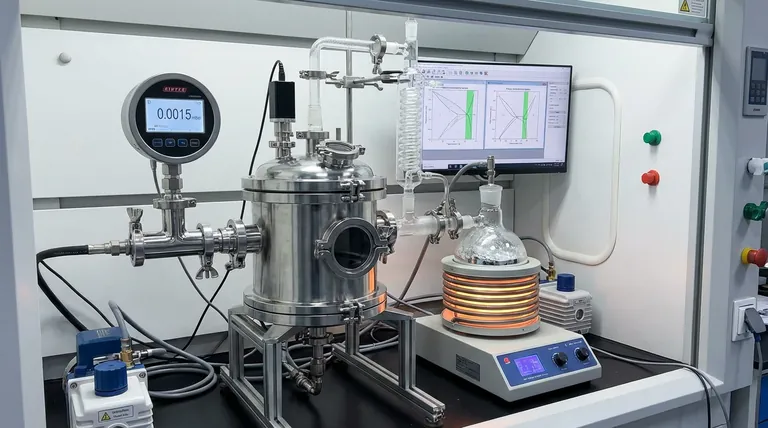
The Thermodynamic Challenge
Narrow Coexistence Zones
In magnesium alloy systems, specifically those involving zinc or cadmium, the state where liquid and vapor can coexist covers a very small range of conditions.
This leaves almost no margin for error. A lack of precision in your simulation inputs or control systems means you are likely operating outside the required phase boundary.
Shifting Phase Boundaries
Precise pressure regulation acts as a lever to manipulate these boundaries.
By fine-tuning the vacuum level, you can significantly shift the phase transition points. This control allows you to move the evaporation region toward the liquidus line, optimizing the conditions for separation.
Common Pitfalls of Pressure Instability
Failure to Separate Components
The primary goal of the process is the effective separation of volatile components.
If the vacuum pressure is unstable, the system cannot maintain the specific thermodynamic conditions required for this separation. The result is a mixture that remains impure, rendering the distillation process ineffective.
Unwanted Crystallization
Pressure instability does not just reduce efficiency; it can physically disrupt the process equipment.
Fluctuations can force the system into a state where solutes crystallize or precipitate unexpectedly. This leads to solid build-up that can foul the equipment and halt the distillation entirely.
Ensuring Simulation Accuracy
To translate your simulation into a successful process, you must prioritize the sensitivity of the vacuum system.
- If your primary focus is purity: Tightly model the pressure variables to ensure the evaporation region remains stable near the liquidus line.
- If your primary focus is operational continuity: Implement strict boundary conditions in your control logic to prevent pressure drifts that lead to solute crystallization.
Mastering the vacuum pressure is the single most critical factor in converting a volatile magnesium mixture into a separated, high-value product.
Summary Table:
| Challenge | Impact of Low Precision | Benefit of High Precision Control |
|---|---|---|
| Coexistence Zones | Narrow margins lead to process drift | Stable phase transition boundaries |
| Phase Boundaries | Poor separation of volatile components | Optimized evaporation near the liquidus line |
| Pressure Stability | Unexpected solute crystallization | Continuous operation without equipment fouling |
| Product Quality | Impure mixtures and low yield | High-purity separation of magnesium-zinc/cadmium |
Optimize Your Vacuum Distillation with KINTEK Expertise
Precision is the difference between a successful separation and equipment failure. At KINTEK, we understand the rigorous thermodynamic requirements of magnesium alloy processing. Backed by expert R&D and manufacturing, we offer high-precision Vacuum, Tube, and Muffle systems, all customizable to maintain the tight pressure boundaries your research demands.
Don't let pressure fluctuations compromise your results. Contact KINTEK today to discover how our specialized lab high-temp furnaces can bring unmatched stability and efficiency to your distillation processes.
References
- В. Н. Володин, Alexey Trebukhov. On the Problem of the Distillation Separation of Secondary Alloys of Magnesium with Zinc and Magnesium with Cadmium. DOI: 10.3390/met14060671
This article is also based on technical information from Kintek Furnace Knowledge Base .
Related Products
- Magnesium Extraction and Purification Condensing Tube Furnace
- Molybdenum Vacuum Heat Treat Furnace
- Vacuum Induction Melting Furnace
- Small Vacuum Heat Treat and Tungsten Wire Sintering Furnace
- Vacuum Heat Treat Sintering Furnace with Pressure for Vacuum Sintering
People Also Ask
- What are the advantages of using a condensing tube furnace for magnesium extraction? Achieve High Purity and Efficient Metal Recovery
- What advanced control features do modern tube furnaces have? Precision Temperature, Atmosphere, and Data Control
- What are the advantages of tube furnaces for certain applications? Unlock Precise Atmosphere and Temperature Control
- What factors should be considered when selecting between a tube furnace and a box furnace? Optimize Your Lab's Thermal Processing
- How does a tube furnace contribute to the carbonization of biomass? Master Precise Pyrolysis for Superior Materials












