
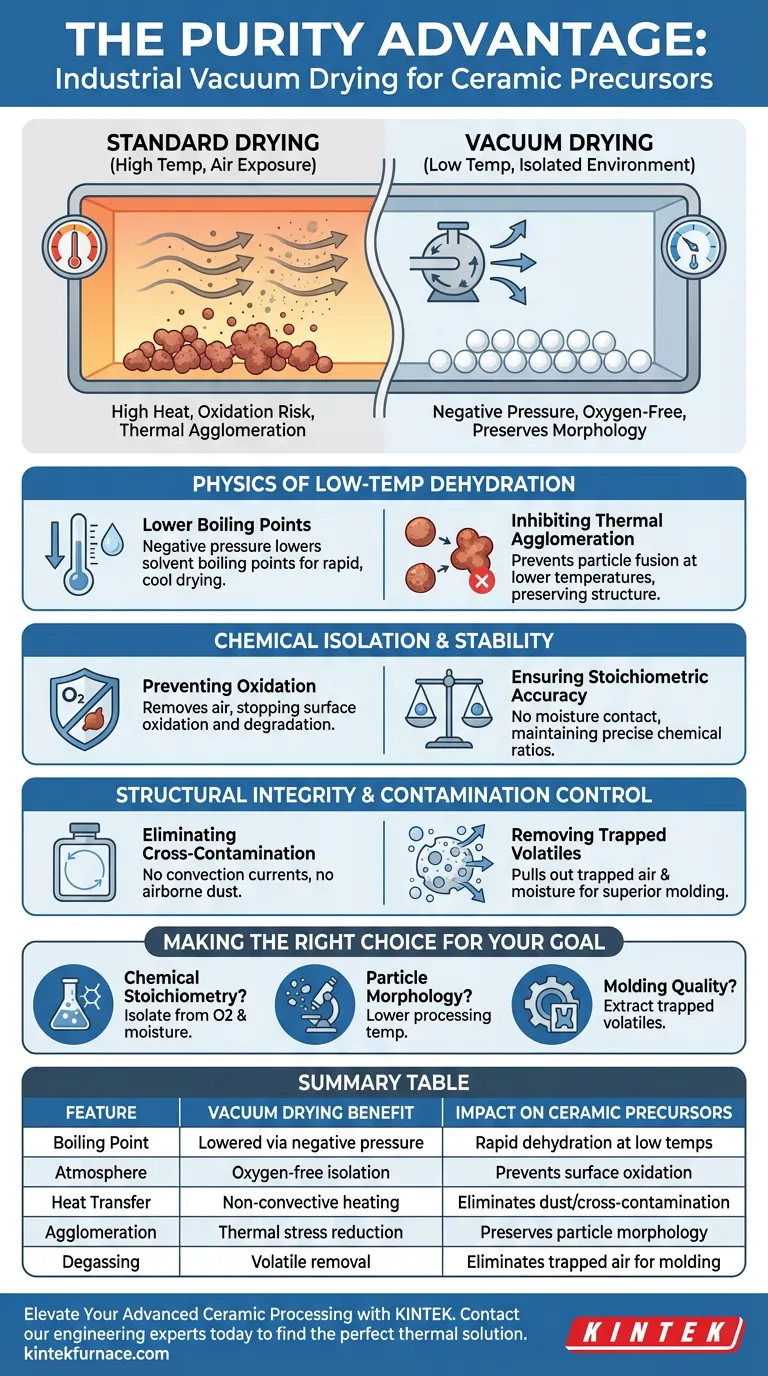
An industrial vacuum drying oven maintains material purity by fundamentally altering the thermodynamic conditions of the drying process. By establishing a negative pressure environment, the oven significantly lowers the boiling point of solvents, enabling rapid dehydration at much lower temperatures than standard methods require. This dual action of low-temperature processing and atmospheric isolation prevents thermal damage while protecting sensitive ceramic precursors from chemical degradation.
The core value of vacuum drying lies in its ability to decouple heat from evaporation; it prevents thermal agglomeration by drying at low temperatures and secures chemical stoichiometry by isolating materials from oxidation and moisture.
The Physics of Low-Temperature Dehydration
Lowering Solvent Boiling Points
In a standard environment, high heat is required to evaporate solvents. A vacuum oven reduces the internal pressure, which directly lowers the boiling point of liquids like water or ethanol.
This allows solvents to vaporize rapidly without subjecting the ceramic powder to extreme thermal stress.
Inhibiting Thermal Agglomeration
High temperatures often cause powder particles to fuse or cluster together, a defect known as thermal agglomeration.
By enabling drying at reduced temperatures, the vacuum mechanism effectively inhibits this agglomeration. This preserves the distinct particle structure necessary for high-quality ceramic performance.
Chemical Isolation and Stability
Preventing Oxidation
Ceramic precursors are often highly sensitive to oxygen. The vacuum environment removes air from the chamber, effectively isolating the raw material.
This prevents surface oxidation, ensuring that the chemical composition of the powder remains pure and unaltered during the heating phase.
Ensuring Stoichiometric Accuracy
Maintaining the correct ratio of elements (stoichiometry) is critical for ceramic precursors. Exposure to moisture in the air can degrade these materials and alter their ratios.
Vacuum drying eliminates contact with atmospheric moisture, preventing degradation and ensuring the final product maintains its precise chemical design.
Structural Integrity and Contamination Control
Eliminating Convection Cross-Contamination
Standard ovens often rely on air circulation (convection) to distribute heat, which can blow dust and contaminants onto the product.
Vacuum ovens operate without air convection. This eliminates the risk of cross-contamination, ensuring the physical purity of the batch.
Removing Trapped Volatiles
Powder clusters often trap air bubbles and moisture deep within their structure.
The negative pressure environment effectively pulls these trapped volatiles out. This results in a dried powder with excellent porosity, which is essential for high-quality molding and densification later in the process.
Understanding the Trade-offs
The Necessity of Sealed Processing
While standard ovens allow for simple operations, they fail to protect sensitive materials from the atmosphere.
The trade-off for the purity achieved by a vacuum oven is the requirement for a sealed, batch-processing environment. This setup prevents the continuous throughput methods seen in some conveyor-based systems but is the only reliable method for chemically sensitive ceramics.
Making the Right Choice for Your Goal
To determine if a vacuum drying oven is the correct solution for your specific ceramic application, consider your primary processing objectives:
- If your primary focus is Chemical Stoichiometry: Rely on vacuum drying to isolate the material from oxygen and moisture, preventing degradation of sensitive raw ingredients.
- If your primary focus is Particle Morphology: Use vacuum drying to lower the processing temperature, thereby preventing thermal agglomeration and fusing of particles.
- If your primary focus is Molding Quality: Leverage the vacuum environment to extract trapped air bubbles and moisture, ensuring the porosity required for defect-free molding.
By controlling both pressure and temperature, you transform the drying phase from a risk factor into a quality assurance step.
Summary Table:
| Feature | Vacuum Drying Benefit | Impact on Ceramic Precursors |
|---|---|---|
| Boiling Point | Lowered via negative pressure | Rapid dehydration at low temperatures |
| Atmosphere | Oxygen-free isolation | Prevents surface oxidation and degradation |
| Heat Transfer | Non-convective heating | Eliminates dust/cross-contamination |
| Agglomeration | Thermal stress reduction | Preserves particle morphology and size |
| Degassing | Volatile removal | Eliminates trapped air for superior molding |
Elevate Your Advanced Ceramic Processing with KINTEK
Maintaining the precise chemical stoichiometry and particle integrity of your precursors is non-negotiable. At KINTEK, we specialize in high-performance laboratory and industrial heating solutions designed for the most demanding applications.
Backed by expert R&D and manufacturing, we offer a comprehensive range of Muffle, Tube, Rotary, Vacuum, and CVD systems, all of which are fully customizable to meet your unique material requirements. Whether you are aiming to prevent thermal agglomeration or eliminate atmospheric contamination, our vacuum drying technology ensures your materials remain pure and process-ready.
Ready to optimize your drying process? Contact our engineering experts today to find the perfect thermal solution for your lab or production line.
Visual Guide
References
- Beatriz Monteiro, Sónia Simões. Microstructure and Mechanical Properties of Ti6Al4V to Al2O3 Brazed Joints Using Ti-Ag/Cu-Ti Thin Films. DOI: 10.3390/met14020146
This article is also based on technical information from Kintek Furnace Knowledge Base .
Related Products
- Dental Porcelain Zirconia Sintering Ceramic Vacuum Press Furnace
- Vacuum Heat Treat Furnace with Ceramic Fiber Liner
- Vacuum Dental Porcelain Sintering Furnace for Dental Laboratories
- Vacuum Heat Treat Sintering Furnace Molybdenum Wire Vacuum Sintering Furnace
People Also Ask
- What factors determine the quality of sintered zirconia restorations? Master Material, Equipment, and Technique
- How do conventional vs rapid sintering in dental furnaces affect zirconia? Optimize Efficiency Without Sacrificing Strength
- What is the purpose of dental sintering furnaces? Transform Zirconia into Durable, High-Quality Dental Restorations
- What precautions should be taken when sintering zirconia in the Fast Slow Dental Sintering Furnace? Master Key Steps for Perfect Results
- What temperature range is used for sintering zirconia ceramics? Achieve Optimal Strength and Translucency



