
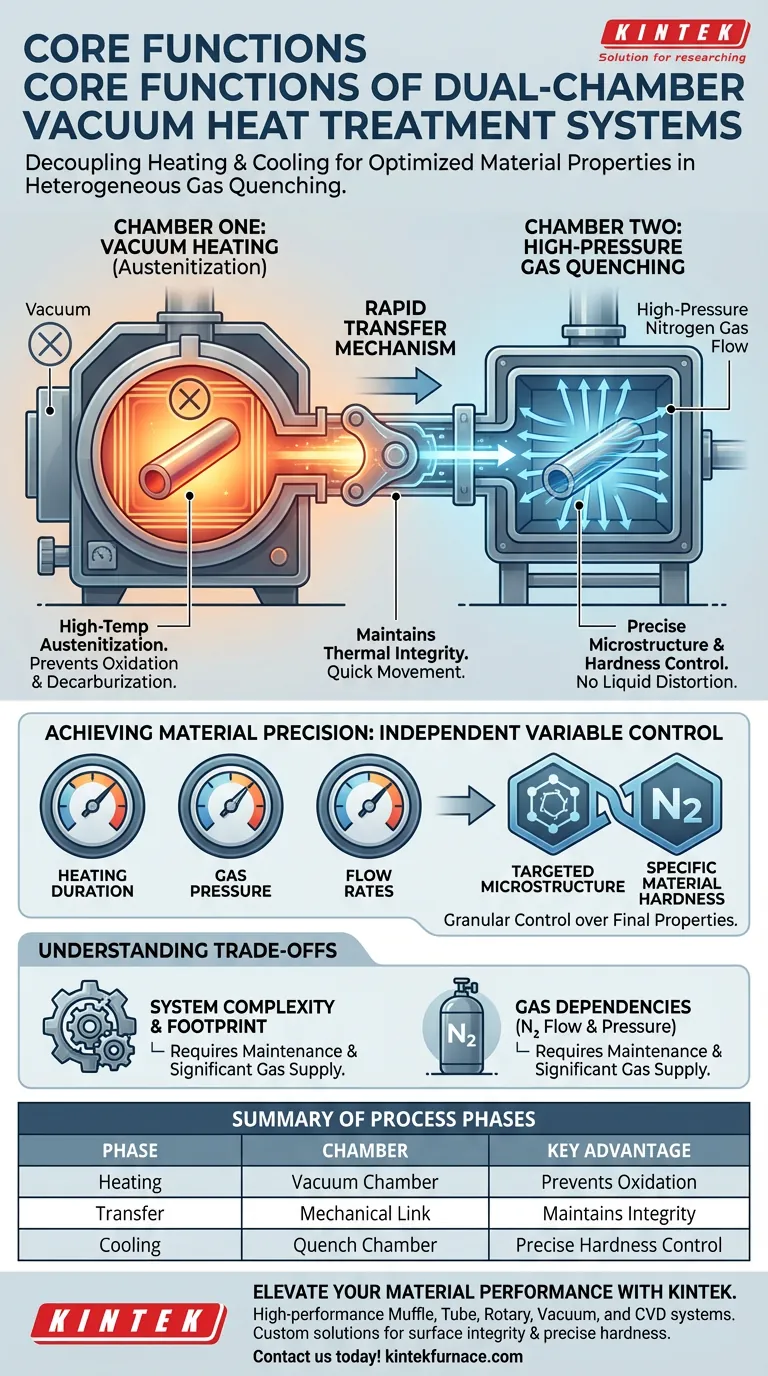
Dual-chamber vacuum heat treatment systems serve as precision integration platforms that decouple the heating and cooling phases of metallurgy to optimize material properties. These systems function by first subjecting specimens to high-temperature austenitization within a protective vacuum environment, then mechanically transferring them to a separate chamber for high-pressure nitrogen gas quenching.
Core Takeaway: The defining advantage of a dual-chamber system is the physical separation of heating and cooling environments. This design allows for oxidation-free heating followed by rapid, high-pressure cooling, granting engineers granular control over microstructure and hardness that single-environment systems often struggle to achieve.
The Mechanics of the Dual-Chamber Process
Chamber One: Protected Austenitization
The first functional stage occurs in the heating chamber. Here, the system performs high-temperature austenitization, heating the specimen to a predetermined set point.
Crucially, this occurs under vacuum protection. This environment eliminates reactive gases, preventing surface oxidation or decarburization during the critical heating phase.
The Rapid Transfer Mechanism
Once the heating cycle is complete, the system initiates a transfer sequence. The specimen is moved from the vacuum heating chamber to the quenching chamber.
Speed is vital here to maintain the temperature integrity of the part before the cooling phase begins.
Chamber Two: High-Pressure Gas Quenching
Upon entering the second chamber, the specimen undergoes rapid cooling. The system introduces high-pressure nitrogen gas to extract heat from the material.
This stage is distinct from liquid quenching; it uses gas flow to achieve the necessary cooling rates without the environmental mess or distortion risks often associated with oil or water.
Achieving Material Precision
Controlling the Critical Variables
The dual-chamber design allows for the independent management of process variables. Operators can precisely modulate heating duration, gas pressure, and flow rates.
This separation ensures that the conditions required for heating do not compromise the conditions required for cooling, and vice versa.
Targeting Microstructure and Hardness
The ultimate function of this system is to manipulate the internal structure of the metal.
By controlling the speed and pressure of the nitrogen quench, engineers can dictate the final microstructure. This directly correlates to achieving the specific material hardness required for the component's end-use application.
Understanding the Trade-offs
System Complexity and Footprint
While effective, dual-chamber systems are inherently more complex than single-chamber designs. The requirement for a mechanical transfer mechanism introduces moving parts that must be maintained to ensure consistent transfer speeds.
Gas Dependencies
The reliance on high-pressure nitrogen for quenching is a core operational consideration. Achieving the most rapid cooling rates requires significant gas flow and pressure, which becomes a primary variable in operational planning.
Making the Right Choice for Your Goal
- If your primary focus is Surface Integrity: The vacuum heating stage is your priority, as it ensures the part remains free of oxidation and requires minimal post-process cleaning.
- If your primary focus is Specific Hardness: Focus on the quenching chamber's capabilities, specifically the adjustability of gas pressure and flow rates to lock in the desired microstructure.
These systems offer the definitive solution for applications where the balance between surface quality and precise mechanical properties cannot be compromised.
Summary Table:
| Process Phase | Chamber Type | Core Function | Key Advantage |
|---|---|---|---|
| Heating | Vacuum Chamber | High-temp Austenitization | Prevents oxidation & decarburization |
| Transfer | Mechanical Link | Rapid specimen movement | Maintains thermal integrity for quench |
| Cooling | Quench Chamber | High-pressure Nitrogen Gas | Precise microstructure & hardness control |
Elevate Your Material Performance with KINTEK
Maximize the potential of your heat treatment processes with KINTEK’s industry-leading thermal solutions. Backed by expert R&D and world-class manufacturing, we provide high-performance Muffle, Tube, Rotary, Vacuum, and CVD systems tailored to the rigorous demands of modern metallurgy.
Whether you require a standard dual-chamber configuration or a fully customizable high-temperature furnace for unique research needs, our engineering team ensures you achieve perfect surface integrity and precise material hardness every time.
Ready to optimize your lab's capabilities? Contact KINTEK today to discuss your specific requirements with our experts.
Visual Guide
References
- Artificial Intelligence Modeling of the Heterogeneous Gas Quenching Process for Steel Batches Based on Numerical Simulations and Experiments. DOI: 10.3390/dynamics4020023
This article is also based on technical information from Kintek Furnace Knowledge Base .
Related Products
- Vacuum Heat Treat Furnace with Ceramic Fiber Liner
- Vacuum Heat Treat Sintering and Brazing Furnace
- Vacuum Heat Treat Sintering Furnace with Pressure for Vacuum Sintering
- Molybdenum Vacuum Heat Treat Furnace
- 2200 ℃ Graphite Vacuum Heat Treat Furnace
People Also Ask
- How does vacuum heat treating affect the grain structure of metal alloys? Achieve Precise Microstructure Control
- What are the benefits of using vacuum heat treating furnaces for metal alloys? Achieve Superior Metal Properties and Performance
- What is one of the most important uses of vacuum heat treating furnaces in aerospace? Achieve Superior Strength in Aircraft Alloys
- How does a vacuum heat treat furnace work? Achieve Pristine, High-Performance Results
- What is the difference between heat treat and vacuum heat treat? Achieve Superior Metal Properties with Pristine Finishes
















