
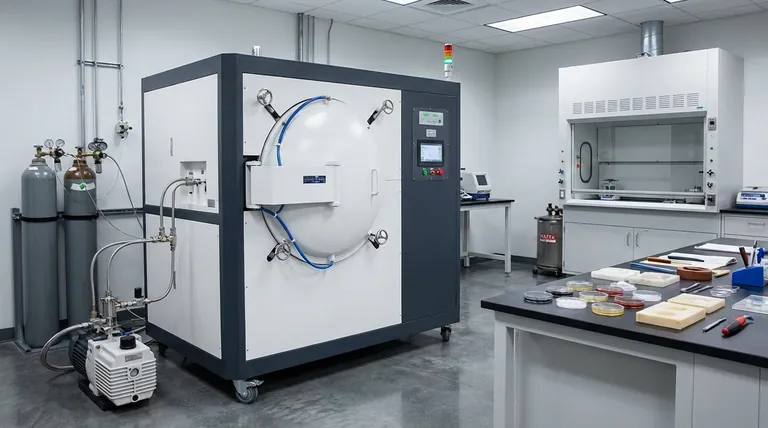
The primary necessity for a vacuum oven or thermal annealing equipment is to rigorously purge volatile components from the polymer layer prior to high-temperature processing. By combining heat with negative pressure, you ensure the complete evaporation of residual solvents that would otherwise cause catastrophic defects during the imprinting phase.
Core Takeaway This equipment acts as a critical stabilization stage, forcing out trapped solvents to prevent the formation of voids and bubbles. Simultaneously, it densifies the polymer matrix through thermal annealing, ensuring the final imprinted microstructures retain their physical fidelity and mechanical strength.
Preventing Structural Defects
The most immediate risk to melt imprinting is the presence of volatile compounds within the polymer precursor.
The Mechanism of Solvent Volatilization
When a polymer solution is dispensed, solvent remains trapped within the layer. If you proceed directly to high-temperature imprinting, this residual solvent will boil and volatilize rapidly.
Eliminating Bubble Formation
The rapid expansion of solvent vapor creates gas bubbles within the material. These bubbles disrupt the continuity of the polymer, leading to voids or phase separation that ruins the integrity of the intended microstructures.
Achieving Uniformity
Vacuum drying accelerates evaporation rates and pulls solvents from the material. This creates a dense, uniform layer free of pockets that could expand under thermal stress.
Enhancing Material Properties via Annealing
Beyond simple drying, thermal treatment acts as an annealing process that fundamentally alters the polymer's molecular arrangement.
Inducing Chain Rearrangement
Heating the film above its glass transition temperature ($T_g$) provides the energy required for polymer chain segments to move. This mobility allows the chains to reorganize into a more thermodynamically stable configuration.
Increasing Cross-Linking Density
This thermal environment facilitates the removal of unreacted monomers and promotes interaction between chains. The result is increased cross-linking density, which directly correlates to higher mechanical modulus and structural stability.
Deep Pore Solvent Removal
For complex or multi-porous structures, surface drying is insufficient. A negative pressure environment ensures that solvents are extracted from deep pores, facilitating uniform crystallization and adhesion of the precursor.
Understanding the Trade-offs
While necessary, this process introduces variables that must be strictly controlled to avoid diminishing returns.
The Risk of Thermal Degradation
While heat aids drying, excessive temperatures can damage sensitive precursors. For example, in oxygen-sensitive materials, improper heating without a sufficient vacuum can lead to oxidation and the loss of electrical conductivity.
Process Bottlenecks
Thorough vacuum drying is time-intensive, sometimes requiring several hours (e.g., 6 hours for deep porous structures). This step often becomes the rate-limiting factor in manufacturing throughput.
Making the Right Choice for Your Goal
How you utilize this equipment depends on the specific failure mode you are trying to prevent.
- If your primary focus is Geometric Fidelity: Prioritize vacuum levels to ensure zero residual solvent remains, as this eliminates the bubbling that distorts micro-patterns.
- If your primary focus is Mechanical Strength: Focus on the thermal annealing aspect, maintaining temperatures above $T_g$ to maximize chain rearrangement and cross-linking density.
- If your primary focus is Material Purity: Ensure a high-vacuum environment to strip moisture and oxygen, preventing chemical degradation or oxidation of sensitive precursors.
Controlled thermal processing under vacuum is not merely a drying step; it is the foundation of structural integrity for high-precision imprinting.
Summary Table:
| Feature | Purpose in Melt Imprinting | Benefit to Final Product |
|---|---|---|
| Vacuum Pressure | Efficiently extracts residual solvents and moisture. | Prevents voids, bubbles, and structural defects. |
| Thermal Annealing | Promotes polymer chain rearrangement above $T_g$. | Increases mechanical strength and stability. |
| Controlled Heating | Facilitates deep-pore solvent removal. | Ensures uniform crystallization and adhesion. |
| Inert Environment | Minimizes oxygen and moisture exposure. | Prevents oxidation and chemical degradation. |
Elevate Your Micro-Manufacturing Precision
Uncontrolled volatilization can ruin hours of high-precision imprinting. At KINTEK, we understand that structural integrity begins with the right thermal environment. Backed by expert R&D and manufacturing, we offer high-performance Muffle, Tube, Rotary, Vacuum, and CVD systems—all fully customizable to meet the unique needs of your polymer precursor research and manufacturing.
Ensure your microstructures achieve maximum density and fidelity with our advanced thermal solutions. Contact KINTEK today to discuss your custom furnace needs!
References
- Ruža Periz, Martin Steinhart. High‐Temperature Melt Stamping of Polymers Using Polymer/Nanoporous Gold Composite Stamps. DOI: 10.1002/smll.202308478
This article is also based on technical information from Kintek Furnace Knowledge Base .
Related Products
- Vacuum Heat Treat Sintering and Brazing Furnace
- Vacuum Heat Treat Sintering Furnace Molybdenum Wire Vacuum Sintering Furnace
- Dental Porcelain Zirconia Sintering Ceramic Vacuum Press Furnace
- Vacuum Hot Press Furnace Machine for Lamination and Heating
- Vacuum Hot Press Furnace Machine Heated Vacuum Press
People Also Ask
- What are the benefits of using vacuum heat treating furnaces for metal alloys? Achieve Superior Metal Properties and Performance
- How does vacuum heat treating affect the grain structure of metal alloys? Achieve Precise Microstructure Control
- What is one of the most important uses of vacuum heat treating furnaces in aerospace? Achieve Superior Strength in Aircraft Alloys
- What is the temperature of a vacuum furnace brazing? Optimize Your Joint Strength and Cleanliness
- What are the steps involved in a typical vacuum brazing treatment? Master the Process for Strong, Clean Joints



















