The necessity of this dual-component system stems from the specific demands of solvothermal synthesis: high internal pressure and chemical aggression. The stainless steel exterior provides the structural containment required to safely withstand pressure generated at temperatures between 70 °C and 120 °C, while the inner PTFE liner acts as a chemical shield to prevent corrosion and contamination.
Core Takeaway: Successful Ce-MOF synthesis requires balancing physical safety with chemical purity. The stainless steel shell manages the thermodynamics of pressure and heat, while the PTFE liner isolates the delicate crystallization process from contaminants.
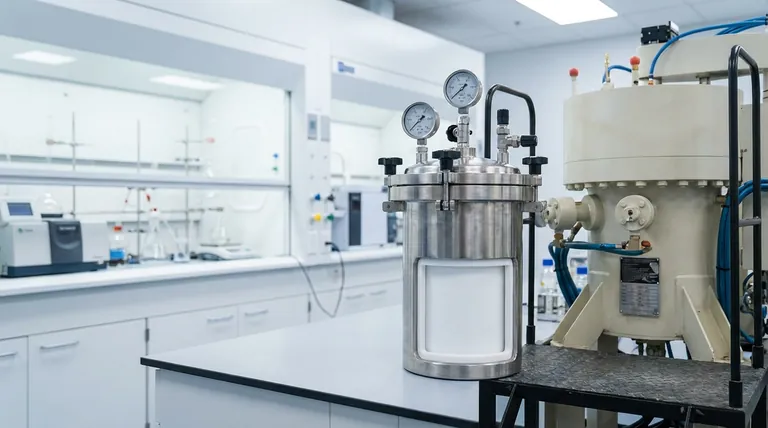
The Role of the Stainless Steel Exterior
Managing Pressure and Temperature
Solvothermal synthesis involves heating solvents in a sealed vessel, often above their boiling points.
Even at the specific processing range of 70 °C to 120 °C, significant internal pressure builds up within the reactor.
Stainless steel provides the high structural integrity and tensile strength required to contain this pressure without deformation or rupture.
The Critical Function of the PTFE Liner
Preventing Hardware Corrosion
The reaction mixtures used to create Ce-MOF carriers are frequently corrosive.
Direct contact with these fluids would rapidly degrade standard metal vessel walls.
Polytetrafluoroethylene (PTFE) offers high chemical inertness, serving as a robust barrier that prevents the reaction fluid from attacking the steel autoclave.
Eliminating Product Contamination
Purity is paramount when synthesizing Metal-Organic Frameworks (MOFs).
If the reaction fluid contacts the steel, iron or other metal ions could leach into the solution.
The PTFE liner ensures a pure synthesis environment, guaranteeing that the final Ce-MOF product is free from foreign metal defects caused by equipment leaching.
Understanding the Trade-offs
Thermal Limits of PTFE
While the stainless steel shell can withstand extreme heat, the PTFE liner is the limiting factor regarding temperature.
Although suitable for the 70 °C to 120 °C range required for Ce-MOF, PTFE can soften or deform at significantly higher temperatures.
Operators must ensure the reaction temperature does not exceed the liner's rated thermal stability to avoid leaks.
Sealing Integrity
The system relies on the interface between the liner and the steel shell to maintain a high-pressure seal.
If the liner is damaged or effectively "creeps" due to overuse, the seal may fail.
Regular inspection of the liner is necessary to maintain the sealed environment required for consistent solvothermal results.
Ensuring Synthesis Success
Selecting the right equipment is about protecting both the operator and the chemistry.
- If your primary focus is Safety: Rely on the stainless steel shell to contain the pressure generated during the heating phase.
- If your primary focus is Purity: Rely on the PTFE liner to prevent ion leaching that would compromise the structural properties of the Ce-MOF.
By using this composite setup, you ensure a controlled, safe, and chemically precise reaction environment.
Summary Table:
| Component | Material | Primary Function | Key Benefit |
|---|---|---|---|
| Outer Shell | Stainless Steel | Structural containment | Safety under high internal pressure |
| Inner Liner | PTFE (Teflon) | Chemical barrier | Prevents corrosion and ion contamination |
| Reaction Range | System Duo | Thermal management | Stable environment (70°C - 120°C) |
Elevate Your Material Synthesis with KINTEK
Precise Ce-MOF crystallization requires the perfect balance of pressure resistance and chemical purity. Backed by expert R&D and manufacturing, KINTEK offers a comprehensive range of high-performance lab equipment, including Muffle, Tube, Rotary, Vacuum, and CVD systems. Our high-temperature furnaces and solvothermal autoclaves are fully customizable to meet your unique research needs.
Don't compromise your synthesis results with subpar equipment. Contact KINTEK today to discover how our specialized lab solutions can enhance your lab's safety and research efficiency!
References
- Simon Lukato, Grzegorz Litwinienko. Enhancing the Green Synthesis of Glycerol Carbonate: Carboxylation of Glycerol with CO2 Catalyzed by Metal Nanoparticles Encapsulated in Cerium Metal–Organic Frameworks. DOI: 10.3390/nano14080650
This article is also based on technical information from Kintek Furnace Knowledge Base .
Related Products
- High Temperature Muffle Oven Furnace for Laboratory Debinding and Pre Sintering
- Vertical Laboratory Quartz Tube Furnace Tubular Furnace
- CF KF Flange Vacuum Electrode Feedthrough Lead Sealing Assembly for Vacuum Systems
- Multi Heating Zones CVD Tube Furnace Machine for Chemical Vapor Deposition Equipment
- Ultra-High Vacuum Flange Aviation Plug Glass Sintered Airtight Circular Connector for KF ISO CF
People Also Ask
- What thermal phenomena occur during polymer binder burnout in ceramic green bodies? Lab Furnace Guide
- What role does a high-temperature muffle furnace play in STFO synthesis? Achieve Pure Perovskite Results
- Why is controlled heat treatment in a muffle furnace necessary for calcined clay? Achieve Optimal Pozzolanic Activity
- How does a high-temperature muffle furnace facilitate the formation of LaNbxAl1−xO3+δ perovskite structures? Key Roles
- What role does a high-temperature muffle furnace play in the multi-stage synthesis of Li0.5MnFe1.5O4? Key to Pure Spinel