
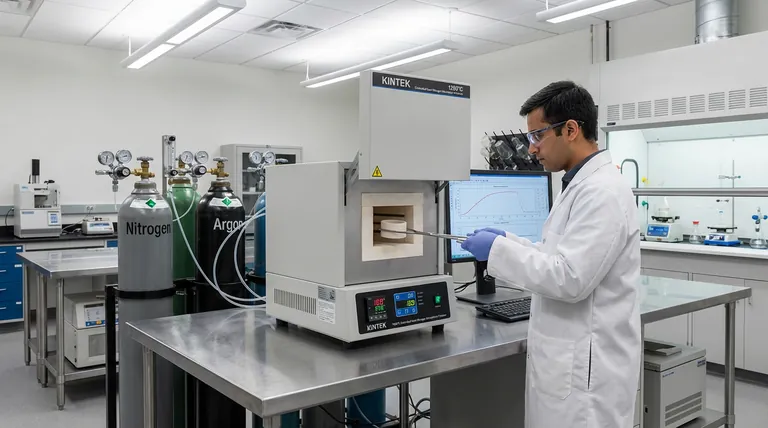
The fundamental advantage of controlled environments is the ability to isolate specific chemical reactions by precisely regulating oxygen partial pressure and humidity. By using a vacuum or inert gas like argon, researchers can suppress the rapid, "active" oxidation found in ambient air to observe the subtle phase transitions and thermodynamic equilibriums that dictate alloy properties.
A controlled environment serves as a critical benchmark for comparing oxide formation, allowing researchers to suppress the active oxidation of volatile elements like magnesium. This control is essential for optimizing metallurgical bonding and establishing how natural oxides function as nucleation substrates.
Isolating Chemical Variables
Establishing a Comparative Benchmark
Using a vacuum or argon atmosphere provides a "clean" baseline that researchers compare against results obtained in ambient air.
This comparison reveals how atmospheric components, such as moisture and high oxygen concentrations, accelerate or alter the natural oxidation path of the alloy.
Regulating Oxygen Partial Pressure
Laboratory-grade furnaces allow for the precise regulation of oxygen partial pressure above the aluminum melt.
By lowering the available oxygen, researchers can slow down the oxidation process enough to identify intermediate stages that would otherwise be bypassed in a normal atmosphere.
Suppressing Active Oxidation
Preserving Alloying Elements
In ambient air, elements like magnesium oxidize rapidly, often depleting the alloy surface of critical components.
Controlled atmospheres maintain a higher equilibrium content of Mg2Si and other intermetallics by preventing magnesium from reacting prematurely with atmospheric oxygen.
Optimizing Metallurgical Bonding
Suppressing active oxidation is vital for studying the metallurgical bonding of dual-alloy interfaces.
When the environment is controlled, researchers can create the specific conditions needed for a clean interface, which is the primary requirement for a strong structural bond between different metals.
Observing Phase Transitions and Nucleation
Tracking Amorphous to Crystalline Shifts
A controlled environment allows for the observation of how initial amorphous alumina films transition into crystalline structures like gamma-alumina (γ-Al2O3).
These transitions are sensitive to the environment; capturing them provides the data needed to create accurate experimental models for industrial production.
Oxides as Nucleation Substrates
Researchers use these environments to study how natural oxides, such as MgO or spinel (MgAl2O4), act as nucleation sites for intermetallic compounds.
Understanding this mechanism allows engineers to use naturally occurring oxide films as a foundation for growing specific, desirable microstructures within the alloy.
Real-Time Surface Characterization
Measuring Wetting and Contact Angles
Controlled furnaces equipped with high-resolution imaging allow researchers to view the droplet profiles of molten aluminum on various substrates.
By eliminating unpredictable oxidation, they can accurately measure contact angles and evaluate the wetting characteristics of the material.
Evaluating Filter Materials
This real-time analysis is crucial when testing materials like manganese oxide for use as filters in aluminum melts.
The vacuum environment ensures that the interaction being observed is strictly between the melt and the filter, rather than a side effect of atmospheric contamination.
Understanding the Trade-offs
Limitations of Simulated Environments
While controlled environments provide clarity, they may not perfectly replicate the chaotic conditions of large-scale industrial casting.
The high cost and technical complexity of maintaining ultra-low oxygen pressures can make these studies difficult to scale or repeat frequently.
Risk of Incomplete Data
Focusing solely on inert environments might lead researchers to overlook how specific trace impurities in ambient air actually improve certain alloy properties through unexpected chemical pathways.
How to Apply This to Your Project
Making the Right Choice for Your Goal
To utilize controlled environments effectively, you must align the atmospheric settings with your specific research objective.
- If your primary focus is improving bond strength: Use an argon atmosphere to suppress magnesium oxidation and maintain high intermetallic equilibrium at the interface.
- If your primary focus is characterizing oxide growth: Utilize a vacuum furnace to precisely step through oxygen partial pressures and observe the transition from amorphous to crystalline alumina.
- If your primary focus is melt filtration or casting quality: Focus on real-time imaging in a controlled atmosphere to measure wetting angles between the melt and your ceramic filters.
Mastering the environment is the only way to transform aluminum oxidation from an unpredictable liability into a controllable metallurgical tool.
Summary Table:
| Research Variable | Impact of Controlled Environment | Metallurgical Benefit |
|---|---|---|
| Oxygen Pressure | Precise regulation and reduction | Slows oxidation to identify intermediate stages |
| Magnesium Content | Prevents rapid element depletion | Preserves Mg2Si and intermetallic equilibrium |
| Alumina Structure | Controls amorphous to crystalline shift | Enables accurate modeling of gamma-alumina growth |
| Surface Tension | Eliminates atmospheric contaminants | Accurate measurement of wetting and contact angles |
Precision Environments for Advanced Metallurgical Research
Unlock the full potential of your alloy studies with KINTEK. As leaders in high-performance laboratory equipment, we provide the specialized tools necessary to master complex oxidation mechanisms.
Backed by expert R&D and manufacturing, KINTEK offers Muffle, Tube, Rotary, Vacuum, CVD systems, and other lab high-temp furnaces, all customizable for your unique research needs. Whether you are optimizing metallurgical bonding or tracking crystalline shifts, our systems deliver the thermal and atmospheric stability required for repeatable, publication-quality data.
Ready to elevate your material science capabilities? Contact us today to discuss your custom furnace requirements with our technical specialists.
References
- Liudmyla Lisova, Wolfram Volk. Dual-Alloy Sand Mold Casting: Main Principles and Features. DOI: 10.1007/s40962-024-01289-6
This article is also based on technical information from Kintek Furnace Knowledge Base .
Related Products
- Vacuum Hot Press Furnace Machine Heated Vacuum Press Tube Furnace
- Vacuum Hot Press Furnace Machine Heated Vacuum Press
- 600T Vacuum Induction Hot Press Vacuum Heat Treat and Sintering Furnace
- 2200 ℃ Tungsten Vacuum Heat Treat and Sintering Furnace
- Vacuum Heat Treat Sintering Furnace with Pressure for Vacuum Sintering
People Also Ask
- Why use Vacuum Hot Press (VHP) for ZnS Ceramics? Achieve Superior IR Transparency and Mechanical Strength
- What safety features are incorporated in vacuum hot press furnaces? Ensure Operator and Equipment Protection
- What are the benefits of the vacuum environment system in a vacuum hot press furnace? Unlock High-Density Sintering
- How does the uniaxial pressure applied by a vacuum hot press furnace affect the microstructure of ZrC-SiC materials?
- Why is a high vacuum environment crucial when preparing copper-carbon nanotube composites in a vacuum hot press furnace? Achieve Superior Composite Integrity



















