
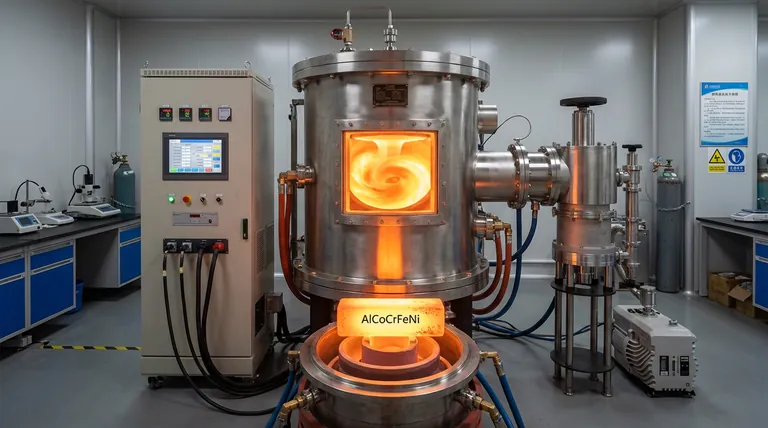
The preference for Vacuum Induction Melting (VIM) when preparing equimolar AlCoCrFeNi alloys stems from its unique ability to solve the twin metallurgical challenges of multi-element homogenization and oxidation control. Conventional melting methods often struggle to mix five distinct elements without contamination or segregation. VIM utilizes a high-vacuum environment to prevent the degradation of reactive elements like Aluminum and Chromium, while simultaneously employing electromagnetic induction to vigorously stir the molten pool for atomic-level uniformity.
Core Takeaway For high-entropy alloys like AlCoCrFeNi, maintaining a precise equimolar ratio is critical for the material's properties. VIM is the preferred method because it generates a natural convective loop that ensures all five metals mix intimately, while the vacuum prevents the loss of active elements that would otherwise alter the alloy's chemical balance.
Achieving Atomic-Scale Homogeneity
The Power of Induction Stirring
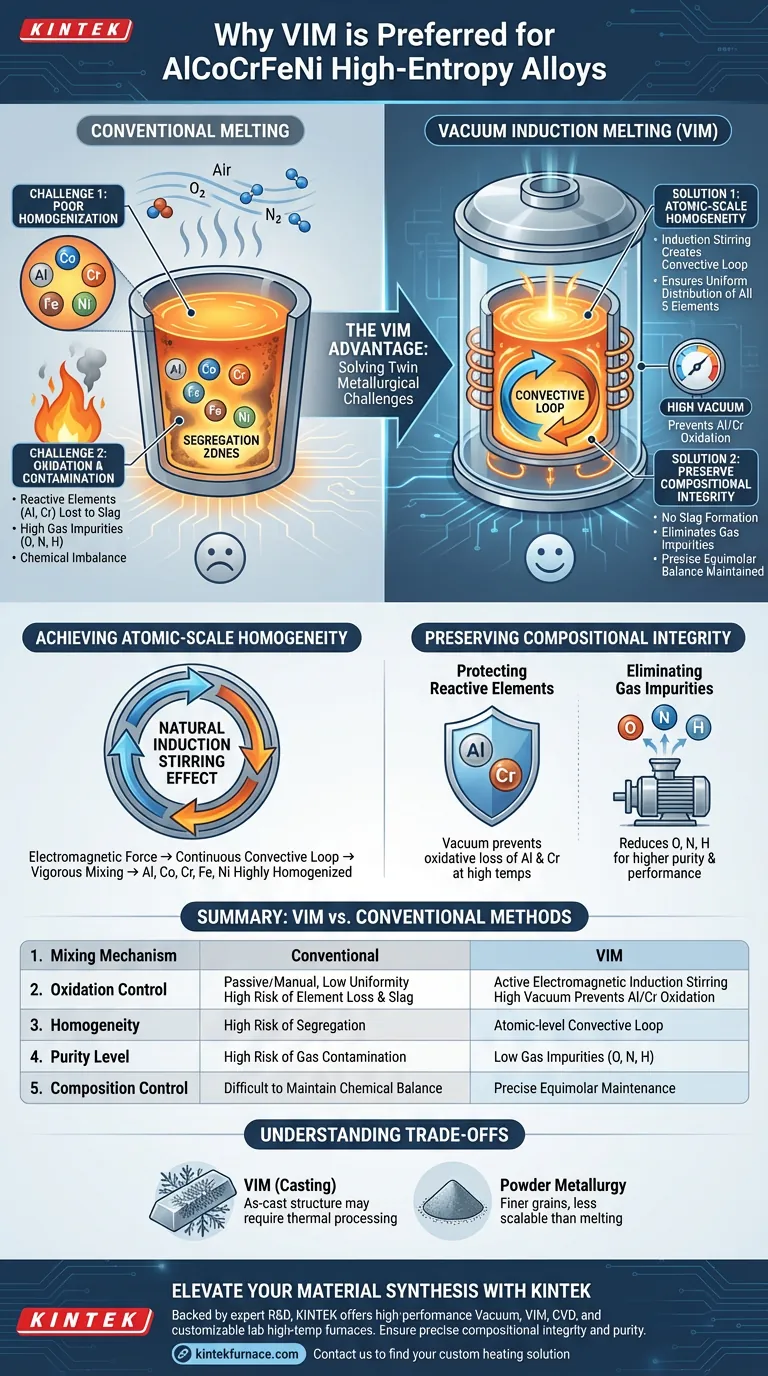
The defining feature of VIM is the natural induction stirring effect. Unlike conventional resistance furnaces, the electromagnetic field used to heat the metal generates strong stirring forces within the crucible.
Creating a Convective Loop
This electromagnetic force creates a continuous convective loop in the molten metal. This physical movement is not merely helpful; it is essential when combining five elements with potentially different melting points and densities.
Ensuring Uniform Distribution
The vigorous mixing action ensures that the Al, Co, Cr, Fe, and Ni atoms are highly homogenized. Without this active stirring, the melt pool could suffer from segregation, where elements cluster rather than mixing evenly, compromising the "high entropy" nature of the alloy.
Preserving Compositional Integrity
Protecting Reactive Elements
AlCoCrFeNi contains Aluminum (Al) and Chromium (Cr), both of which are highly active elements that oxidize rapidly at high temperatures. Conventional melting in air would lead to significant loss of these elements through slag formation.
The Role of High Vacuum
The high-vacuum environment effectively isolates the melt from oxygen. This prevents the oxidative loss of Al and Cr, ensuring the final ingot retains the precise equimolar composition calculated for the experiment.
Eliminating Gas Impurities
Beyond preventing oxidation, the vacuum environment actively degasses the melt. It significantly reduces the content of gas impurities such as oxygen, nitrogen, and hydrogen, which are detrimental to the alloy's purity and mechanical performance.
Understanding the Trade-offs
Cast Structures vs. Powder Metallurgy
While VIM excels at creating pure ingots, it is fundamentally a casting process. It creates a "as-cast" structure which may still contain dendritic formations (tree-like crystal structures) during solidification.
Processing Requirements
Because of these dendritic structures, VIM ingots often require subsequent thermal processing or hot working to fully optimize the grain structure. This contrasts with methods like vacuum hot pressing (a powder metallurgy route), which can produce finer grains directly but may lack the scalability of melting.
Making the Right Choice for Your Goal
While VIM is the superior choice for casting high-purity ingots, understanding your specific project needs is vital.
- If your primary focus is Compositional Accuracy: Rely on VIM to prevent the loss of Aluminum and Chromium, ensuring your final alloy matches your theoretical calculations.
- If your primary focus is Homogeneity: Trust the induction stirring of VIM to mix the five distinct elements more thoroughly than static melting methods can.
- If your primary focus is Microstructural Control: Be aware that VIM ingots may require secondary processing (like forging or annealing) to break down cast dendrites, unlike powder metallurgy methods.
VIM provides the cleanest, most chemically consistent foundation for high-entropy alloy development, acting as the critical first step in high-performance material synthesis.
Summary Table:
| Feature | Vacuum Induction Melting (VIM) | Conventional Melting Methods |
|---|---|---|
| Mixing Mechanism | Active electromagnetic induction stirring | Passive/Manual mixing (low uniformity) |
| Oxidation Control | High vacuum prevents Al/Cr oxidation | High risk of element loss & slag formation |
| Homogeneity | Atomic-level convective loop | High risk of element segregation |
| Purity Level | Low gas impurities (O, N, H) | High risk of gas contamination |
| Composition Control | Precise equimolar maintenance | Difficult to maintain chemical balance |
Elevate Your Material Synthesis with KINTEK
Ready to achieve unmatched homogeneity in your high-entropy alloy production? Backed by expert R&D and manufacturing, KINTEK offers high-performance Vacuum, VIM, CVD, and customizable lab high-temp furnaces specifically designed to meet the rigorous demands of advanced metallurgy.
Whether you are refining equimolar AlCoCrFeNi or developing next-generation materials, our systems ensure precise compositional integrity and elimination of impurities. Contact us today to find your custom heating solution and see how our expertise can optimize your research outcomes.
Visual Guide
References
- Mudassar Hussain, Tuty Asma Abu Bakar. X-Ray Diffraction Analysis of Sigma-Phase Evolution in Equimolar AlCoCrFeNi High Entropy Alloy. DOI: 10.15282/ijame.21.4.2024.14.0917
This article is also based on technical information from Kintek Furnace Knowledge Base .
Related Products
- Vacuum Induction Melting Furnace
- 600T Vacuum Induction Hot Press Vacuum Heat Treat and Sintering Furnace
- Small Vacuum Heat Treat and Tungsten Wire Sintering Furnace
- Vacuum Heat Treat Sintering and Brazing Furnace
- Vacuum Heat Treat Sintering Furnace Molybdenum Wire Vacuum Sintering Furnace
People Also Ask
- What are the core functions of the High Vacuum Induction Melting (VIM) furnace? Optimize DD5 Superalloy Purification
- What role does a Vacuum Induction Melting furnace play in the production of high-aluminum nickel-based superalloys?
- What is the role of VIM and directional solidification in aero-engine blade substrates? Engineering Extreme Durability
- Why is a Vacuum Induction Melting furnace (VIM) used for Cu-Zn-Al-Sn alloys? Achieve Precision Composition Control
- What are the technical advantages of using a Vacuum Induction Melting furnace in the development of advanced packaging steel?



















