
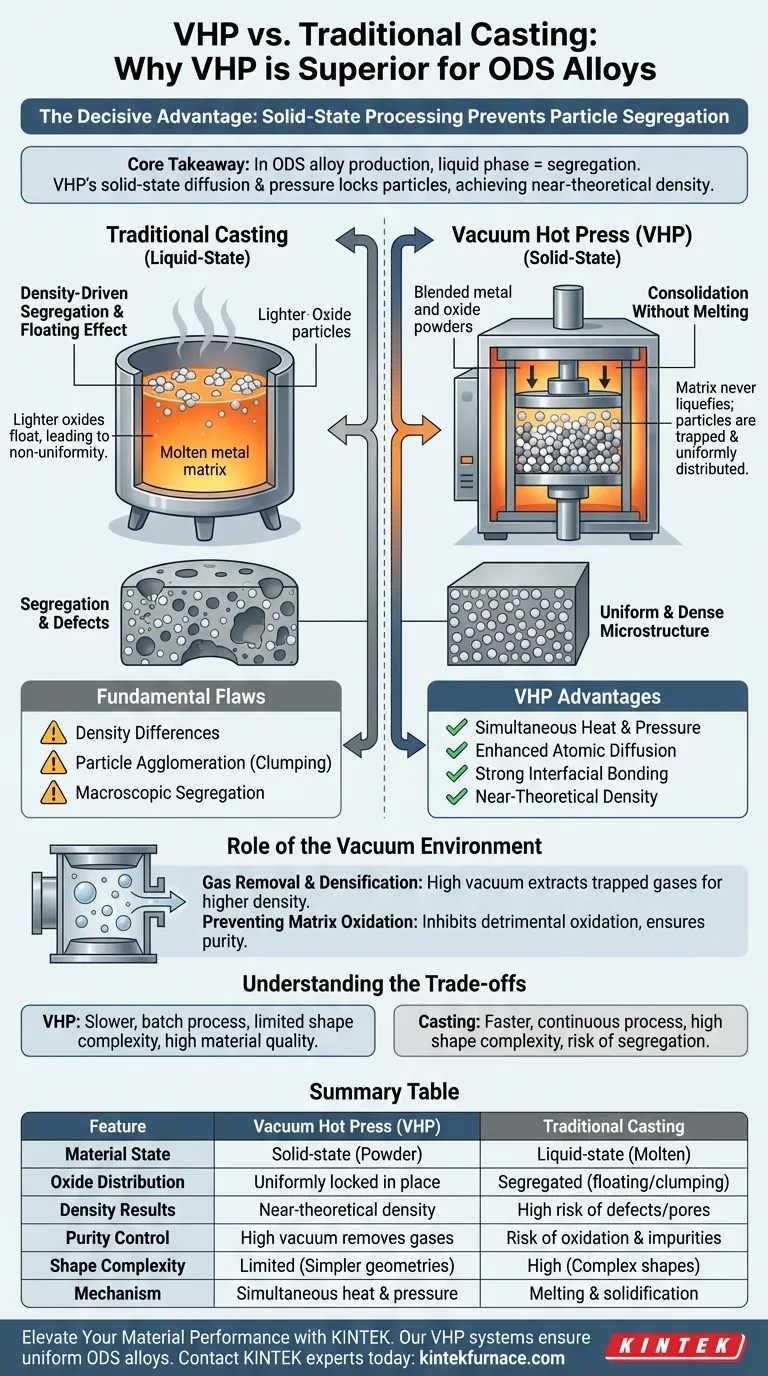
The decisive advantage of a Vacuum Hot Press (VHP) furnace lies in its ability to process materials in a solid state, preventing the particle segregation inherent to liquid casting. While traditional casting melts the metal matrix—causing lighter oxide particles to float or clump together—VHP applies heat and pressure to consolidate powders without melting them. This "freezes" the microstructure in place, ensuring the uniform distribution of strengthening oxides required for high-performance ODS alloys.
The Core Takeaway In ODS alloy production, the liquid phase is the enemy of uniformity. VHP circumvents the laws of buoyancy that plague casting by using solid-state diffusion and mechanical pressure to lock particles in place, achieving near-theoretical density where casting results in segregation and defects.
The Fundamental Flaw of Liquid-State Casting
To understand why VHP is superior, you must first understand the physics failure of traditional casting for this specific application.
Density-Driven Segregation
The primary reference highlights that traditional casting relies on melting the steel (or metal) matrix. In this liquid state, significant density differences exist between the heavy metal matrix and the lighter oxide particles.
The Floating Effect
Because the oxides are lighter, they naturally float to the surface or settle unevenly while the metal is molten. This leads to macroscopic segregation, where one part of the alloy is reinforced and another is weak, compromising the material's structural integrity.
Particle Agglomeration
Liquid metal allows particles to move freely. This mobility often causes fine oxide particles to clump together (agglomerate) rather than staying dispersed. Clumped particles act as stress concentrators rather than strengtheners, leading to premature material failure.
The VHP Advantage: Solid-State Forming
VHP employs powder metallurgy, a fundamentally different approach that builds the material without ever turning the matrix into a liquid.
Consolidation Without Melting
VHP consolidates mechanically alloyed powders at temperatures below the matrix's melting point. Because the matrix never liquefies, the oxide particles are physically unable to float or segregate. They remain trapped exactly where they were mixed, ensuring a homogeneous distribution.
Simultaneous Heat and Pressure
VHP applies uniaxial mechanical pressure simultaneously with high temperature. This combination provides a massive driving force for sintering. The pressure forces particles to rearrange and undergo plastic deformation, filling voids that heat alone might not resolve.
Enhanced Atomic Diffusion
The synchronized application of heat and force promotes atomic diffusion across particle boundaries. This allows the material to achieve high density and strong interfacial bonding between the metal matrix and the oxide particles, which is critical for the load-transfer mechanism in ODS alloys.
The Role of the Vacuum Environment
Beyond the mechanical advantages, the "Vacuum" in VHP plays a critical role in chemical purity that casting cannot match.
Gas Removal and Densification
Powder surfaces often hold adsorbed gases and volatile impurities. The high vacuum environment (e.g., 10^-3 Pa) extracts these gases during the heating phase. If these gases were not removed, they would become trapped pores during densification, lowering the alloy's final density.
Preventing Matrix Oxidation
While ODS alloys rely on specific oxides for strength, uncontrolled oxidation of the metal matrix (such as Titanium or Aluminum) is detrimental. The vacuum inhibits unwanted oxidation of the matrix elements and purifies grain boundaries, ensuring the mechanical properties are derived from the intended dispersion, not random defects.
Understanding the Trade-offs
While VHP is technically superior for material quality, it is important to recognize the operational constraints compared to casting.
Throughput and Scalability
VHP is a batch process. It is significantly slower than casting and restricts the size and complexity of the shapes you can produce. Casting is better suited for high-volume, complex geometries, provided the segregation issues can be tolerated or mitigated.
Processing Time
VHP often requires extended hold times (e.g., 90 minutes) to ensure complete diffusion and bonding. While this creates a superior material, it represents a higher time and energy cost per unit compared to the rapid solidification of casting.
Making the Right Choice for Your Goal
When selecting between VHP and casting for ODS alloys, the decision rests on the balance between microstructural perfection and production scale.
- If your primary focus is Maximum Material Performance: Choose VHP. It is the only reliable way to ensure uniform oxide dispersion and near-theoretical density without segregation defects.
- If your primary focus is High-Volume/Complex Shapes: Casting may be necessary, but you will likely need to employ secondary processing or accept lower mechanical uniformity due to particle settling.
Ultimately, VHP is the industry standard for ODS alloys because it replaces the chaotic physics of liquid flow with the controlled precision of solid-state bonding.
Summary Table:
| Feature | Vacuum Hot Press (VHP) | Traditional Casting |
|---|---|---|
| Material State | Solid-state (Powder) | Liquid-state (Molten) |
| Oxide Distribution | Uniformly locked in place | Segregated (floating/clumping) |
| Density Results | Near-theoretical density | High risk of defects/pores |
| Purity Control | High vacuum removes gases | Risk of oxidation & impurities |
| Shape Complexity | Limited (Simpler geometries) | High (Complex shapes) |
| Mechanism | Simultaneous heat & pressure | Melting & solidification |
Elevate Your Material Performance with KINTEK
Don't let particle segregation compromise your ODS alloy integrity. KINTEK’s advanced Vacuum Hot Press (VHP) systems provide the precise heat and pressure control needed to achieve near-theoretical density and uniform oxide distribution.
Backed by expert R&D and world-class manufacturing, we offer a comprehensive range of lab high-temperature furnaces, including Muffle, Tube, Rotary, Vacuum, and CVD systems—all fully customizable to meet your unique research or production requirements.
Ready to optimize your solid-state processing? Contact KINTEK experts today to discuss your specific application and discover how our specialized equipment can enhance your lab's efficiency.
Visual Guide
Related Products
- Vacuum Hot Press Furnace Machine for Lamination and Heating
- Vacuum Hot Press Furnace Machine Heated Vacuum Press Tube Furnace
- 600T Vacuum Induction Hot Press Vacuum Heat Treat and Sintering Furnace
- Vacuum Hot Press Furnace Machine Heated Vacuum Press
- Vacuum Heat Treat Sintering Furnace with Pressure for Vacuum Sintering
People Also Ask
- What are the primary components of a vacuum hot press furnace? Master the Core Systems for Precise Material Processing
- What safety features are incorporated in vacuum hot press furnaces? Ensure Operator and Equipment Protection
- What are the benefits of the vacuum environment system in a vacuum hot press furnace? Unlock High-Density Sintering
- What industries benefit from the use of vacuum hot press furnaces? Unlock High-Performance Materials for Your Industry
- What is a vacuum hot press furnace? Unlock Superior Material Performance



















