
The core function of a vacuum hot press furnace is to overcome the physical limitations of pure thermal sintering by synergizing high temperatures with external mechanical pressure. In the context of multi-grain nano-copper, this equipment uses pressure to forcibly drive plastic flow and dislocation motion, eliminating stubborn pores that heat alone cannot resolve.
Core Takeaway Standard heating often suffers from "kinetic hysteresis," where thermal energy is insufficient to fully close internal voids. The vacuum hot press furnace solves this by applying mechanical force to activate Shockley dislocations, effectively crushing deep pores caused by lattice orientation differences to achieve near-perfect densification.
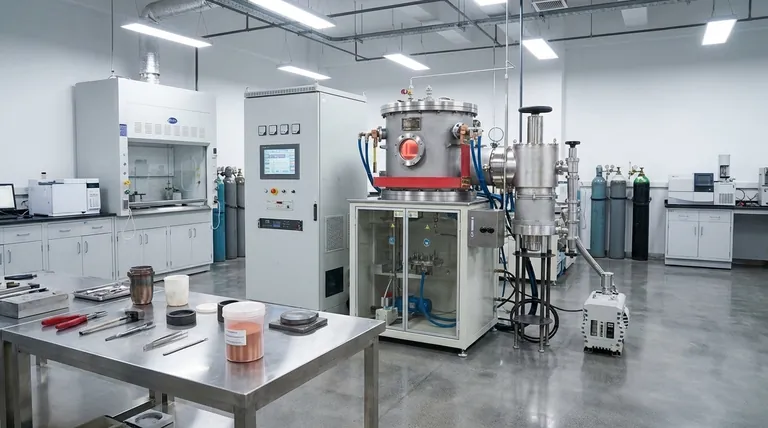
Overcoming the Limits of Thermal Sintering
Addressing Kinetic Hysteresis
In pure thermal sintering, the densification process can stall. This phenomenon, known as kinetic hysteresis, occurs when the driving force of heat is not enough to move material into the final remaining voids.
The Problem of Lattice Orientation
Multi-grain nano-copper contains deep pores resulting from differences in lattice orientation between grains. These structural gaps are resistant to closure through simple diffusion, leaving microscopic weaknesses in the material.
Synergizing Heat and Pressure
The furnace serves as a bridge between thermal and mechanical processing. By applying a high-temperature heat field simultaneously with external pressure, it creates a dual-force environment that forces material consolidation.
The Mechanics of Pressure-Assisted Densification
Driving Plastic Flow
The primary mechanism for densification in this process is plastic flow. The applied uniaxial pressure forces the copper nanoparticles to deform and flow into the interstitial voids, significantly increasing density.
Activating Dislocation Motion
On a microscopic level, the pressure drives dislocation motion, specifically involving Shockley dislocations. This movement allows atomic planes to slide past one another, mechanically rearranging the internal structure to fill gaps.
Suppressing Grain Growth
By utilizing pressure, high densification can be achieved at relatively lower temperatures compared to pressureless sintering. This is critical for nano-copper, as it minimizes grain growth, preserving the desirable nanostructure of the material.
The Role of the Vacuum Environment
Preventing Oxidation
Nano-copper is highly reactive and prone to oxidation. The vacuum environment (often around 0.01 MPa or lower) strips oxygen from the chamber, preventing the formation of oxide layers that would inhibit particle bonding.
Promoting Degassing
The vacuum actively facilitates the removal of harmful gases and impurities trapped between raw material particles. This ensures a clean microscopic interface, allowing for stronger bonds between the metal grains.
Understanding the Trade-offs
Complexity vs. Speed
While vacuum hot pressing yields superior density, it is generally a batch process. It lacks the continuous throughput speed of conventional sintering methods, making it less suitable for high-volume, low-cost production.
Geometric Limitations
The application of uniaxial pressure often limits the geometry of the final part. The process is best "suited for simple shapes" (like discs or plates) rather than complex, net-shape components that might require post-process machining.
Making the Right Choice for Your Goal
To maximize the utility of a vacuum hot press furnace for your nano-copper application, consider your specific density and structural requirements.
- If your primary focus is Maximum Density: Rely on the synergy of heat and pressure to force plastic flow, ensuring the elimination of deep pores caused by lattice mismatches.
- If your primary focus is Nanostructure Retention: Leverage the pressure capabilities to lower the sintering temperature, which suppresses grain growth while still achieving a solid bond.
- If your primary focus is Material Purity: Ensure your vacuum protocols are strict to facilitate complete degassing, preventing oxidation and interface contamination.
The vacuum hot press furnace is not just a heater; it is a mechanical tool that uses force to achieve microstructural integrity where thermal energy alone fails.
Summary Table:
| Feature | Thermal Sintering Limitations | Vacuum Hot Press Advantages |
|---|---|---|
| Densification Force | Heat only (Kinetic Hysteresis) | Synergy of Heat + Mechanical Pressure |
| Microstructure | Prone to grain growth at high temps | Retains nanostructure via lower temp activation |
| Pore Elimination | Struggles with lattice-orientation voids | Forces plastic flow & Shockley dislocations |
| Purity | Risk of oxidation/contamination | Vacuum environment prevents oxides & degasses |
Elevate Your Materials Research with KINTEK
Unlock the full potential of your nano-copper applications with KINTEK’s advanced vacuum hot press systems. Backed by expert R&D and precision manufacturing, KINTEK offers high-performance Muffle, Tube, Rotary, Vacuum, and CVD systems, all fully customizable to meet your unique laboratory needs.
Whether you require maximum density through precise pressure-heat synergy or need to preserve nanostructures via low-temperature sintering, our equipment delivers the control you need. Contact us today to find your custom thermal solution and experience the KINTEK advantage in material science.
Visual Guide

Related Products
- Vacuum Hot Press Furnace Machine for Lamination and Heating
- 600T Vacuum Induction Hot Press Vacuum Heat Treat and Sintering Furnace
- Vacuum Hot Press Furnace Machine Heated Vacuum Press Tube Furnace
- Vacuum Hot Press Furnace Machine Heated Vacuum Press
- High Pressure Laboratory Vacuum Tube Furnace
People Also Ask
- What are the primary components of a vacuum hot press furnace? Master the Core Systems for Precise Material Processing
- What safety features are incorporated in vacuum hot press furnaces? Ensure Operator and Equipment Protection
- What are the benefits of the vacuum environment system in a vacuum hot press furnace? Unlock High-Density Sintering
- What industries benefit from the use of vacuum hot press furnaces? Unlock High-Performance Materials for Your Industry
- How does the uniaxial pressure applied by a vacuum hot press furnace affect the microstructure of ZrC-SiC materials?



















