
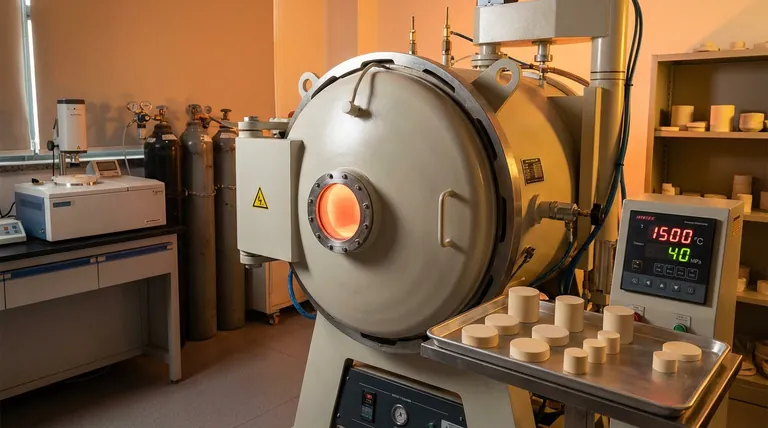
The hot-press sintering furnace serves as the critical densification engine in the production of high-density Y2O3-YAM composite ceramics. By simultaneously applying a specific high temperature (1500 °C) and substantial mechanical pressure (40 MPa), it forces the material to compact in ways that thermal energy alone cannot achieve.
Core Takeaway The hot-press sintering furnace overcomes the limitations of standard heating by introducing mechanical force as a second variable. This dual-action approach drives the ceramic to near 100% theoretical density at significantly lower temperatures, creating a compact structure while preventing the microstructural degradation often caused by excessive heat.
The Mechanics of Densification
Simultaneous Heat and Pressure
The defining characteristic of this furnace is the application of external pressure alongside heat. For Y2O3-YAM composites, the process typically targets 1500 °C and 40 MPa.
While temperature softens the material, the pressure acts as a mechanical "driving force." This combination is far more effective than the passive sintering used in atmospheric furnaces.
Accelerating Diffusion and Flow
The furnace environment promotes two critical physical behaviors: diffusion and plastic flow.
When pressure is applied to the heated powder, the particles are physically rearranged and forced into adjacent voids. This stimulates thermoplasticity, allowing the material to flow into a solid, dense shape much faster than it would through atomic diffusion alone.
Why Pressure Matters for Microstructure
Achieving Near-Theoretical Density
The ultimate goal of using a hot-press furnace is to eliminate porosity. The 40 MPa of pressure effectively closes the gaps between powder particles.
Because of this mechanical assistance, Y2O3-YAM ceramics can reach near 100% theoretical density. This level of compactness is difficult to achieve with pressureless sintering without resorting to extreme temperatures that might damage the material.
Inhibiting Grain Coarsening
One of the greatest challenges in ceramics is that high temperatures usually cause grains (crystals) to grow too large, which weakens the material.
The hot-press furnace solves this by allowing for densification at a lower temperature than would otherwise be required. By keeping the temperature at 1500 °C rather than pushing it higher, the furnace effectively inhibits excessive grain coarsening, preserving the material's mechanical integrity.
Understanding the Trade-offs
The "Vacuum Consequence"
While hot-pressing creates superior density, the vacuum environment and carbon heating elements within the furnace can introduce side effects.
Specifically, the process may leave behind residual carbon and oxygen vacancies. These impurities can negatively affect the electrical, chemical, and optical properties of the final Y2O3-YAM composite.
The Necessity of Post-Annealing
Because of the issues noted above, the hot-press furnace is rarely the final step.
The ceramic typically requires air atmosphere annealing in a separate box furnace (e.g., at 1200 °C). This secondary process removes the residual carbon, repairs oxygen vacancies, and relieves internal stresses generated during the high-pressure sintering phase.
Making the Right Choice for Your Goal
The hot-press sintering furnace is a specialized tool optimized for density and structural control.
- If your primary focus is maximum density: The hot-press furnace is essential to achieve near 100% density through the application of 40 MPa pressure.
- If your primary focus is microstructural refinement: Use this furnace to sinter at lower temperatures (1500 °C), which prevents the grains from growing too large and degrading performance.
- If your primary focus is optical or chemical purity: Be aware that you must follow hot-pressing with an air annealing cycle to remove vacuum-induced defects.
By leveraging mechanical pressure, you substitute raw thermal energy with physical force, achieving a denser material without sacrificing microstructural stability.
Summary Table:
| Feature/Parameter | Role in Y2O3-YAM Fabrication | Key Benefit |
|---|---|---|
| Temperature (1500 °C) | Softens material and promotes atomic diffusion. | Prevents microstructural degradation. |
| Pressure (40 MPa) | Acts as a mechanical driving force to close voids. | Achieves near 100% theoretical density. |
| Vacuum Environment | Facilitates high-pressure sintering conditions. | Requires post-annealing to remove carbon. |
| Grain Control | Enables densification at lower temperatures. | Inhibits grain coarsening for better strength. |
Master Your Ceramic Sintering with KINTEK
Achieve near-theoretical density and precise microstructural control for your advanced materials. Backed by expert R&D and world-class manufacturing, KINTEK offers high-performance Muffle, Tube, Rotary, Vacuum, and CVD systems, as well as specialized high-temp lab furnaces—all fully customizable to meet your unique research and production needs.
Ready to elevate your material properties? Contact KINTEK today to find your perfect furnace solution!
References
- Ho Jin, Young‐Jo Park. Microstructural characterization and inductively coupled plasma-reactive ion etching resistance of Y2O3–Y4Al2O9 composite under CF4/Ar/O2 mixed gas conditions. DOI: 10.1038/s41598-024-57697-5
This article is also based on technical information from Kintek Furnace Knowledge Base .
Related Products
- 600T Vacuum Induction Hot Press Vacuum Heat Treat and Sintering Furnace
- Vacuum Hot Press Furnace Machine Heated Vacuum Press Tube Furnace
- 9MPa Air Pressure Vacuum Heat Treat and Sintering Furnace
- Vacuum Heat Treat Sintering Furnace with Pressure for Vacuum Sintering
- Vacuum Hot Press Furnace Machine Heated Vacuum Press
People Also Ask
- Why use Vacuum Hot Press (VHP) for ZnS Ceramics? Achieve Superior IR Transparency and Mechanical Strength
- How does a vacuum hot press sintering furnace mitigate copper sintering swelling? Solve Fe-Cu Expansion Issues
- What are the benefits of using a vacuum hot press sintering furnace for the preparation of SiCw/2024 aluminum matrix composites? Achieve High-Performance Aerospace Materials
- What are the key advantages of vacuum hot press sintering furnaces? Achieve Superior Density and Purity in Materials
- What is the core function of a vacuum hot press sintering furnace in the preparation of high-density RuTi alloys? Achieve Maximum Density and Purity



















