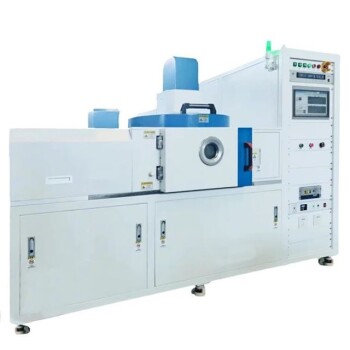
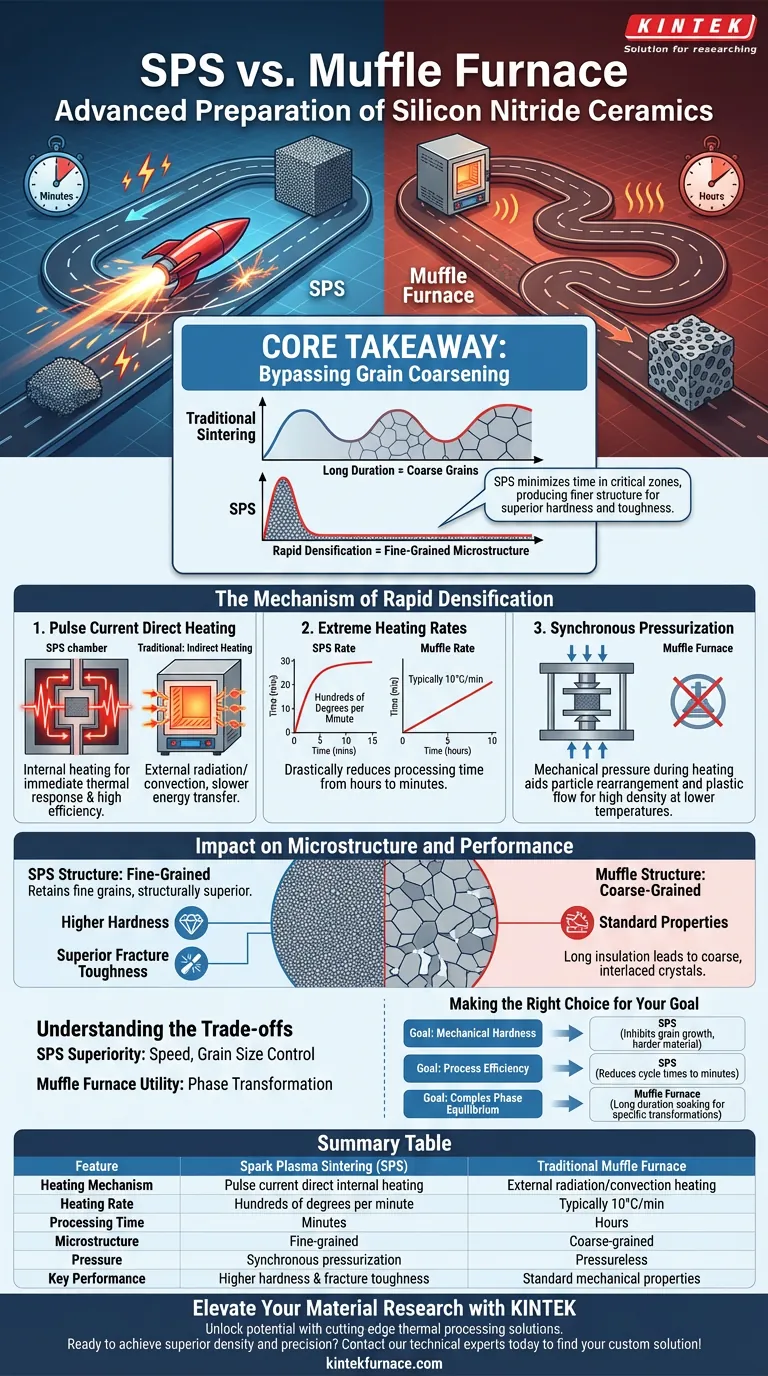
Spark Plasma Sintering (SPS) fundamentally outperforms traditional muffle furnaces for silicon nitride preparation by leveraging pulse current direct heating combined with synchronous pressurization. While a muffle furnace relies on slow, indirect thermal energy, an SPS system generates internal heat to achieve rates of several hundred degrees per minute, enabling rapid densification that traditional methods cannot match.
Core Takeaway The distinct advantage of SPS lies in its ability to bypass the intermediate temperature zones where grain coarsening typically occurs. By minimizing the time spent at these critical temperatures, SPS produces a fine-grained microstructure that delivers superior hardness and fracture toughness compared to the coarser materials produced by conventional sintering.
The Mechanism of Rapid Densification
Pulse Current Direct Heating
Unlike a laboratory muffle furnace, which heats samples from the outside in via radiation or convection, an SPS system utilizes pulse current to directly heat the mold and sample.
This internal heating mechanism allows for immediate thermal response and high energy efficiency.
Extreme Heating Rates
A traditional high-temperature furnace often operates with controlled, slow heating rates (e.g., 10°C/min) to maintain stability.
In contrast, SPS achieves heating rates of several hundred degrees per minute. This capability drastically reduces the overall processing time from hours to mere minutes.
Synchronous Pressurization
SPS integrates mechanical pressure during the heating phase. This synchronous pressurization aids in particle rearrangement and plastic flow.
It allows the silicon nitride to achieve high density at lower temperatures than would be required in a pressureless muffle furnace.
Impact on Microstructure and Performance
Bypassing Grain Coarsening
The most critical metallurgical advantage of SPS is its speed. In a traditional furnace, long dwell times allow grains to grow excessively (coarsen) before the material is fully dense.
SPS heats the material so quickly that it bypasses the intermediate temperature zones responsible for this uncontrolled grain growth.
Preservation of Fine-Grained Structure
Because the densification process is completed in a very short duration, the silicon nitride retains a fine-grained microstructure.
This is structurally superior to the coarse, interlaced crystal structures often resulting from the long-duration insulation typical of conventional sintering.
Superior Mechanical Properties
The direct result of this refined microstructure is enhanced mechanical performance.
SPS-produced silicon nitride exhibits higher hardness and superior fracture toughness, making it more suitable for high-performance engineering applications than conventionally sintered counterparts.
Understanding the Trade-offs
Phase Transformation Requirements
While SPS is superior for densification speed and grain size control, traditional furnaces still hold specific utility.
High-performance silicon nitride often requires a transition from the alpha-phase to the beta-phase to develop specific crystal structures (e.g., interlaced columnar crystals). This process traditionally requires long-duration insulation (e.g., 120 minutes) and high nitrogen pressure, conditions that a standard fast-firing SPS cycle may need to be specifically adapted to mimic.
Making the Right Choice for Your Goal
To determine whether SPS is the correct tool for your specific silicon nitride application, evaluate your primary objectives:
- If your primary focus is mechanical hardness: SPS is the superior choice, as the rapid densification inhibits grain growth, resulting in a harder, fine-grained material.
- If your primary focus is process efficiency: SPS offers a distinct advantage by reducing cycle times from hours to minutes through pulse current heating.
- If your primary focus is complex phase equilibrium: A traditional furnace may be necessary if your specific material grade requires long-duration soaking to facilitate slow alpha-to-beta phase transformation.
Ultimately, for applications demanding high fracture toughness and hardness, SPS provides a microstructural quality that conventional muffle furnaces cannot replicate.
Summary Table:
| Feature | Spark Plasma Sintering (SPS) | Traditional Muffle Furnace |
|---|---|---|
| Heating Mechanism | Pulse current direct internal heating | External radiation/convection heating |
| Heating Rate | Hundreds of degrees per minute | Typically 10°C/min |
| Processing Time | Minutes | Hours |
| Microstructure | Fine-grained (inhibits coarsening) | Coarse-grained (due to long dwell) |
| Pressure | Synchronous pressurization | Pressureless (usually) |
| Key Performance | Higher hardness & fracture toughness | Standard mechanical properties |
Elevate Your Material Research with KINTEK
Unlock the full potential of your advanced ceramics with KINTEK’s cutting-edge thermal processing solutions. Backed by expert R&D and world-class manufacturing, we provide high-performance Muffle, Tube, Rotary, Vacuum, and CVD systems, as well as advanced sintering technologies. All our laboratory high-temp furnaces are fully customizable to meet your unique research or production needs.
Ready to achieve superior density and precision? Contact our technical experts today to find your custom solution!
Visual Guide
References
- ESTIMATION OF VOLATILE MATTER, HEATING VALUE, POROXIMATE, ULTIMATE AND STRUCTURAL COMPOSITION OF BIOMASS (ELEPHANT GRASS). DOI: 10.56726/irjmets48152
This article is also based on technical information from Kintek Furnace Knowledge Base .
Related Products
- Spark Plasma Sintering SPS Furnace
- Chairside Dental Porcelain Zirconia Sintering Furnace with Transformer for Ceramic Restorations
- 600T Vacuum Induction Hot Press Vacuum Heat Treat and Sintering Furnace
- 9MPa Air Pressure Vacuum Heat Treat and Sintering Furnace
- Dental Porcelain Zirconia Sintering Ceramic Vacuum Press Furnace
People Also Ask
- How does the heating mechanism of Spark Plasma Sintering (SPS) function? Enhance TiC/SiC Composite Fabrication
- Why is it necessary to maintain a high vacuum environment during the SPS of SiC? Key to High-Density Ceramics
- What are the technical advantages of using an SPS sintering furnace? Elevate Al2O3-TiC Material Performance
- What are the steps in the discharge plasma sintering process? Master Fast, High-Density Material Consolidation
- What are the advantages of spark plasma sintering (SPS) over traditional forging? Precision Microstructural Control