
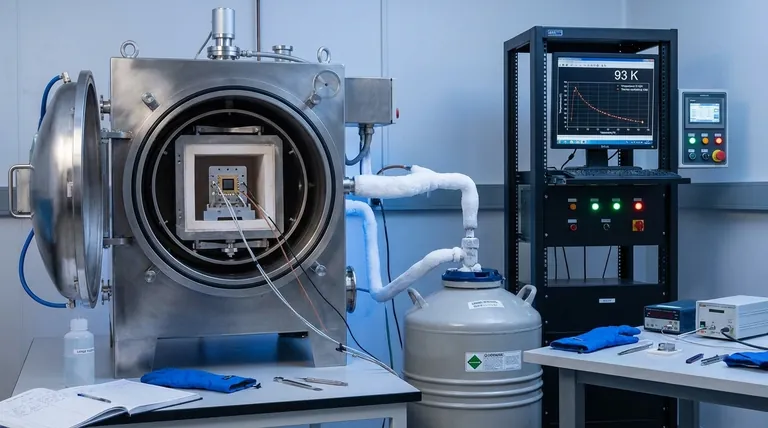
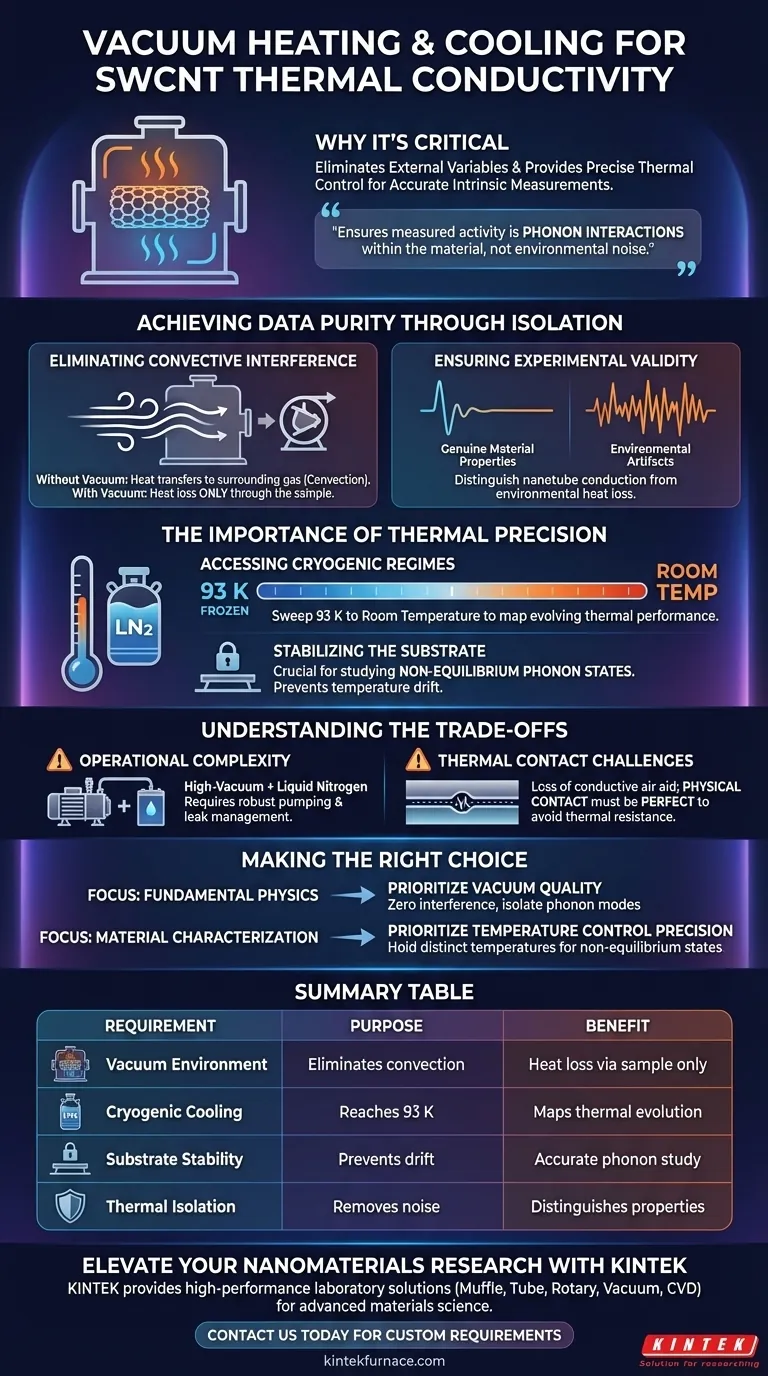
A vacuum heating and cooling stage is critical for studying Single-Walled Carbon Nanotubes (SWCNTs) because it creates the only environment where intrinsic thermal properties can be measured accurately. This equipment eliminates external variables—specifically air currents—and provides the precise thermal control necessary to observe how heat moves through the material at the atomic level.
By removing convective heat transfer and stabilizing substrate temperatures, this setup ensures that any measured thermal activity is the result of phonon interactions within the material, rather than environmental noise.
Achieving Data Purity through Isolation
To understand the thermal conductivity of SWCNTs, you must first eliminate the mechanisms that obscure the data.
Eliminating Convective Interference
The primary enemy of accurate thermal measurement at this scale is convection.
If air is present, heat will transfer from the sample to the surrounding gas. A vacuum environment removes these air molecules, ensuring that heat loss occurs only through the sample itself.
Ensuring Experimental Validity
Without a vacuum, it is impossible to distinguish between the heat conducted by the nanotube and the heat lost to the environment.
The vacuum stage guarantees that the thermal diffusion phenomena you observe are genuine material properties, not artifacts of the test environment.
The Importance of Thermal Precision
Studying SWCNTs requires rigorous control over the temperature of the substrate supporting the sample.
Accessing Cryogenic Regimes
Thermal conductivity changes drastically with temperature.
By combining the stage with a liquid nitrogen cooling system, researchers can sweep a temperature range from 93 K to room temperature. This wide range is essential for mapping how thermal performance evolves from cryogenic conditions to ambient warmth.
Stabilizing the Substrate
The heating and cooling stage does not just reach a target temperature; it effectively "locks" it in.
Precisely maintaining the substrate temperature is required to study non-equilibrium phonon states. If the base temperature drifts, the data regarding these delicate vibrational states becomes unreliable.
Understanding the Trade-offs
While necessary for high-fidelity data, using a vacuum heating and cooling stage introduces specific complexities to the experiment.
Operational Complexity
Integrating a liquid nitrogen system with high-vacuum equipment increases the difficulty of the experimental setup.
Maintaining a stable vacuum while cycling temperatures between 93 K and room temperature requires robust pumping systems and careful leak management to prevent condensation or pressure spikes.
Thermal Contact Challenges
In a vacuum, you lose the conductive aid of air molecules between the sample and the sensor.
This means the physical contact between the SWCNT and the measurement stage must be perfect. Poor contact in a vacuum results in significant thermal contact resistance, which can skew conductivity calculations.
Making the Right Choice for Your Goal
When configuring your apparatus for SWCNT research, consider your specific analytical objectives.
- If your primary focus is fundamental physics: Prioritize the vacuum quality to ensure zero convective interference, allowing for the isolation of pure phonon transport modes.
- If your primary focus is material characterization: Prioritize the precision of the temperature control, ensuring you can hold specific distinct temperatures (e.g., exactly 93 K) to capture non-equilibrium states accurately.
The ultimate value of this setup lies in its ability to strip away the noise of the physical world, leaving only the intrinsic behavior of the nanotube behind.
Summary Table:
| Requirement | Purpose in SWCNT Research | Benefit to Data Quality |
|---|---|---|
| Vacuum Environment | Eliminates convective heat transfer | Ensures heat loss occurs only through the sample itself |
| Cryogenic Cooling | Reaches temperatures as low as 93 K | Maps thermal performance evolution from cryogenic to ambient |
| Substrate Stability | Prevents base temperature drift | Allows accurate study of delicate non-equilibrium phonon states |
| Thermal Isolation | Removes environmental interference | Distinguishes genuine material properties from experimental noise |
Elevate Your Nanomaterials Research with KINTEK
Precise thermal characterization of SWCNTs requires an environment free from interference. KINTEK provides high-performance laboratory solutions designed to meet the rigorous demands of advanced materials science. Backed by expert R&D and manufacturing, we offer a comprehensive range of Muffle, Tube, Rotary, Vacuum, and CVD systems, all of which are fully customizable to your unique experimental needs.
Whether you are exploring fundamental physics or industrial applications, our equipment ensures the thermal stability and vacuum integrity your research deserves. Contact us today to discuss your custom furnace requirements and see how our expertise can bring unparalleled purity to your data.
Visual Guide
References
- Ibrahim Al Keyyam, Xinwei Wang. Direct Observation of Suppressed Optical–Acoustic Phonon Energy Coupling in Supported SWCNT at Cryogenic Temperatures. DOI: 10.1002/advs.202509005
This article is also based on technical information from Kintek Furnace Knowledge Base .
Related Products
- Vacuum Heat Treat Sintering and Brazing Furnace
- Vacuum Hot Press Furnace Machine for Lamination and Heating
- 600T Vacuum Induction Hot Press Vacuum Heat Treat and Sintering Furnace
- 9MPa Air Pressure Vacuum Heat Treat and Sintering Furnace
- Small Vacuum Heat Treat and Tungsten Wire Sintering Furnace
People Also Ask
- How does vacuum heat treating affect the grain structure of metal alloys? Achieve Precise Microstructure Control
- What is one of the most important uses of vacuum heat treating furnaces in aerospace? Achieve Superior Strength in Aircraft Alloys
- What are the benefits of using vacuum heat treating furnaces for metal alloys? Achieve Superior Metal Properties and Performance
- What is the temperature of a vacuum furnace brazing? Optimize Your Joint Strength and Cleanliness
- What are the steps involved in a typical vacuum brazing treatment? Master the Process for Strong, Clean Joints














