
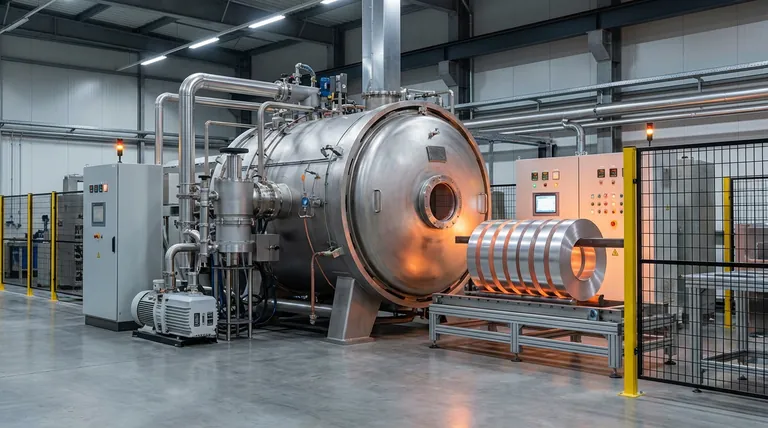
The primary purpose of using industrial vacuum or atmosphere-protected annealing furnaces for 3003mod aluminum alloy strips is to eliminate internal stresses accumulated during cold rolling. By treating intermediate-gauge strips at 350 °C for a duration of two hours, this process facilitates a controlled, moderate recovery of the material.
This thermal treatment is critical for adjusting the alloy's work-hardening state. It ensures the final product achieves the H14 temper with an optimal balance of mechanical properties.
The Role of Thermal Treatment
Eliminating Cold Rolling Stress
During the cold rolling process, the aluminum structure accumulates significant internal energy and stress.
Without treatment, this stress can lead to material instability or processing difficulties. The annealing furnace provides the thermal energy required to release these internal stresses effectively.
Facilitating Moderate Recovery
The goal of this specific process is not always to soften the metal completely.
Instead, the furnace allows for moderate recovery. This partial restoration of the microstructure retains some strength while improving ductility.
Precise Process Parameters
Success depends on strict adherence to specific operational parameters.
For 3003mod aluminum, the standard is maintaining a temperature of 350 °C for 2 hours. Deviating from this time-temperature profile can result in off-spec material.
Achieving the H14 State
Adjusting Work-Hardening
The central objective of this annealing phase is to fine-tune the work-hardening state of the strip.
By carefully controlling the thermal cycle, you are preparing the material's internal structure for its final application.
Balancing Mechanical Properties
The H14 state represents a specific "half-hard" temper.
The furnace ensures the final product strikes an optimal balance between hardness and flexibility. This makes the alloy usable for applications requiring both structural integrity and formability.
Operational Considerations and Trade-offs
The Precision of "Moderate" Recovery
The primary challenge in this process is achieving "moderate" recovery rather than full recrystallization.
If the temperature exceeds 350 °C or the duration extends beyond two hours, you risk over-softening the material. This would result in losing the mechanical properties required for the H14 state.
Equipment Necessity
Using vacuum or atmosphere-protected furnaces is not merely a preference; it is an equipment requirement for this grade.
These furnaces ensure that while the internal structure is being adjusted, the surface quality remains uncompromised by the heating environment.
Optimizing Your Manufacturing Process
To ensure your 3003mod aluminum strips meet the rigorous standards for H14 temper, you must focus on process control.
- If your primary focus is Consistency: Strictly monitor the 350 °C temperature and 2-hour duration to prevent variance in mechanical properties.
- If your primary focus is Material Performance: Ensure the "moderate recovery" phase is fully completed to eliminate cold-rolling stresses without compromising strength.
By mastering this annealing stage, you guarantee a final product that is both stable and mechanically optimized.
Summary Table:
| Parameter | Specification | Purpose |
|---|---|---|
| Material | 3003mod Aluminum Alloy | Intermediate-gauge strips |
| Temperature | 350 °C | Ensure moderate recovery |
| Duration | 2 Hours | Relieve internal stress |
| Target Temper | H14 State | Balance hardness & ductility |
| Atmosphere | Vacuum/Protected | Maintain surface quality |
Maximize Your Material Performance with KINTEK
Precision is non-negotiable when achieving the H14 temper for 3003mod aluminum. KINTEK provides industry-leading Vacuum, Tube, and Atmosphere-protected high-temp furnaces designed to maintain the strict 350 °C thermal cycles your alloys require.
Backed by expert R&D and world-class manufacturing, our customizable systems ensure uniform heating and superior surface protection for labs and industrial production alike. Eliminate internal stress and guarantee consistent mechanical properties—Contact KINTEK today to discuss your unique heat treatment needs!
Visual Guide

References
- Wenhui Zheng, Wei Xu. High-Temperature Mechanical Properties and Microstructure of Ultrathin 3003mod Aluminum Alloy Fins. DOI: 10.3390/met14020142
This article is also based on technical information from Kintek Furnace Knowledge Base .
Related Products
- Vacuum Sealed Continuous Working Rotary Tube Furnace Rotating Tube Furnace
- Vacuum Heat Treat Sintering Furnace Molybdenum Wire Vacuum Sintering Furnace
- Vacuum Heat Treat Sintering Furnace with Pressure for Vacuum Sintering
- Molybdenum Vacuum Heat Treat Furnace
- Small Vacuum Heat Treat and Tungsten Wire Sintering Furnace
People Also Ask
- What is the purpose of rotary tube furnaces? Achieve Uniform Heat Treatment for Powders and Granules
- What are the key advantages of using a rotary tube furnace? Achieve Dynamic, Uniform Heating for Powders
- How does the amount of material processed vary between batch and continuous rotary tube furnaces? Scale Your Production Efficiently
- What are the advantages of rotary tube furnaces in fuel compatibility? Boost Efficiency and Cut Costs
- What is the temperature range of some rotary tube furnaces? Achieve Uniform Heating Up to 1200°C



















