
A vacuum heat treatment furnace serves as the critical catalyst that transforms lithium disilicate from a workable intermediate state into a durable, functional dental restoration. This equipment provides the precise thermal environment required to convert lithium metasilicate into lithium disilicate crystals, doubling the material's strength while ensuring the optical clarity required for clinical use.
The vacuum furnace performs two simultaneous functions: it drives the secondary crystallization necessary for structural integrity and creates a pressure-free environment to eliminate porosity. Without this specific processing step, the material would remain fragile, opaque, and unsuitable for patient placement.
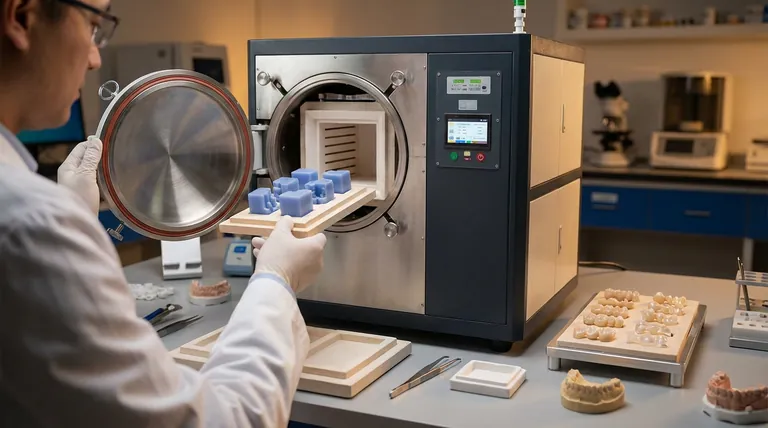
The Physics of Phase Transformation
Converting the "Blue Block"
Lithium disilicate is typically milled in a partially crystallized state known as lithium metasilicate or "blue ceramic."
In this state, the material is softer, allowing milling machines to shape it easily without chipping. However, it lacks the final properties required for a dental restoration.
Doubling Mechanical Strength
The vacuum furnace executes a secondary crystallization program, typically heating the material to 840–850 °C for 20–25 minutes.
During this cycle, the metasilicate phase transforms into the final lithium disilicate crystal structure. This transformation is not merely cosmetic; it increases the flexural strength of the material from approximately 130 MPa to over 260 MPa.
The Critical Role of Vacuum
Eliminating Micro-Porosity
The "vacuum" component of the furnace is just as vital as the heat. During the sintering or crystallization process, air can become trapped within the glass matrix.
By creating a vacuum environment, the furnace actively draws air out of the material. This results in a dense, flawless barrier free of internal air bubbles, which would otherwise act as stress concentrators and weaken the restoration.
Optimizing the Glaze Layer
For aesthetic finishes, a vacuum environment is essential when firing glaze powder and liquid at temperatures around 770 °C.
The vacuum ensures the glaze forms a uniform glassy layer that excludes air bubbles. This dense layer inhibits moisture penetration and prevents the decomposition of the silica network, significantly improving the color stability and longevity of the restoration.
Advanced Processing: Pressing Technology
Reducing Internal Porosity
High-temperature vacuum pressing furnaces take the concept further by applying pressure to preheated ingots.
Using hot-pressing technology, the ceramic is pushed into an investment mold within the vacuum. This method effectively reduces internal porosity even further than standard sintering.
Enhancing Marginal Adaptation
The combination of vacuum and pressure results in superior marginal adaptation.
Restorations processed this way often exhibit higher fracture toughness compared to traditional slip-casting or standard sintering methods because the material density is maximized.
Understanding the Trade-offs
While the vacuum furnace is essential, improper calibration can lead to significant defects.
The Risk of Grain Coarsening
Precise temperature control is non-negotiable. If the temperature fluctuates or holding times are incorrect, the crystals may not precipitate in a regulated manner.
Overheating can lead to grain coarsening, where crystals grow too large. This destroys the fine-grained microstructure, reducing mechanical strength and compromising the material's translucent optical properties.
Thermal Cycling Constraints
Horizontal electric furnaces are often used for firing and annealing to prevent contamination.
These units must provide gradual heating and cooling cycles. Rapid temperature changes (thermal shock) can induce cracks or warping in the final component, regardless of the vacuum quality.
Making the Right Choice for Your Goal
To maximize the quality of lithium disilicate restorations, you must match the furnace capabilities to your specific processing method.
- If your primary focus is structural durability: Ensure your furnace can hold a strict 840–850 °C plateau to guarantee the full conversion to lithium disilicate and achieve 260+ MPa strength.
- If your primary focus is aesthetics and longevity: Prioritize a high-quality vacuum system during the glazing cycle (770 °C) to prevent bubbles and ensure a dense, moisture-resistant surface.
- If your primary focus is fit and margin quality: Utilize a vacuum pressing furnace to leverage hot-pressing technology for minimized internal porosity and superior mold adaptation.
Ultimately, the vacuum heat treatment furnace is not just a heater; it is a precision instrument that dictates the final physical and optical reality of the ceramic material.
Summary Table:
| Feature | Function in Lithium Disilicate Processing | Outcome |
|---|---|---|
| Secondary Crystallization | Converts metasilicate to disilicate at 840–850 °C | Flexural strength increases from 130 to 260+ MPa |
| Vacuum Environment | Removes air from the glass matrix during sintering | Eliminates micro-porosity and internal air bubbles |
| Glazing Cycle | Fires glaze liquid/powder under vacuum at 770 °C | Creates a moisture-resistant, color-stable surface |
| Hot-Pressing | Applies pressure into investment molds | Superior marginal adaptation and maximized density |
Maximize Your Lab’s Precision with KINTEK
Ensure perfect phase transformation and flaw-free aesthetics for every restoration. Backed by expert R&D and manufacturing, KINTEK offers a wide range of specialized high-temperature systems, including Muffle, Tube, Rotary, Vacuum, and CVD systems. Our equipment is fully customizable to meet the rigorous thermal demands of modern dental ceramics and materials science.
Ready to elevate your material properties? Contact us today to discuss your unique needs!
References
- Nestor Washington Solís Pinargote, Pavel Peretyagin. Materials and Methods for All-Ceramic Dental Restorations Using Computer-Aided Design (CAD) and Computer-Aided Manufacturing (CAM) Technologies—A Brief Review. DOI: 10.3390/dj12030047
This article is also based on technical information from Kintek Furnace Knowledge Base .
Related Products
- Vacuum Heat Treat Furnace with Ceramic Fiber Liner
- 2200 ℃ Graphite Vacuum Heat Treat Furnace
- Molybdenum Vacuum Heat Treat Furnace
- 2200 ℃ Tungsten Vacuum Heat Treat and Sintering Furnace
- Vacuum Heat Treat Sintering Furnace with Pressure for Vacuum Sintering
People Also Ask
- How does vacuum heat treating affect the grain structure of metal alloys? Achieve Precise Microstructure Control
- What are the benefits of using vacuum heat treating furnaces for metal alloys? Achieve Superior Metal Properties and Performance
- What is one of the most important uses of vacuum heat treating furnaces in aerospace? Achieve Superior Strength in Aircraft Alloys
- How does a vacuum heat treat furnace work? Achieve Pristine, High-Performance Results
- What is the difference between heat treat and vacuum heat treat? Achieve Superior Metal Properties with Pristine Finishes



















