
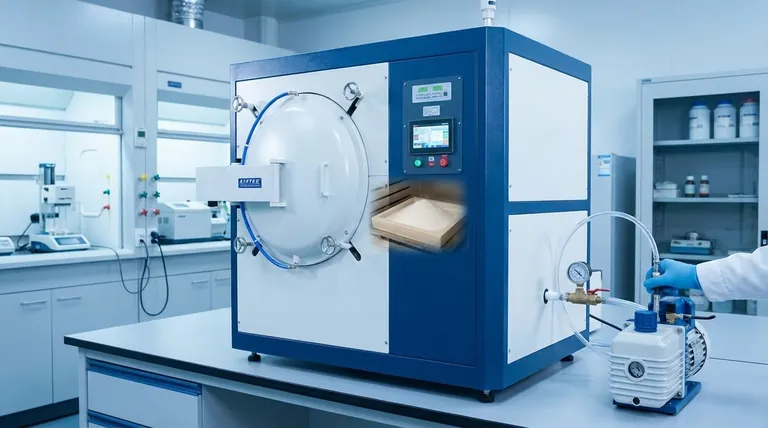
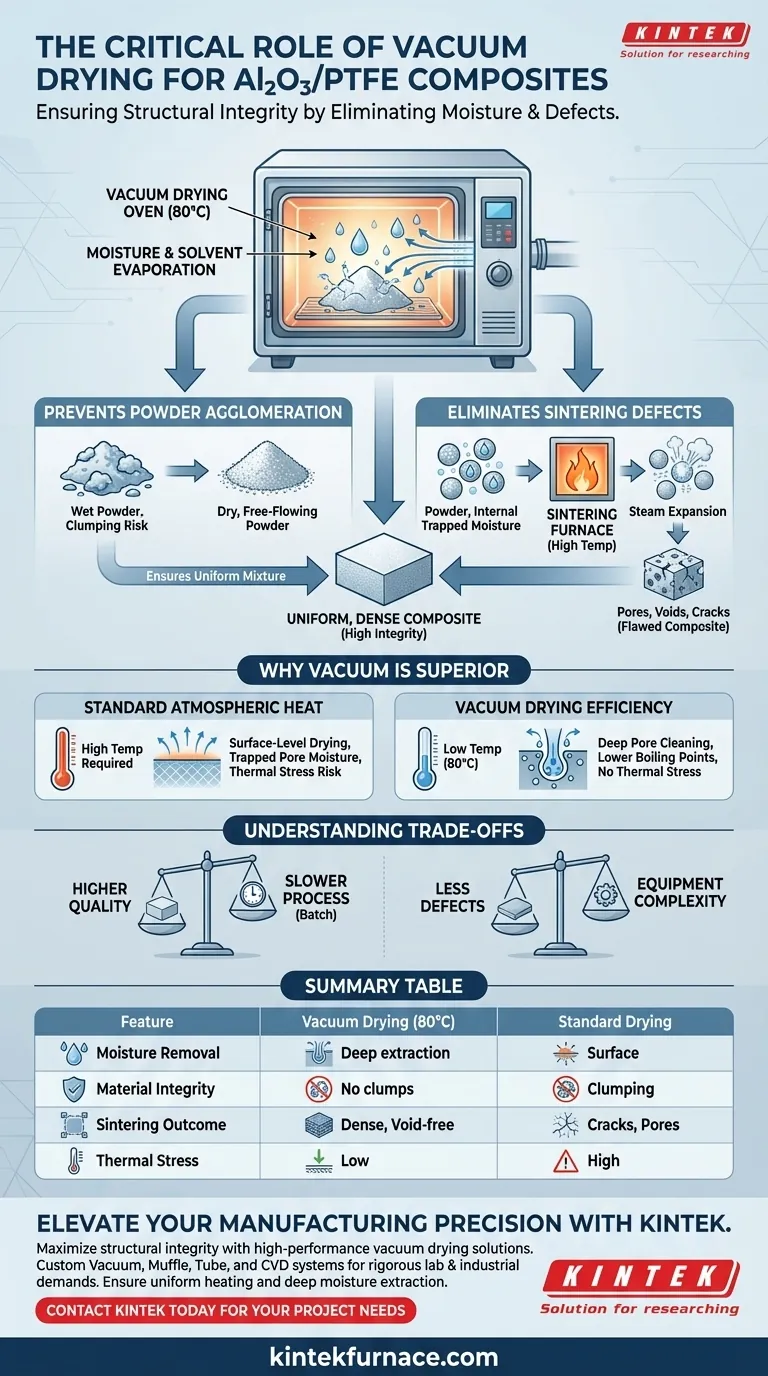
Vacuum drying is the critical process step utilized to ensure the structural integrity and density of Al2O3/PTFE composites. It is specifically employed to thoroughly remove residual moisture and solvents from cleaned alumina particles at controlled, moderate temperatures—typically around 80°C.
By lowering the boiling point of liquids, vacuum drying prevents the "clumping" of particles caused by moisture while eliminating the risk of steam-induced defects during high-temperature sintering.
The Mechanics of Defect Prevention
Preventing Powder Agglomeration
Moisture acts as a binding agent between fine powder particles. If alumina (Al2O3) particles are not perfectly dry, they tend to stick together.
Vacuum drying effectively removes this moisture at the microscopic level.
This ensures the powder remains free-flowing and does not form hard agglomerates. Preventing these clumps is vital for achieving a uniform mixture with the PTFE matrix later in the process.
Eliminating Sintering Defects
The most dangerous threat to a composite material is trapped moisture during the high-temperature sintering phase.
If water remains within the powder, it will rapidly vaporize and expand when heated during sintering.
This expansion creates pores, voids, or cracks inside the material. By using a vacuum oven beforehand, you guarantee the removal of volatiles, ensuring the final composite is dense and free of structural voids.
Why Vacuum is Superior to Standard Heat
Low-Temperature Efficiency
The primary reference notes that this process occurs at 80°C.
Under standard atmospheric pressure, effectively removing all solvents might require higher temperatures that could alter surface chemistry.
The vacuum environment lowers the boiling point of water and solvents, allowing for complete evaporation at this gentler temperature without thermally stressing the material.
Deep Pore Cleaning
Simple air drying often leaves moisture trapped in the tiny, capillary-like pores of ceramic powders.
A vacuum creates a pressure differential that physically pulls gas and moisture out of these deep pores.
This is far more effective than forced-air methods, ensuring that the "internal" moisture—not just surface moisture—is evacuated.
Understanding the Trade-offs
Process Time vs. Throughput
While vacuum drying ensures higher quality, it is generally a batch process that may be slower than continuous forced-air drying methods used for less sensitive materials (such as the biomass precursors mentioned in general drying contexts).
It requires a sealed environment, limiting the volume of material that can be processed at once.
Equipment Complexity
Vacuum drying requires maintaining a specific pressure and temperature balance.
If the vacuum seal fails or the pump degrades, moisture removal becomes inconsistent. This adds a layer of maintenance and monitoring that simple convection ovens do not require.
Making the Right Choice for Your Goal
To optimize your Al2O3/PTFE composite manufacturing, align your drying strategy with your performance targets:
- If your primary focus is Mechanical Strength: Prioritize vacuum drying to eliminate micropores, as even small voids can become stress concentration points that lead to fracture.
- If your primary focus is Homogeneity: Ensure the vacuum cycle is long enough to prevent agglomeration, guaranteeing that the Al2O3 disperses evenly within the PTFE without clumping.
Reliable high-performance composites begin with the absolute elimination of moisture before the sintering furnace is ever turned on.
Summary Table:
| Feature | Vacuum Drying (at 80°C) | Standard Atmospheric Drying |
|---|---|---|
| Moisture Removal | Deep pore extraction via pressure differential | Primarily surface-level evaporation |
| Material Integrity | Prevents clumping and ensures free-flowing powder | High risk of particle agglomeration |
| Sintering Outcome | Dense, void-free composite structure | Potential for cracks, pores, and steam defects |
| Thermal Stress | Low (boiling point reduction) | High (requires more heat for same results) |
Elevate Your Composite Manufacturing Precision
Maximize the structural integrity of your Al2O3/PTFE materials with KINTEK’s high-performance vacuum drying solutions. Backed by expert R&D and world-class manufacturing, we provide customizable Vacuum, Muffle, Tube, and CVD systems designed to meet the rigorous demands of lab and industrial high-temperature processes.
Don't let trapped moisture compromise your sintering results. Our specialized equipment ensures uniform heating and deep moisture extraction to eliminate voids and cracks in your final products. Contact KINTEK today to discuss your unique project needs and discover how our advanced furnace technology can optimize your production workflow.
Visual Guide
References
- Guofeng Zhao, Shifan Zhu. Al2O3/PTFE Composites for Marine Self-Lubricating Bearings: Modulation Mechanism of Alumina Particle Size on Material Mechanical Properties and Tribological Behavior. DOI: 10.3390/lubricants13090377
This article is also based on technical information from Kintek Furnace Knowledge Base .
Related Products
- Vacuum Heat Treat Sintering and Brazing Furnace
- Vacuum Heat Treat Sintering Furnace Molybdenum Wire Vacuum Sintering Furnace
- Dental Porcelain Zirconia Sintering Ceramic Vacuum Press Furnace
- Vacuum Hot Press Furnace Machine for Lamination and Heating
- Vacuum Hot Press Furnace Machine Heated Vacuum Press
People Also Ask
- What are the benefits of using vacuum heat treating furnaces for metal alloys? Achieve Superior Metal Properties and Performance
- How does vacuum heat treating affect the grain structure of metal alloys? Achieve Precise Microstructure Control
- What is one of the most important uses of vacuum heat treating furnaces in aerospace? Achieve Superior Strength in Aircraft Alloys
- What is the temperature of a vacuum furnace brazing? Optimize Your Joint Strength and Cleanliness
- What are the steps involved in a typical vacuum brazing treatment? Master the Process for Strong, Clean Joints







