
The use of a tube resistance furnace with an argon atmosphere is essential to prevent the degradation of the nickel foam substrate while ensuring the structural stabilization of the titanium dioxide. This setup combines an inert environment to stop oxidation with precise thermal control to manage material crystallization.
Core Takeaway
The success of TiO2/Nickel foam composites hinges on preserving the metallic nature of the substrate. An argon atmosphere prevents the nickel foam from becoming an insulator via oxidation, while the tube furnace provides the exacting thermal regulation required to crystallize the TiO2 without compromising the structural integrity of the composite.
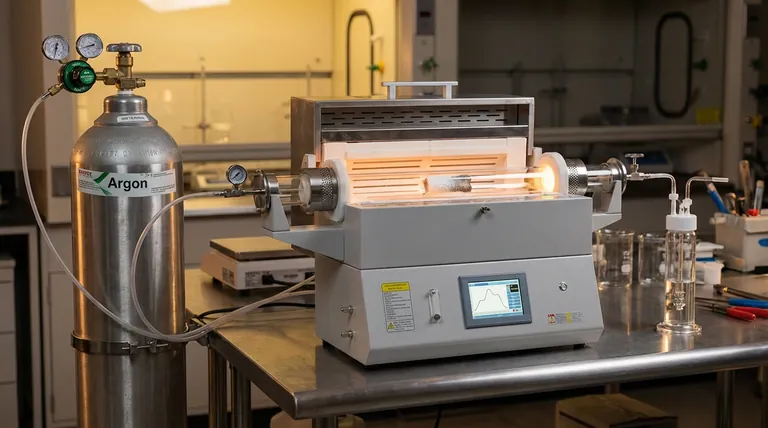
The Critical Role of the Argon Atmosphere
Preventing Substrate Failure
The primary reason for introducing high-purity argon is to create an inert protective atmosphere.
Nickel foam acts as the conductive skeleton for the composite. However, nickel is susceptible to excessive oxidation when exposed to oxygen at temperatures exceeding 300°C.
Preserving Conductivity
If the nickel foam oxidizes, it transforms from a highly conductive metal into a semi-conductive or insulating oxide.
By displacing oxygen with argon, you maintain the metallic conductivity of the base material. This ensures the final composite retains the electrochemical activity necessary for its intended application.
Why a Tube Resistance Furnace is Required
Precise Temperature Control
Material stabilization requires a thermal environment that is both uniform and strictly regulated.
A tube resistance furnace provides a precisely controlled temperature environment, allowing for specific heating rates and dwell times. This precision is vital for transforming the TiO2 precursor into its active crystalline phase without overheating the delicate nickel structure.
Controlling Microstructure
Beyond simple heating, the furnace allows for the regulation of the material's microstructure.
Strict control over heating rates (e.g., in similar oxide processes, slow rates like 2°C/min are often used) prevents the excessive growth of titanium dioxide grains. This ensures the active material maintains a high surface area, which is critical for performance.
Common Pitfalls and Trade-offs
The Risk of Impurities
Even a tube furnace is ineffective if the gas quality is compromised.
Industrial standards often require argon purity exceeding 99.999% to create a completely inert atmosphere. Lower purity levels introduce trace oxygen, which can lead to partial surface oxidation or "ablation" of carbon-based components if present.
Thermal Stress vs. Crystallinity
There is a delicate balance between reaching the temperatures needed for TiO2 crystallization and preserving the nickel foam.
High temperatures favor better crystallinity and stability for the TiO2. However, excessive heat or rapid temperature changes can compromise the structural integrity of the foam, leading to brittleness or mechanical failure.
Making the Right Choice for Your Project
To maximize the performance of your TiO2 and Nickel foam composites, consider your specific processing goals:
- If your primary focus is electrochemical conductivity: Prioritize gas purity and flow rate. Ensure your system is completely purged of oxygen before heating passes the 300°C threshold to protect the nickel core.
- If your primary focus is catalytic performance: Prioritize programmable heating profiles. Use the furnace's precision to set slow heating rates that limit grain growth and maximize the active surface area of the TiO2.
The synthesis is only as effective as the environment you create; protect the substrate to empower the catalyst.
Summary Table:
| Feature | Purpose in TiO2/Nickel Foam Treatment | Impact on Final Composite |
|---|---|---|
| Argon Atmosphere | Displaces oxygen to prevent nickel oxidation | Maintains high metallic conductivity |
| Inert Environment | Stops the formation of insulating oxide layers | Preserves electrochemical activity |
| Precise Temp Control | Manages TiO2 crystallization phases | Ensures structural stability of the foam |
| Heating Rate Control | Limits titanium dioxide grain growth | Maximizes active surface area |
| High Gas Purity | Eliminates trace impurities (99.999% Ar) | Prevents surface ablation and contamination |
Elevate Your Advanced Material Synthesis with KINTEK
Don't compromise the conductivity of your nickel foam composites. Backed by expert R&D and manufacturing, KINTEK offers high-precision Tube, Muffle, Rotary, Vacuum, and CVD systems designed to meet the most stringent laboratory requirements. Our customizable high-temperature furnaces ensure the ultra-pure inert environments and exact thermal profiles necessary for successful TiO2/Nickel foam integration.
Ready to optimize your heat treatment process? Contact our technical specialists today to find the perfect furnace solution for your unique research needs.
References
- Beata Tryba, Waldemar Pichór. Application of TiO2 Supported on Nickel Foam for Limitation of NOx in the Air via Photocatalytic Processes. DOI: 10.3390/molecules29081766
This article is also based on technical information from Kintek Furnace Knowledge Base .
Related Products
- 1200℃ Controlled Inert Nitrogen Atmosphere Furnace
- Mesh Belt Controlled Atmosphere Furnace Inert Nitrogen Atmosphere Furnace
- 1400℃ Controlled Inert Nitrogen Atmosphere Furnace
- 1700℃ Controlled Inert Nitrogen Atmosphere Furnace
- 1700℃ High Temperature Laboratory Tube Furnace with Alumina Tube
People Also Ask
- What controlled-atmosphere furnace conditions are required for sintering powder metallurgy copper alloy compacts? Ideal Setup
- What types of gases are used in controlled atmosphere furnaces? Optimize Material Protection and Transformation
- What factors should be considered when choosing a controlled atmosphere furnace? Ensure Optimal Performance for Your Materials
- What are the operational advantages of using a controlled atmosphere furnace? Boost Quality and Efficiency in Heat Treatment
- Why is a controlled atmosphere furnace required for 316L debinding? Ensure Structural Integrity & Zero Cracks



















