
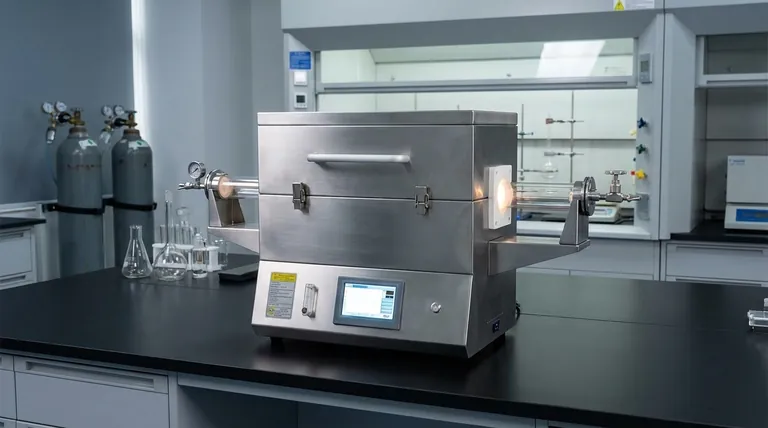
High-precision laboratory tube furnaces are the critical engine behind the creation of high-performance oxygen reduction electrocatalysts. They provide the exacting thermal environment required for chemical activators, such as potassium hydroxide or phosphoric acid, to effectively etch carbon matrices. This controlled etching process generates a complex network of pores, vastly increasing the material's surface area and exposing the electrochemical active sites necessary for the reaction.
By enabling accurate, programmed temperature rises, these furnaces allow chemical agents to restructure biomass-derived carbon. This transformation maximizes porosity and specific surface area, which are the primary drivers of catalytic efficiency in oxygen reduction.
The Mechanics of Chemical Activation
Precise Temperature Programming
Chemical activation is not a static process; it requires dynamic thermal management. High-precision tube furnaces allow researchers to execute accurate programmed temperature rises.
This specific ramping capability ensures that the reaction between the carbon precursor and the chemical activator occurs at the optimal rate.
Etching the Carbon Matrix
The core function of the furnace in this application is to facilitate chemical etching. In the heated environment, activators like potassium hydroxide (KOH) or phosphoric acid aggressively interact with the carbon structure.
This reaction effectively "eats away" parts of the carbon matrix. It creates voids within the material without destroying its structural integrity.
Creation of Micro and Mesopores
The immediate result of this thermal etching is the formation of a high volume of micropores and mesopores.
This turns a relatively dense biomass-derived carbon into a sponge-like structure. The precision of the furnace ensures that this pore network is uniform rather than chaotic.
Optimizing Catalyst Performance
Increasing Specific Surface Area
The performance of an electrocatalyst is directly tied to its available surface area. By generating pores, the tube furnace significantly increases the specific surface area of the activated carbon.
A larger surface area means there is more physical space for electrochemical reactions to occur.
Exposing Active Sites
Surface area alone is not enough; the surface must be chemically active. The etching process exposes specific electrochemical active sites that were previously locked inside the bulk material.
High-precision thermal treatment ensures these sites are accessible to reactants, directly boosting the efficiency of oxygen reduction.
Critical Parameters and Trade-offs
Atmosphere Control Requirements
While chemical activators drive the etching, the surrounding atmosphere affects the outcome. Factors such as gas flow rate and atmosphere composition (e.g., mixtures for phase transformation) must be strictly controlled to prevent unwanted oxidation or contamination.
Managing Dwell Time and Consistency
The effectiveness of the activation depends heavily on the "dwell time"—how long the material remains at the target temperature.
Inconsistencies in the temperature profile or incorrect dwell times can lead to under-activation (low porosity) or over-etching (structural collapse), rendering the catalyst ineffective.
Making the Right Choice for Your Goal
To maximize the efficacy of your electrocatalyst synthesis, align your furnace operation with your specific objectives:
- If your primary focus is maximizing porosity: Prioritize a furnace with rigorous ramp-rate control to optimize the chemical etching interaction between the activator and the carbon matrix.
- If your primary focus is material phase transformation: Ensure your furnace setup offers precise atmosphere control (such as H2/Ar mixtures) to induce oxygen vacancies and modify surface morphology.
Mastering the thermal profile is the difference between a generic carbon material and a high-performance electrocatalyst.
Summary Table:
| Feature | Impact on Electrocatalyst Development |
|---|---|
| Precise Temp Programming | Ensures optimal reaction rates for biomass-derived carbon restructuring. |
| Chemical Etching Control | Facilitates activator interaction (KOH/H3PO4) to create uniform voids. |
| Pore Engineering | Maximizes formation of micropores and mesopores for sponge-like density. |
| Surface Area Optimization | Increases specific surface area to expose critical electrochemical active sites. |
| Atmosphere Management | Prevents unwanted oxidation and enables surface phase transformation. |
Elevate Your Catalyst Synthesis with KINTEK
Precise thermal management is the difference between generic carbon and high-performance electrocatalysts. Backed by expert R&D and world-class manufacturing, KINTEK offers a comprehensive range of Muffle, Tube, Rotary, Vacuum, and CVD systems tailored for high-precision laboratory applications. Our high-temp furnaces are fully customizable to meet your unique chemical activation and phase transformation needs, ensuring consistent dwell times and rigorous atmosphere control.
Ready to maximize your material's porosity and catalytic efficiency? Contact KINTEK today to find the perfect furnace solution for your research!
References
- Shuling Liu, Baojun Li. Catalytically Active Carbon for Oxygen Reduction Reaction in Energy Conversion: Recent Advances and Future Perspectives. DOI: 10.1002/advs.202308040
This article is also based on technical information from Kintek Furnace Knowledge Base .
Related Products
- High Pressure Laboratory Vacuum Tube Furnace
- 1400℃ High Temperature Laboratory Tube Furnace with Alumina Tube
- 1700℃ High Temperature Laboratory Tube Furnace with Alumina Tube
- Magnesium Extraction and Purification Condensing Tube Furnace
- 1200℃ Split Tube Furnace Laboratory Quartz Tube Furnace with Quartz Tube
People Also Ask
- What role does a high vacuum tube furnace play in Co-Al sintering? Master High-Purity Porous Material Synthesis
- What are the different types of tube furnaces available? Find the Perfect Fit for Your Lab's Needs
- What are the main advantages of vacuum tube furnaces in the market? Achieve Purity and Precision in Material Processing
- What is the role of a vacuum tube furnace during the final thermal treatment stage of Fe3O4@CSAC catalysts?
- What conditions does a tube furnace provide for post-ion-implantation? Achieve Precise Microstructural Repair



















