
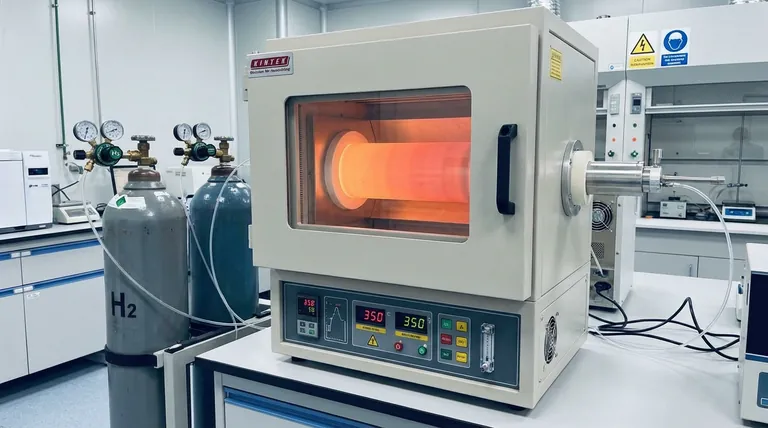
The high-temperature tube furnace functions as a precision reactor that facilitates the simultaneous chemical reduction of iron oxide (Fe2O3) and graphene oxide (GO). By maintaining a strictly controlled environment of 350°C with a continuous flow of hydrogen gas (H2), the furnace enables the removal of oxygen atoms, converting the precursors into metallic iron (Fe) nanosheets and reduced graphene oxide (RGO).
The furnace does not merely heat the material; it creates a specific "reduction atmosphere" where thermal energy and hydrogen gas work together to strip oxygen from the composite. This controlled environment is essential to fully convert the metal oxides without destroying the delicate carbon framework of the graphene.
The Mechanism of Transformation
Creating the Reducing Atmosphere
The tube furnace allows for the precise introduction of hydrogen (H2) gas into the reaction chamber.
This gas acts as the chemical reducing agent, which is chemically necessary to interact with the oxygen atoms present in the precursor materials.
Simultaneous Deoxygenation
At the specific operating temperature of 350°C, the environment triggers a dual transformation.
The graphene oxide undergoes deoxygenation, shedding its oxygen-containing functional groups to restore the conductive carbon lattice of RGO. Simultaneously, the Fe2O3 is reduced, stripping away oxygen to leave behind pure metallic iron (Fe) nanosheets.
Thermal Field Uniformity
The "tube" design of the furnace ensures a uniform thermal field around the sample.
This consistency ensures that the reduction reaction occurs evenly throughout the material, preventing localized hot spots or cold zones that could lead to heterogeneous products.
The Critical Role of Precision
Preserving the Graphene Framework
One of the most critical functions of the furnace is limiting thermal damage.
If the temperature is too high or the airflow uncontrolled, the carbon lattice of the graphene can degrade. The furnace allows researchers to lock in the 350°C parameter, ensuring reduction occurs while preventing excessive damage to the graphene structure.
Controlling Reaction Completeness
The furnace allows for the precise regulation of airflow and residence time.
This control ensures the reaction is driven to completion, leaving no unreduced iron oxide or graphene oxide behind, which is vital for the final material's magnetic and electrical properties.
Common Operational Trade-offs
The Temperature Balancing Act
While higher temperatures might accelerate the reduction of iron, they pose a significant risk to the organic component.
Exceeding the 350°C threshold significantly increases the likelihood of thermally degrading the graphene, reducing the quality of the final composite.
Atmosphere Sensitivity
The effectiveness of the tube furnace relies entirely on the purity of the reduction atmosphere.
Even minor leaks or insufficient hydrogen flow can introduce ambient oxygen, which will immediately re-oxidize the iron or burn the graphene, rendering the process a failure.
Optimizing the Synthesis Process
To ensure the successful conversion of Fe2O3/GO to Fe/RGO, consider the following based on your specific objectives:
- If your primary focus is Structural Integrity: Strictly maintain the temperature at 350°C to maximize the reduction of graphene oxide while minimizing defects in the carbon framework.
- If your primary focus is Chemical Purity: Prioritize the calibration of the hydrogen airflow to ensure a consistent, oxygen-free environment throughout the entire heating duration.
The ultimate value of the tube furnace lies in its ability to decouple thermal energy from atmospheric composition, allowing for a reaction that is chemically aggressive against oxygen but gentle on the carbon structure.
Summary Table:
| Feature | Function in Fe2O3/GO Conversion | Impact on Final Composite |
|---|---|---|
| Reducing Atmosphere | Facilitates H2 flow to strip oxygen atoms | Converts oxides to pure Fe and RGO |
| Precise Temp (350°C) | Balances reaction speed and material safety | Prevents degradation of graphene framework |
| Thermal Uniformity | Ensures consistent heat distribution | Eliminates heterogeneous product zones |
| Atmosphere Control | Prevents ambient oxygen ingress | Ensures chemical purity and high conductivity |
Elevate Your Material Synthesis with KINTEK
Precise control over reduction atmospheres is critical for the delicate conversion of Fe2O3/GO to high-performance composites. KINTEK provides industry-leading high-temperature solutions including Tube, Muffle, Rotary, Vacuum, and CVD systems, all designed to deliver the thermal uniformity and atmospheric purity your research demands.
Why partner with KINTEK?
- Expert R&D: Our systems are engineered for precise chemical vapor deposition and reduction processes.
- Fully Customizable: Tailor furnace dimensions and gas flow controls to your specific Fe/RGO synthesis needs.
- Reliable Performance: Achieve repeatable results with advanced temperature stability.
Ready to optimize your lab's high-temperature processes? Contact us today to find your custom furnace solution!
References
- Kaili Zhang, Xiaoxiao Huang. Tracking Regulatory Mechanism of Trace Fe on Graphene Electromagnetic Wave Absorption. DOI: 10.1007/s40820-023-01280-6
This article is also based on technical information from Kintek Furnace Knowledge Base .
Related Products
- 1700℃ High Temperature Laboratory Tube Furnace with Alumina Tube
- 1400℃ High Temperature Laboratory Tube Furnace with Alumina Tube
- 2200 ℃ Graphite Vacuum Heat Treat Furnace
- 1200℃ Split Tube Furnace Laboratory Quartz Tube Furnace with Quartz Tube
- Vertical Laboratory Quartz Tube Furnace Tubular Furnace
People Also Ask
- How does zone-melting in tube furnaces synthesize bismuth micro-wires? Master Single-Crystal Thermoelectric Growth
- How are high-temperature laboratory tube furnaces applied in long-term vacuum homogenization heat treatments for intermetallic samples?
- How are high-temp tube furnaces used to measure diffusion coefficients per Fick's law? Master Precision Annealing
- How do high-temperature laboratory tube furnaces ensure environmental stability? Precision Thermal Reduction Tips
- How are high-temperature tube furnaces applied in testing ceramic-supported alloy membranes? Insights



















