
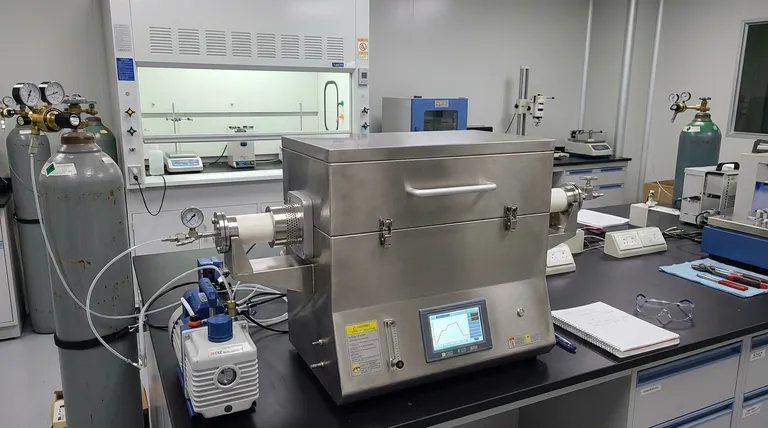
The tube atmosphere furnace functions as a precise, confined reactor that synchronizes the breakdown of fiber material with the growth of new nanostructures. By heating polyacrylonitrile (PAN) fibers to approximately 900 °C, the furnace creates an environment where the gases released during the fiber's own decomposition are captured and repurposed to grow carbon nanotubes (CNTs) directly on the fiber surface.
Core Takeaway Rather than simply venting waste gases, the tube furnace utilizes a "local Chemical Vapor Deposition (CVD)" process where carbon-rich byproducts (like methane and carbon monoxide) react with embedded catalysts. This transforms the carbonization step from a subtractive process into an additive synthesis of hierarchical structures.
The Mechanism of In-Situ CVD
Thermal Triggering of Pyrolysis
The fundamental role of the furnace is to provide a program-controlled heating curve up to 900 °C. This thermal energy triggers pyrolysis, the chemical decomposition of the PAN fibers. This process breaks down the polymer chains, converting the organic fiber into a carbon-rich structure.
Utilization of Released Gases
As the PAN fibers decompose, they release carbon-containing gases, specifically methane and carbon monoxide. In a standard open system, these would escape. However, the confined geometry of the furnace tube retains these gases, effectively turning the fiber's own byproducts into a feedstock for CVD.
Catalytic Activation
The process relies on iron-cobalt (Fe-Co) nanoparticles that are embedded on the surface of the PAN fibers. The furnace heats these nanoparticles to their activation temperature. Once active, these metal particles act as nucleation sites for the hot carbon gases.
Localized Nanostructure Growth
Because the catalyst is embedded on the fiber, the reaction is strictly localized. The "in-situ" reaction occurs where the gas meets the hot metal nanoparticle. This causes the carbon atoms to rearrange and grow outward as carbon nanotubes (CNTs), creating a hierarchical structure without requiring an external CVD chamber.
Critical Environmental Controls
Creating an Inert Baseline
While the CVD process uses reactive carbon gases, the background environment must remain inert. The tube furnace maintains a controlled atmosphere (often Nitrogen) to prevent the combustion of the fibers. This ensures that the carbon atoms participate in nanotube growth rather than reacting with oxygen to form ash.
Surface Preparation via Desizing
Before the CVD process can occur effectively, the fiber surface must be pristine. The tube furnace is often used in a preliminary stage at around 550 °C to "desize" the fibers. This removes chemical residues and sizing agents, ensuring the catalyst nanoparticles act directly on the fiber substrate without interference.
Understanding the Trade-offs
Balancing Gas Flow and Retention
A common pitfall is mismanaging the gas flow rate within the tube. If the flow of carrier gas (like Nitrogen) is too high, it flushes away the valuable pyrolysis gases (methane/CO) before they can react with the catalyst. If the flow is too low, stagnant byproducts may inhibit the reaction or cause uneven deposition.
Temperature Uniformity vs. Gradient
While the primary reaction requires 900 °C, variations in the thermal field can lead to inconsistent CNT growth. The furnace must provide exceptional thermal uniformity to ensuring the catalyst nanoparticles across the entire fiber batch activate simultaneously. Inconsistent heating leads to structural defects and weak points in the final composite.
Making the Right Choice for Your Goal
To maximize the effectiveness of a tube atmosphere furnace for PAN carbonization:
- If your primary focus is Hierarchical Structure Synthesis: Prioritize a furnace with precise programmable heating to dwell exactly at 900 °C, optimizing the interaction between released gases and Fe-Co catalysts.
- If your primary focus is Fiber Mechanical Integrity: Ensure the furnace offers exceptional thermal uniformity and strict atmosphere control to prevent oxidative damage during the sensitive pyrolysis phase.
- If your primary focus is Surface Purity: Utilize a multi-stage heating profile that includes a distinct desizing dwell at 550 °C to remove contaminants before higher-temperature carbonization begins.
The success of local CVD lies not just in high heat, but in the furnace's ability to turn the fiber's decomposition byproducts into a constructive resource.
Summary Table:
| Feature | Parameter/Role | Impact on Process |
|---|---|---|
| Core Temperature | 900 °C | Triggers pyrolysis and activates Fe-Co catalysts |
| Atmosphere Control | Inert (Nitrogen) | Prevents fiber combustion and oxygen reaction |
| Mechanism | Localized CVD | Converts waste methane/CO into carbon nanotubes |
| Pre-treatment | 550 °C Desizing | Removes residues for pristine catalyst-surface contact |
| Gas Management | Controlled Flow | Balances gas retention for reaction vs. byproduct removal |
Elevate Your Advanced Fiber Research with KINTEK
Unlock the full potential of in-situ CVD and hierarchical structure synthesis with KINTEK’s high-precision thermal solutions. Backed by expert R&D and world-class manufacturing, KINTEK offers a comprehensive range of Muffle, Tube, Rotary, Vacuum, and CVD systems—all fully customizable to meet the rigorous demands of carbonization and nanostructure growth.
Whether you are focusing on fiber mechanical integrity or complex catalytic activation, our furnaces provide the exceptional thermal uniformity and atmosphere stability your lab requires. Contact us today to discuss your unique needs and discover how our expert-engineered laboratory furnaces can transform your material synthesis outcomes.
References
- Sura Nguyen, Sergio O. Martínez‐Chapa. Synthesis and characterization of hierarchical suspended carbon fiber structures decorated with carbon nanotubes. DOI: 10.1007/s10853-024-09359-0
This article is also based on technical information from Kintek Furnace Knowledge Base .
Related Products
- Custom Made Versatile CVD Tube Furnace Chemical Vapor Deposition CVD Equipment Machine
- Split Chamber CVD Tube Furnace with Vacuum Station CVD Machine
- Multi Heating Zones CVD Tube Furnace Machine for Chemical Vapor Deposition Equipment
- Slide PECVD Tube Furnace with Liquid Gasifier PECVD Machine
- 1200℃ Controlled Inert Nitrogen Atmosphere Furnace
People Also Ask
- What is a CVD tube furnace and what is its primary function? Discover Precision Thin-Film Deposition
- Why are CVD tube furnace sintering systems indispensable for 2D material research and production? Unlock Atomic-Scale Precision
- How does CVD tube furnace sintering enhance graphene growth? Achieve Superior Crystallinity and High Electron Mobility
- Which industries and research fields benefit from CVD tube furnace sintering systems for 2D materials? Unlock Next-Gen Tech Innovations
- What temperature range do standard CVD tube furnaces operate at? Unlock Precision for Your Material Deposition



















