
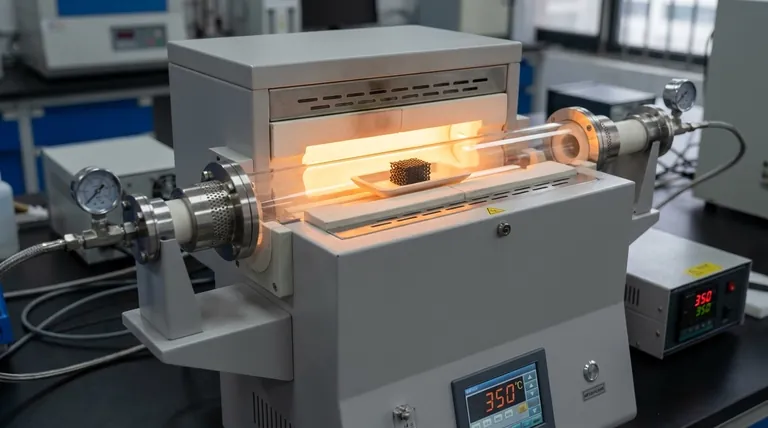
A high-temperature tube furnace is the critical tool required to transform 3D-printed graphene from a raw composite into a functional, conductive material. It performs a specific annealing process, typically around 350 °C, which drives the carbonization of binding agents and physically densifies the structure under a protective atmosphere.
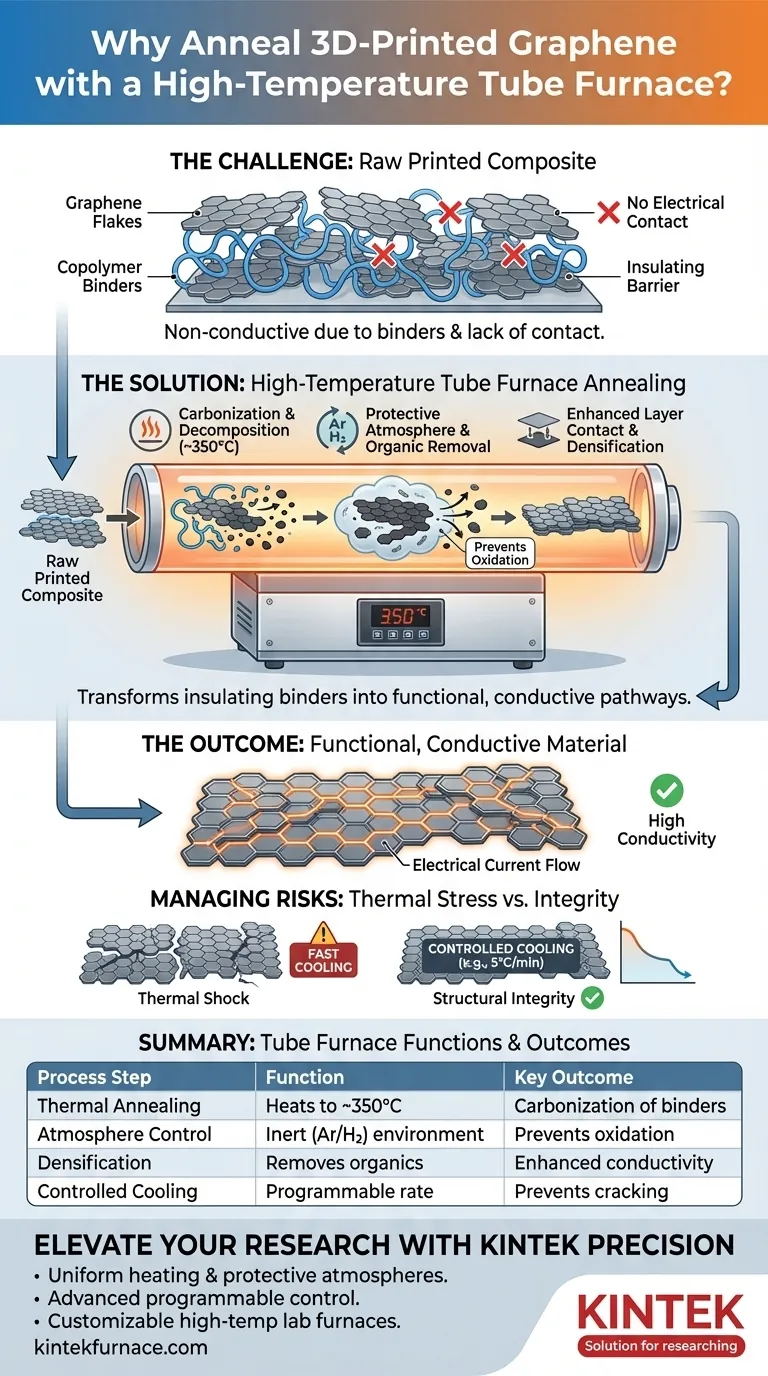
The Core Insight 3D printing inks rely on non-conductive binders to maintain shape during printing. The tube furnace removes these insulating barriers through thermal decomposition, allowing graphene layers to touch and establishing the continuous pathways necessary for high macroscopic electrical conductivity.
The Challenge of Printed Graphene
The Role of Binders
To make graphene printable, it is mixed with copolymer binders to create a viscous ink. While necessary for the printing process, these binders remain in the final structure as insulating "impurities."
The Conductivity Gap
Immediately after printing, the graphene flakes are separated by these organic components. Without post-processing, the structure lacks the necessary contact points between layers to conduct electricity effectively or maintain long-term structural stability.
How the Tube Furnace Solves the Problem
Facilitating Carbonization
The primary function of the furnace is to heat the structure to specific temperatures (e.g., 350 °C). At this heat, the copolymer binders undergo carbonization or partial thermal decomposition.
Removing Excess Organics
As the binders decompose, the furnace environment allows for the removal of excess organic components. This effectively "cleans" the internal structure of the printed object, leaving behind the functional nanomaterials.
Enhancing Layer Contact
Once the insulating binders are removed, the graphene layers are free to settle closer together. This proximity enhances the inter-layer contact, which is the physical requirement for electrons to move through the material.
Protective Atmosphere Control
Crucially, this process cannot happen in a standard open-air oven. The tube furnace provides a sealed environment where a protective atmosphere (such as Argon or Hydrogen mixtures) prevents the graphene itself from oxidizing or burning away during the heating cycle.
Understanding the Trade-offs and Risks
Thermal Stress Management
While heat creates conductivity, it also introduces physical stress. Materials expand and contract at different rates. If the printed structure is on a substrate (like silver or copper), the difference in thermal expansion can lead to cracking or peeling.
The Importance of Programmable Cooling
A high-quality tube furnace mitigates this risk through programmable temperature control. By implementing slow-cooling strategies (e.g., 5°C per minute), the furnace prevents thermal shock, ensuring the graphene layer remains intact and adhered to its substrate.
Making the Right Choice for Your Goal
To maximize the effectiveness of your annealing process, align your furnace settings with your specific objectives:
- If your primary focus is Electrical Conductivity: Prioritize the removal of binders by maintaining the target temperature (e.g., 350 °C) long enough to ensure complete carbonization of organic components.
- If your primary focus is Structural Integrity: Utilize the furnace's programmable features to enforce a slow, controlled cooling rate, preventing thermal stress fractures between the graphene and the substrate.
Ultimately, the tube furnace is not just a heater; it is a precision instrument that dictates the final quality and performance of your printed electronic devices.
Summary Table:
| Process Step | Function of Tube Furnace | Key Outcome |
|---|---|---|
| Thermal Annealing | Heats structures to ~350 °C in a controlled environment | Carbonization of insulating binders |
| Atmosphere Control | Provides inert (Ar/H2) protective atmosphere | Prevents graphene oxidation and burning |
| Densification | Removes organic impurities/excess binders | Enhances inter-layer contact and conductivity |
| Controlled Cooling | Programmable slow-cooling (e.g., 5°C/min) | Prevents thermal shock and structural cracking |
Elevate Your Graphene Research with KINTEK Precision
Transitioning from a 3D-printed prototype to a high-performance functional material requires the rigorous thermal control only a professional system can provide. KINTEK delivers industry-leading Tube, Vacuum, and CVD systems designed to handle the delicate carbonization and annealing needs of graphene and nanomaterials.
Why choose KINTEK?
- Expert R&D & Manufacturing: Our furnaces provide the uniform heating and protective atmospheres essential for preventing oxidation.
- Advanced Control: Precise programmable cooling prevents thermal stress and ensures structural integrity.
- Customizable Solutions: We tailor our lab high-temp furnaces to your specific research parameters.
Ready to achieve superior electrical conductivity in your printed devices? Contact KINTEK today to find your custom furnace solution!
Visual Guide
References
- Xu Liu, Theoni K. Georgiou. Graphene inks for printing based on thermoresponsive ABC triblock terpolymer gels. DOI: 10.1039/d5lp00071h
This article is also based on technical information from Kintek Furnace Knowledge Base .
Related Products
- 2200 ℃ Graphite Vacuum Heat Treat Furnace
- 1400℃ High Temperature Laboratory Tube Furnace with Alumina Tube
- 1700℃ High Temperature Laboratory Tube Furnace with Alumina Tube
- 1200℃ Split Tube Furnace Laboratory Quartz Tube Furnace with Quartz Tube
- High Temperature Muffle Oven Furnace for Laboratory Debinding and Pre Sintering
People Also Ask
- Why are vacuum heat treating furnaces essential for aerospace? Ensure Superior Material Integrity for High-Stakes Applications
- What is the primary application of vacuum heat treating furnaces in aerospace? Enhance Component Performance with Precision
- How does a vacuum heat treating furnace improve the condition of metal alloys? Achieve Superior Metal Performance
- How does vacuum heat treating work in terms of temperature and time control? Master Precise Material Transformations
- What is the process of vacuum heat treating? Achieve Superior Metallurgical Properties



















