
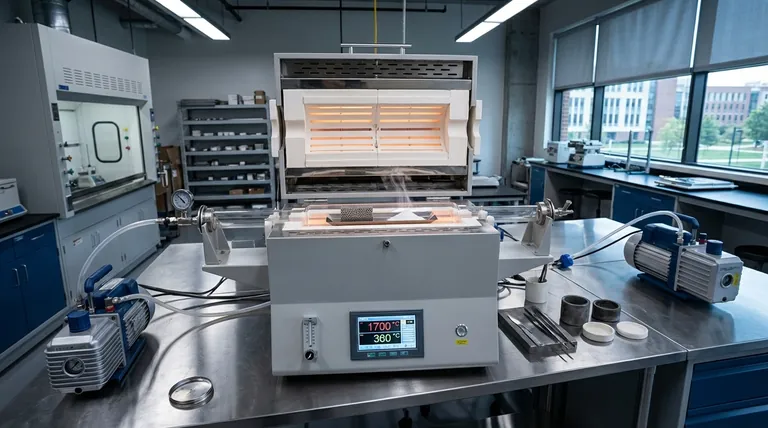
The vacuum tube sintering furnace performs two specific technical functions in porous alloy production: facilitation of pore creation and high-temperature structural bonding.
First, it creates a vacuum environment at lower temperatures to drive the sublimation and volatilization of pore-forming agents (like NaCl), leaving behind controlled voids. Second, it sustains a high-temperature thermal field to enable solid-phase diffusion, which fuses the remaining alloy particles into a robust structure.
By decoupling the removal of temporary fillers from the fusing of permanent metal particles, this equipment allows for the precise engineering of porosity without compromising the material's structural integrity or purity.
Function 1: Facilitating Controlled Pore Formation
The first critical phase of the process is not about heating the metal, but about removing the "spacer" material to create the porous architecture.
Vacuum-Assisted Sublimation
The furnace establishes a vacuum environment before peak temperatures are reached. This low-pressure atmosphere lowers the boiling point of the pore-forming agent (commonly sodium chloride, NaCl).
Volatilization of Agents
Under these conditions, the pore-forming agent undergoes sublimation or volatilization. It transitions directly from a solid or liquid state into a gas.
Creation of the Matrix
As the agent evaporates and is evacuated by the vacuum system, it leaves behind empty spaces. These spaces become the defined pores within the alloy matrix.
Function 2: High-Temperature Structural Consolidation
Once the pores are formed, the furnace's second function is to transform the remaining loose metal powder into a solid, cohesive unit.
Establishing the Thermal Field
The furnace ramps up to a stable, high-temperature thermal field, typically around 1373 K (1100°C) or 1200°C depending on the alloy (e.g., 316L stainless steel).
Solid-Phase Diffusion
At these temperatures, the metal particles do not fully melt. Instead, the heat promotes solid-phase diffusion. Atoms migrate across the boundaries where particles touch.
Sintering Neck Formation
This atomic movement creates "sintering necks"—bridges of solid metal connecting the particles. This process, known as diffusion bonding, imparts mechanical strength to the porous framework without collapsing the pores created in the first step.
Understanding the Critical Trade-offs
While the vacuum tube sintering furnace is highly effective, operators must navigate specific technical trade-offs to ensure quality.
Vacuum Level vs. Element Evaporation
While a high vacuum (up to $10^{-3}$ Pa) prevents oxidation and aids pore-former removal, excessive vacuum at peak temperatures can inadvertently vaporize volatile alloying elements. This can alter the final chemical composition of the alloy.
Temperature Uniformity vs. Pore Stability
Achieving the 1373 K target is necessary for strength, but thermal spikes can be detrimental. If the temperature effectively exceeds the sintering window, the metal may soften too much, causing the carefully created pores to collapse and reducing the material's permeability.
Making the Right Choice for Your Goal
When configuring a vacuum tube sintering furnace for your specific application, prioritize your parameters based on the desired outcome.
- If your primary focus is Pore Structure Integrity: Prioritize the vacuum control phase to ensure the pore-forming agent is completely sublimated at lower temperatures before ramping up to sintering heat.
- If your primary focus is Mechanical Strength: Focus on the stability of the high-temperature thermal field to maximize the development of sintering necks and diffusion bonding.
Mastering the transition between the volatilization phase and the diffusion phase is the key to producing high-performance porous alloys.
Summary Table:
| Core Function | Technical Mechanism | Primary Goal |
|---|---|---|
| Pore Formation | Vacuum-assisted sublimation & volatilization | Removal of pore-formers (e.g., NaCl) to create voids |
| Structural Consolidation | High-temperature solid-phase diffusion | Formation of sintering necks for mechanical strength |
| Process Control | Precise vacuum & thermal field management | Balancing porosity integrity with material purity |
Elevate Your Materials Science with KINTEK
Unlock precision in your alloy production with KINTEK’s advanced vacuum tube sintering solutions. Backed by expert R&D and manufacturing, we provide high-performance Tube, Muffle, Rotary, Vacuum, and CVD systems tailored for the rigorous demands of porous material engineering. Whether you need to optimize sublimation phases or ensure uniform diffusion bonding, our systems are fully customizable to meet your unique laboratory needs.
Ready to refine your sintering process? Contact our technical experts today to discover how KINTEK can enhance your structural integrity and production efficiency.
Visual Guide

References
- Xinyue Li, Jie Zhu. Mechanical and Magnetic Properties of Porous Ni50Mn28Ga22 Shape Memory Alloy. DOI: 10.3390/met14030291
This article is also based on technical information from Kintek Furnace Knowledge Base .
Related Products
- Vacuum Hot Press Furnace Machine Heated Vacuum Press Tube Furnace
- Vacuum Heat Treat Sintering Furnace Molybdenum Wire Vacuum Sintering Furnace
- Vacuum Heat Treat Sintering Furnace with Pressure for Vacuum Sintering
- Small Vacuum Heat Treat and Tungsten Wire Sintering Furnace
- 9MPa Air Pressure Vacuum Heat Treat and Sintering Furnace
People Also Ask
- Why use Vacuum Hot Press (VHP) for ZnS Ceramics? Achieve Superior IR Transparency and Mechanical Strength
- What are the benefits of the vacuum environment system in a vacuum hot press furnace? Unlock High-Density Sintering
- What safety features are incorporated in vacuum hot press furnaces? Ensure Operator and Equipment Protection
- Why is a high vacuum environment crucial when preparing copper-carbon nanotube composites in a vacuum hot press furnace? Achieve Superior Composite Integrity
- What temperature control features do vacuum hot press furnaces have? Achieve Precision in High-Temp Material Processing



















