
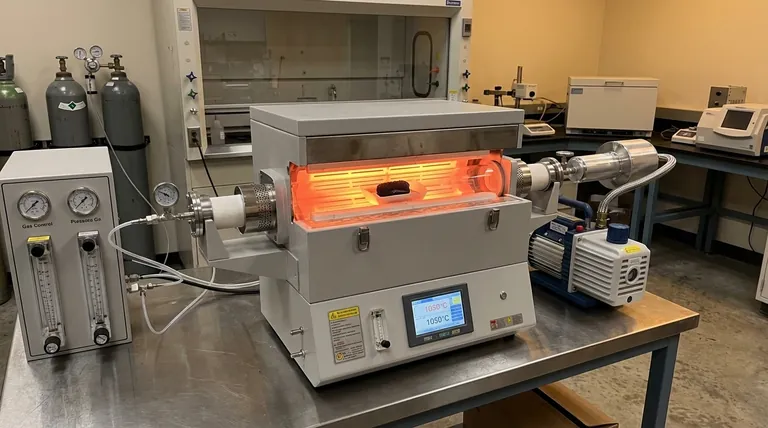
The high-vacuum tube furnace serves as the foundational reactor for converting TF-COF precursors into functional porous carbon electrocatalysts. By providing a rigorously controlled thermal environment between 800 and 1100 °C under a protective nitrogen atmosphere, the furnace drives the pyrolysis and recombination of organic components. This precise processing is required to transform the raw precursor into a highly graphitized structure with optimized chemical properties.
The furnace's role extends beyond simple heating; it provides the stabilized reaction environment necessary to simultaneously achieve in-situ element doping and the development of a high specific surface area.
Mechanisms of Material Transformation
Precision Thermal Activation
The primary function of the tube furnace is to supply specific thermal activation energy, strictly maintained within the 800 to 1100 °C range.
This constant temperature control triggers pyrolysis, causing the organic components within the TF-COF precursor to decompose.
Through this thermal treatment, the material undergoes significant structural rearrangement, evolving from a raw organic framework into a stable carbonized matrix.
Protective Atmospheric Control
To ensure the carbonization process yields a usable electrocatalyst, the furnace operates under a nitrogen protective atmosphere.
This inert environment is critical for preventing the oxidation of the carbon material during high-temperature treatment.
By excluding oxygen, the furnace forces the material to undergo recombination rather than combustion, preserving the carbon skeleton.
Enhancing Electrocatalytic Properties
Facilitating In-Situ Doping
The controlled environment within the furnace is directly responsible for the chemical functionalization of the final product.
The process facilitates the in-situ doping of nitrogen and fluorine elements into the carbon lattice.
This doping is not an external addition but a result of the precise recombination of the precursor's components, which enhances the material's catalytic activity.
Structural Evolution and Graphitization
The furnace drives the physical evolution of the material into a graphitized porous carbon structure.
This graphitization increases the electrical conductivity of the material, a vital property for electrocatalysis.
Simultaneously, the process creates a high specific surface area, effectively exposing more active sites for electrochemical reactions.
Understanding the Trade-offs
The Necessity of Uniformity
While the furnace enables transformation, the quality of the output is heavily dependent on temperature uniformity.
Inconsistent heating zones can lead to incomplete graphitization or phase impurities, compromising the crystal structure.
Atmosphere Sensitivity
The success of the process relies entirely on the integrity of the vacuum and nitrogen seal.
Even minor leaks or fluctuations in the protective atmosphere can alter the chemical composition, leading to the loss of desired doping elements or unwanted surface oxidation.
Optimizing the Carbonization Strategy
To achieve the best results when converting TF-COF precursors, consider your specific material goals:
- If your primary focus is Maximizing Catalytic Activity: Ensure strict adherence to the inert atmosphere protocols to preserve nitrogen and fluorine content during doping.
- If your primary focus is Conductivity and Stability: Prioritize precise temperature control at the higher end of the 800-1100 °C spectrum to maximize graphitization.
The high-vacuum tube furnace is the bridge between a raw organic precursor and a high-performance electrocatalytic tool.
Summary Table:
| Feature | Role in Carbonization Process | Impact on Electrocatalyst |
|---|---|---|
| Thermal Activation | Precise control (800-1100 °C) | Drives pyrolysis and structural rearrangement |
| Inert Atmosphere | Nitrogen-protected environment | Prevents oxidation; preserves carbon skeleton |
| In-situ Doping | Facilitates N and F recombination | Enhances catalytic activity and active sites |
| Graphitization | High-temp structural evolution | Increases electrical conductivity and surface area |
Elevate Your Material Research with KINTEK
Achieving the perfect graphitized structure for your TF-COF precursors requires absolute thermal precision and atmospheric integrity. KINTEK provides the cutting-edge high-vacuum tube furnace systems needed to master the carbonization process.
Backed by expert R&D and manufacturing, KINTEK offers Muffle, Tube, Rotary, Vacuum, and CVD systems, all fully customizable to meet your unique lab requirements. Whether you are focused on maximizing catalytic activity or enhancing material conductivity, our high-temperature furnaces deliver the uniform heating and reliable vacuum seals essential for your success.
Ready to optimize your electrocatalyst production? Contact us today to find your custom solution!
Visual Guide

References
- Linqiang Li, Liwei Mi. Rational design of nitrogen and fluorine co-doped metal-free porous carbons electrocatalysts for highly efficient oxygen reduction and zinc-air batteries. DOI: 10.1007/s43979-024-00117-4
This article is also based on technical information from Kintek Furnace Knowledge Base .
Related Products
- High Pressure Laboratory Vacuum Tube Furnace
- Magnesium Extraction and Purification Condensing Tube Furnace
- Vacuum Hot Press Furnace Machine Heated Vacuum Press Tube Furnace
- Vacuum Sealed Continuous Working Rotary Tube Furnace Rotating Tube Furnace
- 2200 ℃ Tungsten Vacuum Heat Treat and Sintering Furnace
People Also Ask
- What role does a high vacuum tube furnace play in Co-Al sintering? Master High-Purity Porous Material Synthesis
- What are the different types of tube furnaces available? Find the Perfect Fit for Your Lab's Needs
- What are the main advantages of vacuum tube furnaces in the market? Achieve Purity and Precision in Material Processing
- What is the role of a vacuum tube furnace during the final thermal treatment stage of Fe3O4@CSAC catalysts?
- What conditions does a tube furnace provide for post-ion-implantation? Achieve Precise Microstructural Repair



















