
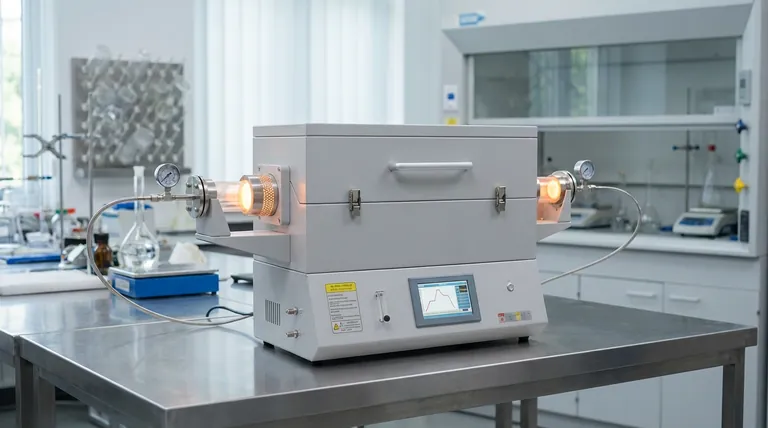
In the melt-diffusion synthesis of traditional Se/NC composites, the tube furnace serves as the critical thermal activation chamber. It provides the precise thermal energy required to transition selenium from a solid to a molten state, enabling it to penetrate the porous architecture of the nitrogen-doped carbon (NC) substrate.
The tube furnace does not simply heat the materials; it creates the thermodynamic environment necessary for capillary forces to draw selenium into the carbon host. This ensures the selenium is physically confined within the pores rather than aggregating on the surface.
The Mechanism of Thermal Integration
Triggering the Phase Change
The primary function of the tube furnace is to raise the temperature of the selenium and carbon mixture above the melting point of selenium.
Until this thermal threshold is crossed, the materials remain a physical mixture of distinct solid particles. The furnace ensures the selenium becomes a fluid capable of mobility.
Facilitating Capillary Action
Once the selenium is in a molten state, the tube furnace maintains the environment necessary for melt-diffusion.
Similar to how liquid sulfur behaves in comparable processes, molten selenium is drawn into the highly developed pore structure of the carbon carrier via capillary forces. This is the defining moment where the material transforms from a mixture into a true composite.
Ensuring Uniform Distribution
According to standard preparation protocols, the tube furnace is responsible for the uniform distribution of the active material.
By maintaining a consistent temperature profile, the furnace allows the selenium to disperse evenly throughout the carbon base, maximizing the utilization of the internal pore volume.
The Importance of Pre-Processing
While the tube furnace drives the chemical and physical integration, it relies on physical preparation to be effective.
Maximizing Contact Area
Before entering the furnace, the raw materials typically undergo mechanical processing.
This step reduces particle size and increases the contact area between the selenium and the carbon host. This mechanical groundwork is essential for the thermal process in the furnace to achieve a homogenous result.
Understanding the Trade-offs
Temperature Control vs. Volatilization
While the tube furnace must provide enough heat for diffusion, excessive temperatures can be detrimental.
If the temperature is too high or uncontrolled, there is a risk of volatilizing the selenium (similar to CVD processes) rather than melting it into the pores. This leads to material loss and unpredictable stoichiometry.
Pore Filling vs. Surface Accumulation
The goal of the tube furnace treatment is physical confinement inside the pores.
However, if the heating duration or temperature is insufficient, the selenium may not fully diffuse. This results in surface accumulation, where the active material sits on the exterior of the carbon skeleton, leading to poor electrical contact and reduced performance.
Making the Right Choice for Your Goal
To maximize the effectiveness of the tube furnace in your synthesis, consider the following approach:
- If your primary focus is material homogeneity: Prioritize thorough mechanical milling before the furnace stage to maximize the contact area between the Se and NC particles.
- If your primary focus is pore confinement: Ensure the furnace temperature is strictly controlled to maintain the melt state without inducing rapid volatilization, allowing capillary forces sufficient time to act.
The tube furnace is the bridge that turns a physical mixture into a mechanically and electrically integrated composite.
Summary Table:
| Process Phase | Role of Tube Furnace | Key Mechanism |
|---|---|---|
| Thermal Activation | Triggers phase change | Transitions Se from solid to molten fluid |
| Integration | Facilitates melt-diffusion | Capillary forces draw Se into carbon pores |
| Homogenization | Maintains thermal profile | Ensures uniform Se distribution across NC matrix |
| Control Stage | Manages volatility | Prevents material loss through precise temp control |
Elevate Your Composite Synthesis with KINTEK
Precise thermal control is the difference between surface accumulation and true pore confinement. KINTEK provides industry-leading Tube, Muffle, Rotary, and Vacuum systems designed for the rigorous demands of advanced material science.
Backed by expert R&D and manufacturing, our systems are fully customizable to your specific melting points and diffusion protocols. Whether you are preparing Se/NC composites or specialized CVD-based materials, KINTEK ensures your laboratory achieves perfect stoichiometry and material homogeneity every time.
Ready to optimize your melt-diffusion process? Contact our technical experts today to find the ideal high-temperature furnace for your research.
References
- Ying Wang, Yun Wang. <i>In‐situ</i> confining selenium within bubble – like carbon nanoshells for ultra‐stable Li−Se batteries. DOI: 10.1002/chem.202304114
This article is also based on technical information from Kintek Furnace Knowledge Base .
Related Products
- Vacuum Sealed Continuous Working Rotary Tube Furnace Rotating Tube Furnace
- 1400℃ High Temperature Laboratory Tube Furnace with Alumina Tube
- 1700℃ High Temperature Laboratory Tube Furnace with Alumina Tube
- Magnesium Extraction and Purification Condensing Tube Furnace
- High Pressure Laboratory Vacuum Tube Furnace
People Also Ask
- What is the purpose of rotary tube furnaces? Achieve Uniform Heat Treatment for Powders and Granules
- What are the key advantages of using a rotary tube furnace? Achieve Dynamic, Uniform Heating for Powders
- How does the amount of material processed vary between batch and continuous rotary tube furnaces? Scale Your Production Efficiently
- What are the advantages of rotary tube furnaces in fuel compatibility? Boost Efficiency and Cut Costs
- What is the temperature range of some rotary tube furnaces? Achieve Uniform Heating Up to 1200°C



















