
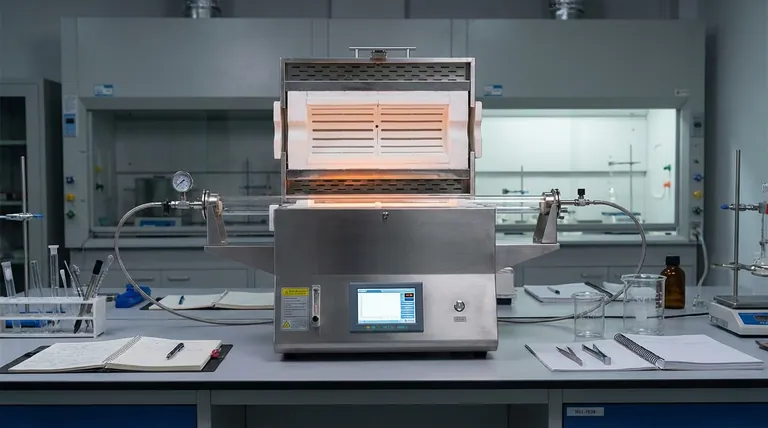
An industrial tube furnace is essential for processing SiCN(Ni)/BN ceramics because it provides a strictly controlled reaction environment that standard kilns cannot match. Specifically, it enables the precise regulation of heating rates and maintains a high-purity nitrogen atmosphere to prevent oxidation. This control is mandatory to successfully convert polysilazane precursors into a functional semiconducting SiCN ceramic phase.
The tube furnace serves as a precision instrument rather than a simple heat source. It facilitates a complex, two-stage pyrolysis process that allows for the orderly release of gases and the catalytic growth of carbon nanofibers, ensuring the final material achieves its optimal microscopic morphology.
The Critical Role of Atmosphere Control
Preventing Material Oxidation
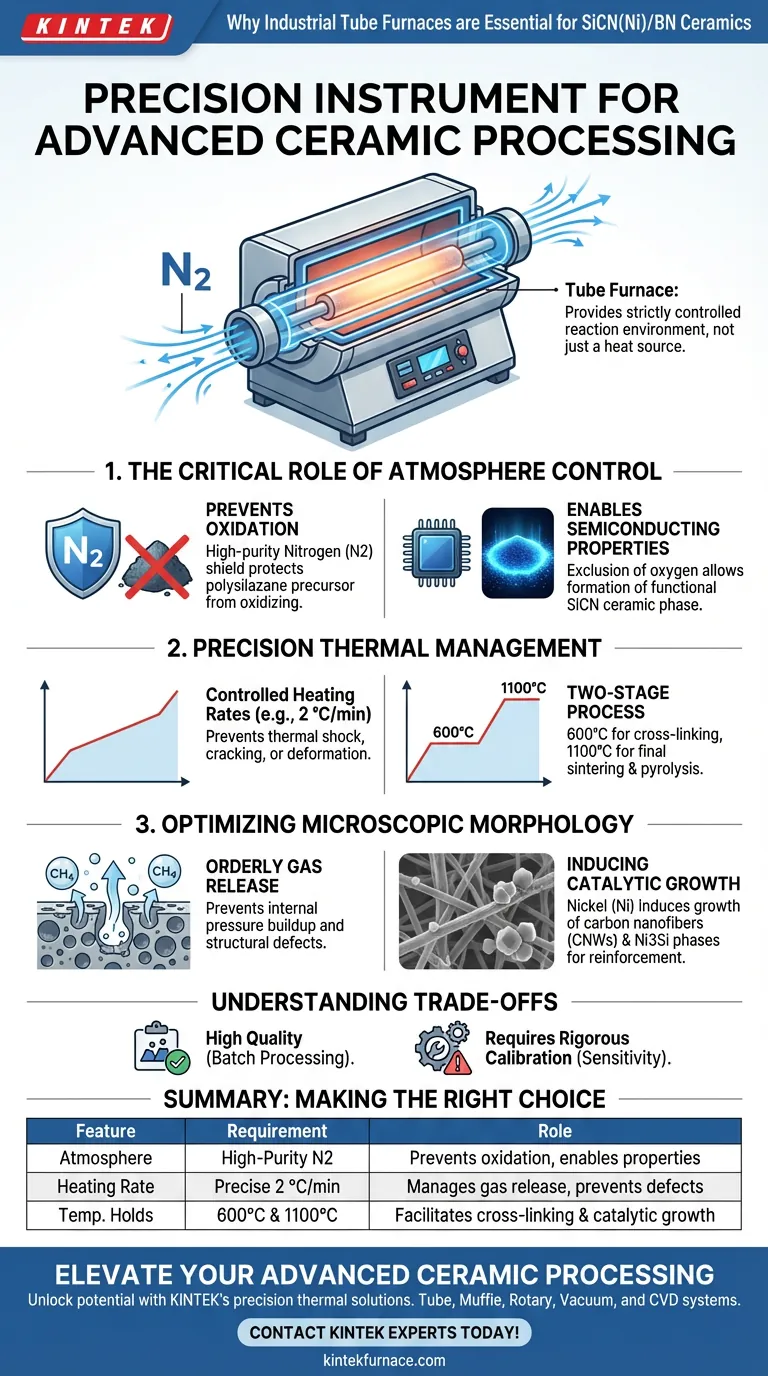
The primary function of the tube furnace in this context is to maintain a high-purity nitrogen (N2) protective atmosphere.
Without this shielding gas, the polysilazane precursor would oxidize during pyrolysis rather than converting into the desired ceramic phase.
Enabling Semiconducting Properties
The exclusion of oxygen is critical for the chemical transformation of the precursor.
By ensuring the reaction occurs in an inert environment, the furnace allows the formation of the SiCN ceramic phase, which is responsible for the material's specific semiconducting properties.
Precision Thermal Management
Controlled Heating Rates
Successful conversion requires a slow, steady rise in temperature, specifically at rates such as 2 °C per minute.
The industrial tube furnace allows for this granular control, preventing thermal shock or rapid reactions that could crack or deform the ceramic body.
Executing a Two-Stage Process
The conversion of SiCN(Ni)/BN ceramics is not a linear heating event; it requires a programmable two-stage heating process.
The furnace effectively manages a hold at 600 °C for steady cross-linking, followed by a ramp to 1100 °C for final sintering and pyrolysis.
Optimizing Microscopic Morphology
Managing Gas Release
During pyrolysis, small molecule gases like methane (CH4) are generated within the material.
The precise temperature control program of the tube furnace ensures these gases are released in an orderly fashion, preventing internal pressure buildup that could lead to structural defects.
Inducing Catalytic Growth
The specific thermal environment allows the nickel (Ni) component to act as a catalyst during the heating cycle.
Under these strictly maintained conditions, nickel induces the in-situ growth of carbon nanofibers (CNWs) and Ni3Si crystalline phases, which are vital for reinforcing the ceramic's structure.
Understanding the Trade-offs
Batch Processing Limitations
While tube furnaces offer superior environmental control, they are typically batch-processing units with limited volume.
This ensures high quality for specialized materials like SiCN(Ni)/BN but may restrict throughput compared to continuous belt furnaces used for lower-grade ceramics.
Calibration Sensitivity
The strict requirements for heating rates (e.g., 2 °C/min) and atmosphere purity mean the equipment requires rigorous calibration.
Inaccurate sensors or leaks in the tube seals can lead to immediate oxidation or incomplete pyrolysis, rendering the batch unusable.
Making the Right Choice for Your Goal
To ensure the successful fabrication of SiCN(Ni)/BN ceramics, align your equipment settings with your specific material objectives:
- If your primary focus is Phase Purity: Ensure the furnace is certified for high-vacuum or high-purity positive pressure operations to maintain the integrity of the nitrogen atmosphere.
- If your primary focus is Structural Integrity: Prioritize a furnace with advanced programmable controllers to strictly enforce the 2 °C/min heating rate and the multi-stage temperature holds.
Ultimately, the industrial tube furnace is not just a heater, but the enabling tool that defines the chemical and structural reality of advanced ceramic composites.
Summary Table:
| Feature | Requirement | Role in Ceramic Processing |
|---|---|---|
| Atmosphere | High-Purity Nitrogen (N2) | Prevents oxidation and enables semiconducting properties |
| Heating Rate | Precise 2 °C/min | Manages gas release (CH4) and prevents structural defects |
| Temperature Holds | 600°C & 1100°C Stages | Facilitates cross-linking and catalytic growth of carbon nanofibers |
| System Type | Controlled Tube Furnace | Ensures high-purity environment vs. standard kilns |
Elevate Your Advanced Ceramic Processing
Unlock the full potential of your SiCN(Ni)/BN ceramics with KINTEK’s precision thermal solutions. Backed by expert R&D and world-class manufacturing, we provide high-performance Tube, Muffle, Rotary, Vacuum, and CVD systems tailored to your specific research or production needs. Whether you require strict atmosphere control or programmable multi-stage heating, our customizable furnaces ensure your materials achieve optimal microscopic morphology and purity.
Ready to optimize your heat treatment? Contact KINTEK Experts Today to discuss your unique laboratory or industrial requirements!
Visual Guide
References
- Yanchun Tong, Shigang Wu. Enhanced electromagnetic wave absorption properties of SiCN(Ni)/BN ceramics by <i>in situ</i> generated Ni and Ni<sub>3</sub>Si. DOI: 10.1039/d3ra07877a
This article is also based on technical information from Kintek Furnace Knowledge Base .
Related Products
- Magnesium Extraction and Purification Condensing Tube Furnace
- High Pressure Laboratory Vacuum Tube Furnace
- Vacuum Sealed Continuous Working Rotary Tube Furnace Rotating Tube Furnace
- Vertical Laboratory Quartz Tube Furnace Tubular Furnace
- 1400℃ High Temperature Laboratory Tube Furnace with Alumina Tube
People Also Ask
- What are the advantages of using a condensing tube furnace for magnesium extraction? Achieve High Purity and Efficient Metal Recovery
- What are some common applications of tube furnaces in laboratories? Unlock Precision in Material Processing
- How does thermal treatment in a tube furnace improve biomass films? Enhance Heat Management via Graphitization
- What is a tube furnace and what is its primary use? Achieve Precision High-Temp Processing for Your Lab
- Why is a high-temperature tube furnace required for MoS2 and WS2 thin films? Achieve 2H Crystalline Phase Excellence



















