
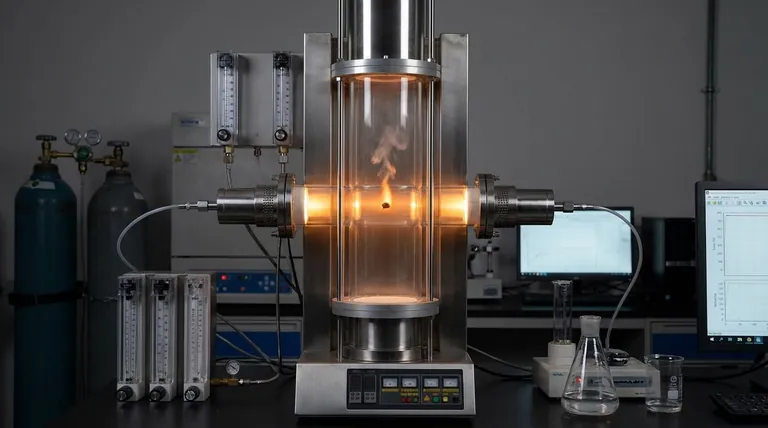
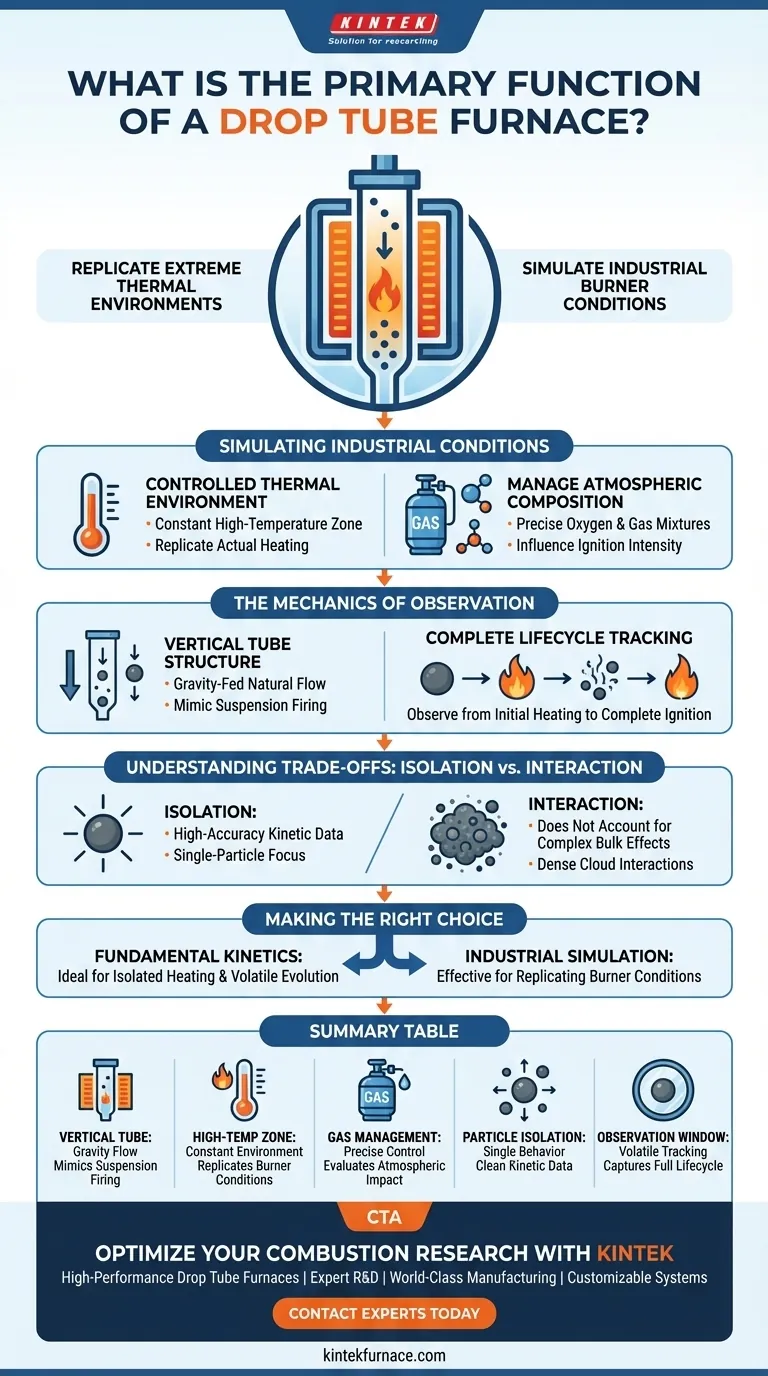
The primary function of a Drop Tube Furnace (DTF) is to replicate the extreme thermal environment of industrial burners within a controlled laboratory setting. By utilizing a vertical tube structure, it allows researchers to drop individual solid fuel particles through a constant high-temperature zone, enabling the precise observation of their behavior from initial heating to complete ignition.
By isolating single particles in a gravity-fed environment, the Drop Tube Furnace removes external variables found in bulk combustion. This allows for an accurate analysis of how specific atmospheric compositions and temperatures drive the volatile evolution and ignition process.
Simulating Industrial Conditions
Creating a Controlled Thermal Environment
To understand how fuel will behave in a real-world power plant or engine, you must replicate the heat without the chaos of a full-scale system.
The Drop Tube Furnace provides a constant high-temperature environment. This consistency is critical for simulating the actual heating conditions found in industrial burners, ensuring that the data collected is relevant to real-world applications.
Managing Atmospheric Composition
Combustion does not happen in a vacuum; it is dictated by the surrounding gases.
The DTF allows researchers to introduce a specific atmospheric composition into the tube. This capability enables the study of how different oxygen levels or gas mixtures influence the speed and intensity of ignition.
The Mechanics of Observation
Utilizing Gravity for Natural Flow
The defining physical feature of this apparatus is its vertical tube structure.
Solid particles are allowed to fall freely under the influence of gravity. This mimics the suspension firing methods often used in industry, where fuel is injected and burned while suspended in air.
Tracking the Complete Lifecycle
The primary goal of the DTF is not just to see if fuel burns, but to see how it burns.
Because the environment is so controlled, researchers can perform a precise observation of the entire sequence. This includes the initial heating of the particle, the volatile evolution (release of gases), and finally, the complete ignition process.
Understanding the Trade-offs
Isolation vs. Interaction
While the Drop Tube Furnace is excellent for characterizing individual fuel particles, this strength is also a limitation.
By focusing on single-particle ignition, the apparatus intentionally removes the interactions that occur between particles in a dense fuel cloud. Therefore, while it provides highly accurate kinetic data for a single unit of fuel, it does not account for the complex particle-to-particle effects found in a dense industrial fuel bed.
Making the Right Choice for Your Research
If you are designing an experiment to characterize solid fuel, consider the following based on the specific capabilities of a Drop Tube Furnace:
- If your primary focus is fundamental kinetics: The DTF is ideal because it isolates the heating and volatile evolution of single particles, providing clean data free from interference.
- If your primary focus is industrial simulation: The DTF is effective because it replicates the constant high-temperature and gravity-driven flow of actual burners, validating how fuel will perform under stress.
Ultimately, the Drop Tube Furnace serves as the critical link between theoretical fuel chemistry and practical industrial combustion.
Summary Table:
| Feature | Function in DTF | Research Benefit |
|---|---|---|
| Vertical Tube Structure | Uses gravity for natural particle flow | Mimics industrial suspension firing methods |
| High-Temp Zone | Maintains constant thermal environment | Replicates extreme burner conditions precisely |
| Gas Management | Precise control of atmospheric composition | Evaluates impact of oxygen/gas levels on ignition |
| Particle Isolation | Focuses on single-particle behavior | Provides clean kinetic data without bulk interference |
| Observation Window | Tracks volatile evolution & ignition | Captures the full lifecycle of solid fuel combustion |
Optimize Your Combustion Research with KINTEK
Precision in fuel characterization starts with the right equipment. Backed by expert R&D and world-class manufacturing, KINTEK offers high-performance Drop Tube Furnaces, Muffle, Tube, and Vacuum systems tailored for your lab's most demanding thermal processing needs. Whether you are analyzing fundamental kinetics or simulating industrial burners, our customizable systems provide the constant temperature control and atmospheric precision necessary for groundbreaking results.
Ready to elevate your lab's capabilities? Contact our experts today to discuss your unique project requirements and discover how KINTEK's advanced heating solutions can drive your research forward.
Visual Guide
Related Products
- Vacuum Sealed Continuous Working Rotary Tube Furnace Rotating Tube Furnace
- Slide PECVD Tube Furnace with Liquid Gasifier PECVD Machine
- Custom Made Versatile CVD Tube Furnace Chemical Vapor Deposition CVD Equipment Machine
- 1200℃ Split Tube Furnace Laboratory Quartz Tube Furnace with Quartz Tube
- Laboratory Vacuum Tilt Rotary Tube Furnace Rotating Tube Furnace
People Also Ask
- What is the purpose of rotary tube furnaces? Achieve Uniform Heat Treatment for Powders and Granules
- What are the key advantages of using a rotary tube furnace? Achieve Dynamic, Uniform Heating for Powders
- How does the amount of material processed vary between batch and continuous rotary tube furnaces? Scale Your Production Efficiently
- What are the advantages of rotary tube furnaces in fuel compatibility? Boost Efficiency and Cut Costs
- What is the temperature range of some rotary tube furnaces? Achieve Uniform Heating Up to 1200°C



















