
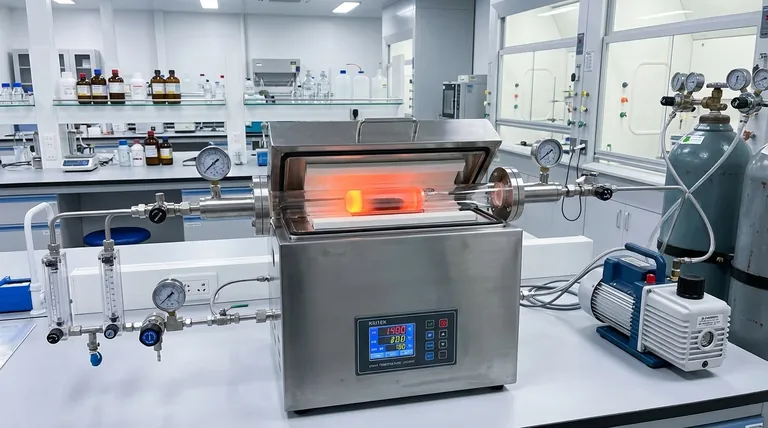
In short, a quartz tube furnace supports controlled atmosphere experiments by first using a vacuum system to remove unwanted ambient air, particularly oxygen, from the sealed quartz tube. After this evacuation, a specific gas or mixture of gases, such as inert argon or nitrogen, is introduced and managed with precision flow controllers to create the exact non-reactive or reactive environment required for the process.
The true value of a quartz tube furnace isn't just its ability to reach high temperatures, but its capacity to completely isolate a sample from the reactive environment of open air. This control over the atmosphere is what enables the synthesis and processing of high-purity, advanced materials that would be impossible to create otherwise.
The Core Principle: Isolating the Sample Environment
A controlled atmosphere experiment is fundamentally about removing variables. The most common and disruptive variable in high-temperature processing is the air around us, which is rich in reactive oxygen and moisture.
The Role of the Quartz Tube
The quartz tube itself is the heart of the system. It acts as a transparent, chemically inert, and high-temperature-resistant chamber that contains both the sample and its carefully managed atmosphere.
Step 1: Creating a Vacuum
Before a controlled atmosphere can be introduced, the existing one must be removed. A vacuum pump is connected to the sealed tube to evacuate the ambient air. This critical step purges the system of oxygen and water vapor, which could otherwise cause unwanted oxidation or contamination.
Step 2: Introducing a Controlled Gas
Once a sufficient vacuum is achieved, the tube is backfilled with a specific gas from a compressed gas cylinder. For many applications, this is an inert gas like argon or nitrogen, which prevents chemical reactions. For other processes, a reactive gas might be used to intentionally modify the sample's surface, such as in carburizing or nitriding.
Key Components for Atmosphere Control
Achieving a stable and precise atmosphere relies on several interconnected components working together to seal, purge, and regulate the environment inside the tube.
Sealing Flanges and Fittings
Airtight seals are non-negotiable. Specialized flanges, often made of stainless steel with O-ring gaskets, are used to seal the ends of the quartz tube. These flanges provide the necessary ports for connecting vacuum pumps and gas lines.
Vacuum Pumps
The pump's job is to evacuate the tube. The type of pump used—from a basic rotary vane pump to a high-vacuum turbomolecular pump—depends on how completely the initial atmosphere must be removed for the experiment's sensitivity.
Flow Meters and Mass Flow Controllers
Simply filling the tube with gas is not enough; its flow must be regulated. Flow meters monitor the rate of gas entering the furnace, while more advanced mass flow controllers (MFCs) can be programmed to maintain a precise, constant flow rate or even create complex gas mixtures, ensuring a stable and reproducible environment.
Understanding the Trade-offs and Limitations
While powerful, these systems require careful planning and an understanding of their inherent limitations to ensure successful and safe operation.
The Importance of Gas Purity
The effectiveness of a controlled atmosphere is only as good as the gas being used. Using a low-purity grade of argon, for example, can introduce enough oxygen or moisture to compromise an experiment designed to be oxygen-free.
Material and Temperature Constraints
Quartz is an excellent material, but it is not indestructible. It has a maximum service temperature (typically around 1100-1200°C) and can be susceptible to thermal shock if heated or cooled too rapidly. Certain highly reactive materials can also etch or damage the tube over time.
Seal Integrity and Leaks
Maintaining a perfect seal is a constant challenge. Even a microscopic leak in a flange or fitting can allow air to seep back into the tube, contaminating the controlled atmosphere and potentially ruining the experiment. Regular leak-checking is a critical part of the process.
Making the Right Choice for Your Goal
The required complexity of your atmosphere control system is dictated entirely by your experimental objective.
- If your primary focus is simple annealing or oxidation prevention: A basic setup with a vacuum pump to purge the air, followed by a continuous low flow of inert gas managed by a simple flow meter, is often sufficient.
- If your primary focus is sensitive material synthesis (e.g., crystal growth): A high-vacuum system is necessary, paired with high-purity gas and a precision mass flow controller to guarantee an ultra-clean and stable environment.
- If your primary focus is a reactive process (e.g., chemical vapor deposition): You need a robust system with mass flow controllers for multiple reactive gases, along with careful management of pressure and exhaust streams.
Mastering atmosphere control transforms a simple furnace into a precision tool for advanced material innovation.
Summary Table:
| Key Aspect | Description |
|---|---|
| Core Function | Isolates samples from ambient air using vacuum and gas control for precise environments. |
| Main Steps | 1. Evacuate air with vacuum pump. 2. Introduce inert or reactive gases via flow controllers. |
| Key Components | Quartz tube, sealing flanges, vacuum pumps, flow meters, mass flow controllers (MFCs). |
| Applications | Material synthesis, annealing, chemical vapor deposition (CVD), oxidation prevention. |
| Limitations | Max temperature ~1100-1200°C, susceptibility to thermal shock, requires high gas purity and seal integrity. |
Elevate your laboratory's capabilities with KINTEK's advanced high-temperature furnace solutions! Leveraging exceptional R&D and in-house manufacturing, we provide quartz tube furnaces and other systems like Muffle, Tube, Rotary, Vacuum & Atmosphere Furnaces, and CVD/PECVD Systems. Our strong deep customization capability ensures precise alignment with your unique experimental needs, whether for material synthesis, annealing, or reactive processes. Contact us today to discuss how we can support your controlled atmosphere experiments and drive innovation in your research!
Visual Guide

Related Products
- Laboratory Quartz Tube Furnace RTP Heating Tubular Furnace
- 1200℃ Split Tube Furnace Laboratory Quartz Tube Furnace with Quartz Tube
- Vertical Laboratory Quartz Tube Furnace Tubular Furnace
- Multi Zone Laboratory Quartz Tube Furnace Tubular Furnace
- High Pressure Laboratory Vacuum Tube Furnace
People Also Ask
- What physical conditions does a laboratory Tube Furnace provide for SOEC? Precision Heat for Solid Oxide Characterization
- What are the main features and functions of a laboratory tube furnace? Unlock Precise High-Temp Control for Your Lab
- Why is a laboratory tube furnace necessary for BiVO4/RGO synthesis? Achieve Precise Nano-Structure Control
- Why is control of heating rate and gas flow in a lab tube furnace critical for EM wave absorption materials?
- What role does a laboratory tube furnace play in geological and mineralogical research? Unlock Earth's Secrets with Precision



















