
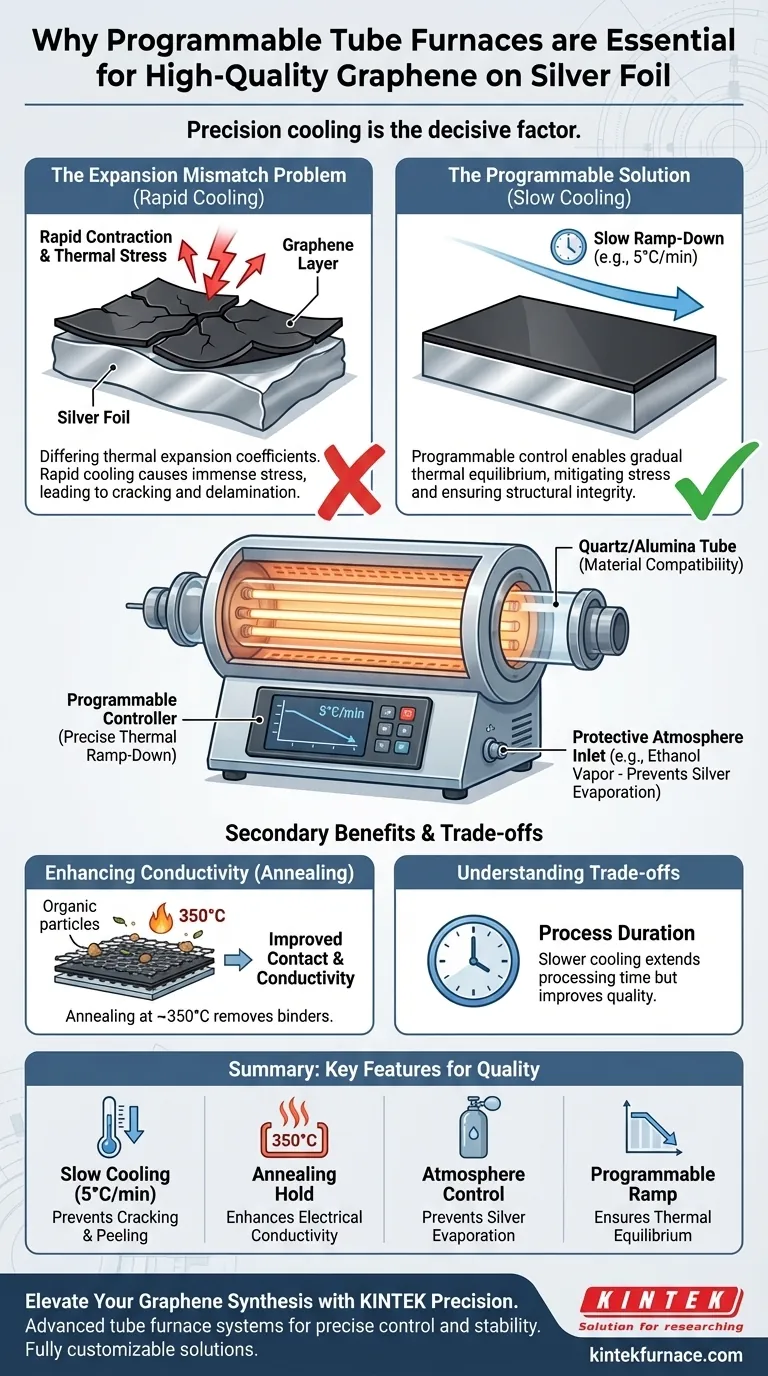
Precision cooling is the decisive factor in graphene quality. A tube furnace with programmable temperature control is necessary because it enables the execution of specific slow-cooling strategies, such as a rate of 5°C per minute. Without this controlled thermal descent, the significant difference in thermal expansion between the silver foil and the graphene layer would cause the coating to crack, peel, or delaminate during the cooling phase.
Core Takeaway High-quality graphene production relies on managing the mismatch in thermal expansion coefficients between the substrate and the coating. Programmable furnaces provide the precise thermal ramp-down required to mitigate stress, ensuring the graphene layer maintains its structural integrity and adhesion to the silver foil.
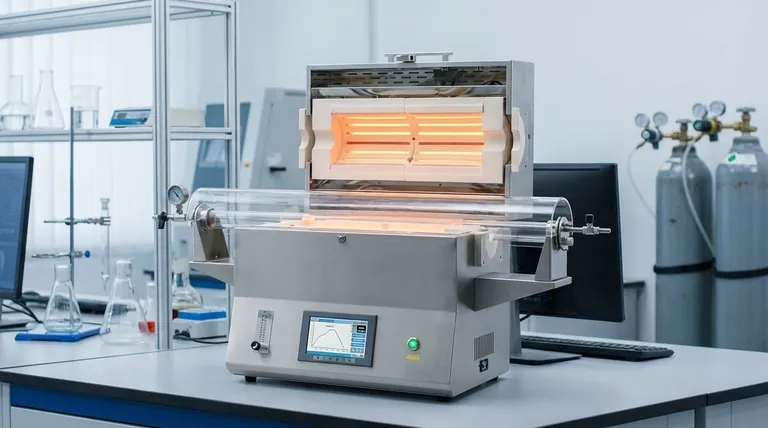
The Mechanics of Thermal Stress
The Expansion Mismatch
Silver and graphene possess vastly different thermal expansion coefficients. As the materials are heated and subsequently cooled, they expand and contract at different rates.
The Risk of Rapid Cooling
If the sample is cooled too quickly—as would happen in a non-programmable furnace—the silver substrate contracts much faster than the graphene layer.
This rapid contraction generates immense thermal stress at the interface between the two materials. This stress physically tears the graphene, leading to cracking or complete detachment from the foil.
How Programmable Control Solves the Problem
Implementing Slow-Cooling Strategies
Programmable controllers allow researchers to define an exact cooling curve. By setting a slow ramp-down rate, specifically around 5°C per minute, the furnace ensures that both materials cool gradually.
Mitigating Structural Failure
This gradual process allows the materials to reach thermal equilibrium continuously. It minimizes the instantaneous stress on the interface, preventing the graphene from fracturing.
Atmosphere Management
The tube furnace design allows for a continuous supply of a protective atmosphere, such as ethanol vapor. This is critical during the cooling phase to prevent the evaporation of silver, which can further destabilize the graphene layer.
Secondary Benefits of the Tube Furnace
Enhancing Conductivity through Annealing
Beyond stress management, the precise heating capabilities of the furnace facilitate effective annealing (often around 350°C). This process carbonizes residual binders and removes excess organic components.
Improving Contact
This removal of impurities enhances the contact between graphene layers. The result is significantly improved macroscopic electrical conductivity and better structural stability.
Understanding the Trade-offs
Process Duration
The primary trade-off of using programmable slow cooling is time. Strategies requiring 5°C/minute ramp-downs significantly extend the total processing time compared to rapid-cooling methods, reducing throughput.
Material Compatibility
While tube furnaces offer versatility, one must carefully select the tube material (e.g., quartz vs. alumina). Incorrect selection can lead to adverse chemical reactions between the furnace tube and the sample at high temperatures, contaminating the graphene.
Making the Right Choice for Your Goal
To maximize the quality of your graphene-on-silver synthesis, consider the following:
- If your primary focus is Structural Integrity: Prioritize a programmable cooling rate of 5°C/min to prevent thermal stress fractures.
- If your primary focus is Electrical Conductivity: Ensure your profile includes an annealing hold (e.g., 350°C) to fully decompose organic binders and improve layer contact.
- If your primary focus is Purity: Verify that your furnace tube material (Quartz or Alumina) is chemically inert relative to your specific silver and carbon precursors.
Control the cooling rate, and you control the structural destiny of your material.
Summary Table:
| Feature | Purpose in Graphene Synthesis | Benefit to Material Quality |
|---|---|---|
| Slow Cooling (5°C/min) | Manages thermal expansion mismatch | Prevents cracking, peeling, and delamination |
| Annealing (350°C) | Carbonizes binders and removes organics | Enhances macroscopic electrical conductivity |
| Atmosphere Control | Provides protective ethanol vapor | Prevents silver evaporation and destabilization |
| Programmable Ramp | Ensures thermal equilibrium | Minimizes interface stress for structural integrity |
Elevate Your Graphene Synthesis with KINTEK Precision
Don’t let thermal stress compromise your material research. KINTEK’s advanced tube furnace systems provide the precise programmable temperature control and atmospheric stability required for high-quality graphene production.
Backed by expert R&D and manufacturing, we offer a comprehensive range of Tube, Muffle, Rotary, Vacuum, and CVD systems—all fully customizable to meet your laboratory's unique high-temperature requirements.
Ready to optimize your thermal profiles? Contact KINTEK today to find your perfect furnace solution!
Visual Guide
References
- Hikaru Iwatani, Fumihiko Maeda. Graphene Synthesis on Silver Foil by Chemical Vapor Deposition Using Ethanol. DOI: 10.1380/ejssnt.2025-026
This article is also based on technical information from Kintek Furnace Knowledge Base .
Related Products
- Vacuum Sealed Continuous Working Rotary Tube Furnace Rotating Tube Furnace
- 1400℃ High Temperature Laboratory Tube Furnace with Alumina Tube
- 1700℃ High Temperature Laboratory Tube Furnace with Alumina Tube
- 1200℃ Split Tube Furnace Laboratory Quartz Tube Furnace with Quartz Tube
- Vertical Laboratory Quartz Tube Furnace Tubular Furnace
People Also Ask
- What is the purpose of rotary tube furnaces? Achieve Uniform Heat Treatment for Powders and Granules
- What are the key advantages of using a rotary tube furnace? Achieve Dynamic, Uniform Heating for Powders
- How does the amount of material processed vary between batch and continuous rotary tube furnaces? Scale Your Production Efficiently
- What are the advantages of rotary tube furnaces in fuel compatibility? Boost Efficiency and Cut Costs
- What is the temperature range of some rotary tube furnaces? Achieve Uniform Heating Up to 1200°C



















