
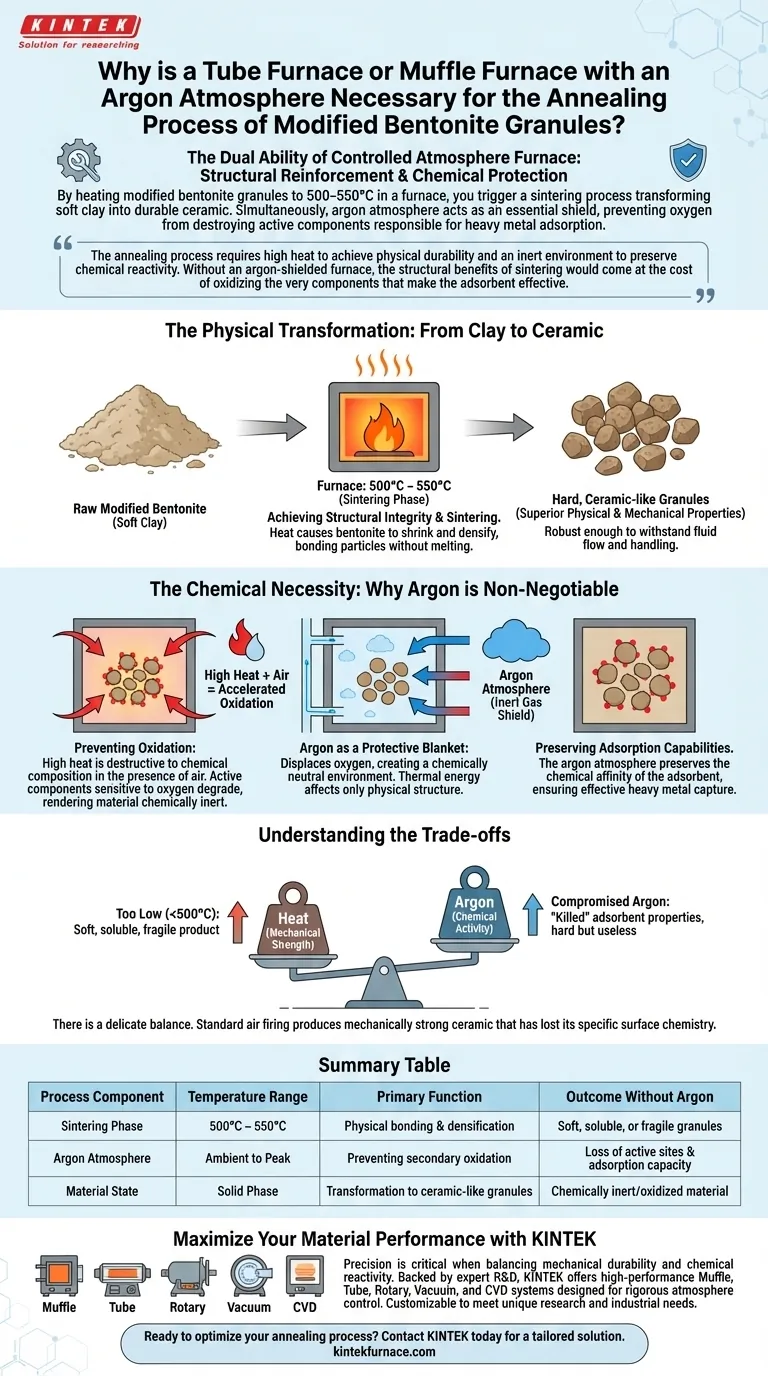
The necessity of a controlled atmosphere furnace lies in its dual ability to structurally reinforce the material while chemically protecting it. By heating modified bentonite granules to 500–550°C in a tube or muffle furnace, you trigger a sintering process that transforms soft clay into durable ceramic. Simultaneously, the argon atmosphere acts as an essential shield, preventing oxygen from destroying the active components responsible for heavy metal adsorption.
The annealing process requires high heat to achieve physical durability and an inert environment to preserve chemical reactivity. Without an argon-shielded furnace, the structural benefits of sintering would come at the cost of oxidizing the very components that make the adsorbent effective.

The Physical Transformation: From Clay to Ceramic
Achieving Structural Integrity
Modified bentonite in its raw form may lack the mechanical strength required for industrial applications.
To correct this, the furnace must reach temperatures between 500°C and 550°C. This specific heat range initiates sintering, a process where the particles bond together without melting.
Sintering and Shrinkage
During this thermal treatment, the granules undergo significant physical changes.
The heat causes the bentonite to shrink and densify. This transformation converts the material into hard, ceramic-like granules. These granules possess superior physical and mechanical properties, making them robust enough to withstand fluid flow and handling without breaking down.
The Chemical Necessity: Why Argon is Non-Negotiable
Preventing Oxidation
While high heat is necessary for structure, it is destructive to chemical composition in the presence of air.
The modified bentonite contains active components that are sensitive to oxygen at high temperatures. Without protection, the heat would accelerate oxidation, degrading these components and rendering the material chemically inert.
The Role of Inert Gas
Argon acts as a protective blanket.
By displacing oxygen within the furnace tube or muffle, argon creates a chemically neutral environment. This ensures that the thermal energy affects only the physical structure (sintering) and does not trigger unwanted chemical reactions like secondary oxidation.
Preserving Adsorption Capabilities
The ultimate goal of modified bentonite is often to remove contaminants, such as heavy metal ions.
The argon atmosphere preserves the chemical affinity of the adsorbent. By preventing the degradation of active sites during heating, the final product retains its ability to effectively target and capture heavy metals.
Understanding the Trade-offs
Heat vs. Chemical Activity
There is a delicate balance between mechanical strength and chemical performance.
If the temperature is too low (below 500°C), the granules may not sinter fully, resulting in a product that is too soft or soluble. Conversely, if the argon atmosphere is compromised, the high heat will "kill" the adsorbent properties, resulting in a hard but useless granule.
The Cost of Complexity
Using an argon atmosphere adds complexity and cost compared to standard air firing.
However, this is not an optional luxury. Standard air firing would likely produce a mechanically strong ceramic that has lost its specific surface chemistry, negating the purpose of the modification.
Making the Right Choice for Your Process
To ensure the success of your annealing process, prioritize the following parameters:
- If your primary focus is mechanical durability: Ensure your furnace creates a stable heating profile between 500°C and 550°C to guarantee complete sintering and ceramic transformation.
- If your primary focus is adsorption efficiency: Verify the integrity of the argon seal and flow rate to ensure zero oxygen ingress during the high-temperature phase, protecting the active sites.
Success depends on using the furnace to harden the body of the granule while using argon to protect its chemical soul.
Summary Table:
| Process Component | Temperature Range | Primary Function | Outcome Without Argon |
|---|---|---|---|
| Sintering Phase | 500°C – 550°C | Physical bonding & densification | Soft, soluble, or fragile granules |
| Argon Atmosphere | Ambient to Peak | Preventing secondary oxidation | Loss of active sites & adsorption capacity |
| Material State | Solid Phase | Transformation to ceramic-like granules | Chemically inert/oxidized material |
Maximize Your Material Performance with KINTEK
Precision is critical when balancing mechanical durability and chemical reactivity. Backed by expert R&D and manufacturing, KINTEK offers high-performance Muffle, Tube, Rotary, Vacuum, and CVD systems designed to maintain rigorous atmosphere control for sensitive processes like bentonite annealing.
Whether you need custom gas flow configurations or precise temperature uniformity to protect your active components, our lab high-temperature furnaces are fully customizable to meet your unique research and industrial needs.
Ready to optimize your annealing process? Contact KINTEK today for a tailored solution.
Visual Guide
References
- Bakytgul Kussainova, Aidana Bazarkhankyzy. Physico-Chemical Properties of Granular Sorbents Based on Natural Bentonite Modified by Polyhydroxocations of Aluminum and Iron (III) by Co-Precipitation. DOI: 10.3390/molecules30010195
This article is also based on technical information from Kintek Furnace Knowledge Base .
Related Products
- 1200℃ Controlled Inert Nitrogen Atmosphere Furnace
- Mesh Belt Controlled Atmosphere Furnace Inert Nitrogen Atmosphere Furnace
- 1400℃ Controlled Inert Nitrogen Atmosphere Furnace
- 1700℃ Controlled Inert Nitrogen Atmosphere Furnace
- Controlled Inert Nitrogen Hydrogen Atmosphere Furnace
People Also Ask
- What controlled-atmosphere furnace conditions are required for sintering powder metallurgy copper alloy compacts? Ideal Setup
- How Sintering Temp Affects Density & Resistivity of Cu-Oxide Composites
- What are the operational advantages of using a controlled atmosphere furnace? Boost Quality and Efficiency in Heat Treatment
- What are the operational considerations for a controlled atmosphere furnace? Master Key Factors for Material Processing
- What types of gases are used in controlled atmosphere furnaces? Optimize Material Protection and Transformation



















