
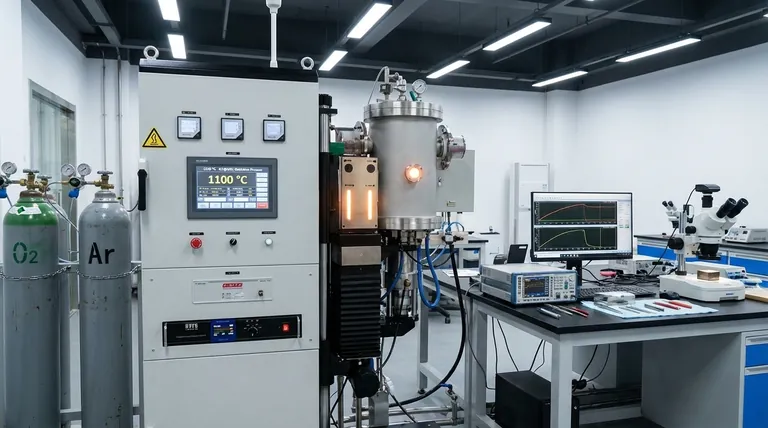
The critical requirement for heating equipment during the in-situ oxidation stage is the capability to maintain extreme temperature control precision at exactly 1100 °C. This specific thermal regulation is not merely about reaching a high temperature; it is about sustaining a highly stable environment to fine-tune the oxidation kinetics on the Silicon Carbide (SiC) surface. Without this precision, the formation of the necessary heterostructure features becomes impossible.
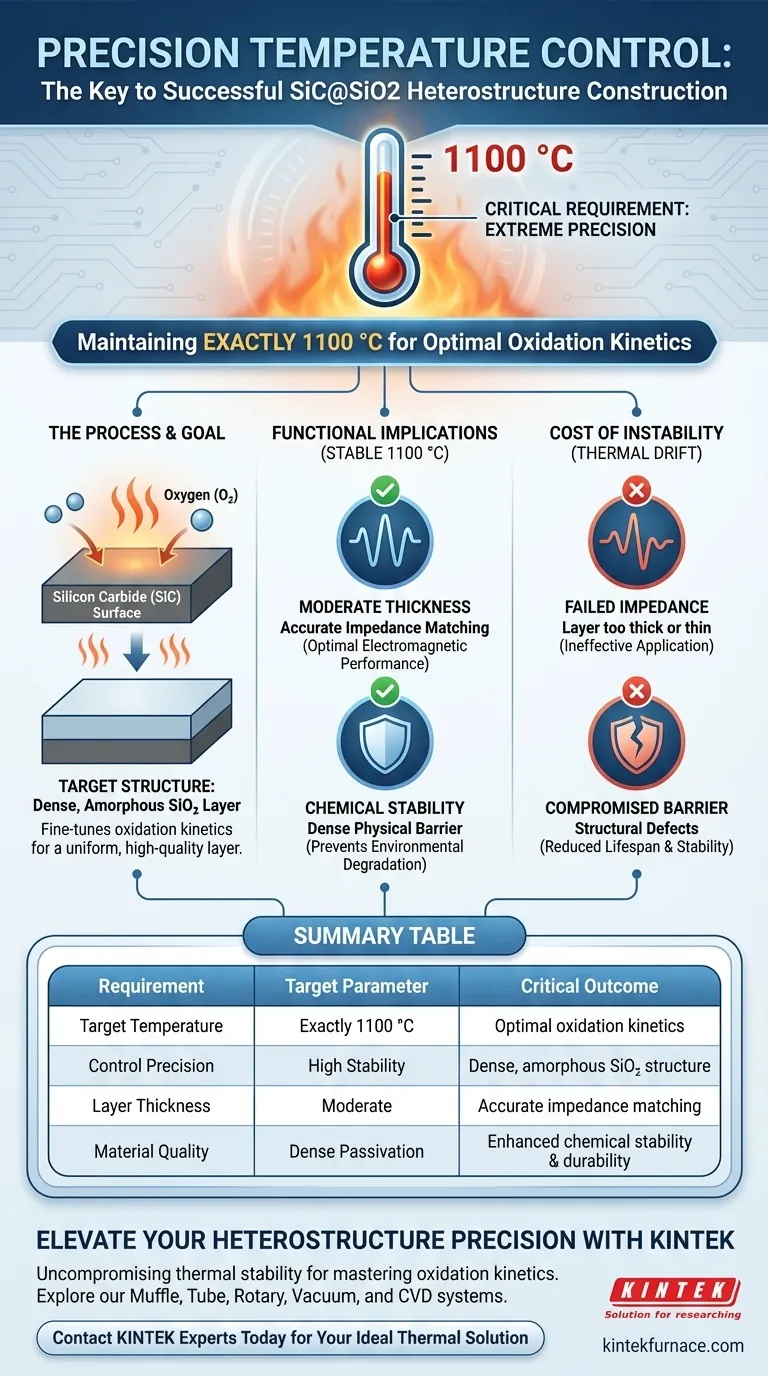
The success of SiC@SiO2 heterostructure construction depends on stabilizing reaction kinetics at 1100 °C. Precise thermal control is the only mechanism that ensures the formation of a dense, amorphous SiO2 layer with the moderate thickness required for optimal performance.
The Role of Precision in Oxidation Kinetics
Controlling Reaction Rates
At 1100 °C, the chemical interaction between Silicon Carbide and oxygen is highly sensitive. The heating equipment must offer precision control to fine-tune the oxidation kinetics.
This ensures the reaction proceeds at a predictable and constant rate. Any fluctuation in temperature will alter the speed of oxidation, leading to inconsistent material properties.
Forming the Target Structure
The ultimate goal of this thermal stage is to create a dense, amorphous SiO2 passivation layer.
This specific structural phase—dense and amorphous rather than porous or crystalline—can only be achieved if the temperature remains strictly regulated throughout the process.
Functional Implications of Thermal Control
Achieving Moderate Thickness
The thickness of the SiO2 layer is directly correlated to the temperature and duration of the oxidation.
The heating equipment must maintain stability to produce a layer of moderate thickness. This specific thickness is essential for adjusting impedance matching, a critical factor in the material's electromagnetic performance.
Ensuring Chemical Stability
The SiO2 layer serves as a physical barrier for the underlying SiC.
By maintaining precise heat, the equipment ensures the layer is sufficiently dense to provide robust chemical stability. This prevents environmental degradation of the core material.
The Cost of Thermal Instability
Risks to Impedance Matching
If the heating equipment lacks precision, the oxidation kinetics will drift.
This results in a passivation layer that is either too thick or too thin. Consequently, the impedance matching will fail, rendering the heterostructure ineffective for its intended application.
Compromised Barrier Integrity
Temperature fluctuations during the in-situ stage can lead to structural defects in the SiO2 layer.
A layer formed under unstable thermal conditions may lack the necessary density. This compromises its ability to act as a reliable physical barrier, reducing the overall lifespan and stability of the component.
Optimizing Your Heating Strategy
To ensure the successful construction of SiC@SiO2 heterostructures, select heating equipment based on the specific performance metrics you need to achieve.
- If your primary focus is Electromagnetic Performance: Prioritize equipment with minimal thermal drift to ensure the precise "moderate thickness" required for accurate impedance matching.
- If your primary focus is Long-Term Durability: Ensure the system can hold 1100 °C without fluctuation to guarantee the formation of a dense, amorphous barrier for maximum chemical stability.
The quality of your final heterostructure is ultimately defined by the stability of your thermal environment.
Summary Table:
| Requirement | Target Parameter | Critical Outcome |
|---|---|---|
| Target Temperature | Exactly 1100 °C | Optimal oxidation kinetics |
| Control Precision | High Stability | Dense, amorphous SiO2 structure |
| Layer Thickness | Moderate | Accurate impedance matching |
| Material Quality | Dense Passivation | Enhanced chemical stability & durability |
Elevate Your Heterostructure Precision with KINTEK
Successful SiC@SiO2 construction demands uncompromising thermal stability at 1100°C. KINTEK provides the advanced heating solutions required to master oxidation kinetics and achieve perfect impedance matching.
Backed by expert R&D and world-class manufacturing, we offer a comprehensive range of Muffle, Tube, Rotary, Vacuum, and CVD systems. Whether you are developing high-performance electromagnetic materials or robust semiconductor components, our lab high-temp furnaces are fully customizable to meet your unique research needs.
Ensure consistent results and superior material integrity—Contact KINTEK experts today to find your ideal thermal solution.
Visual Guide
References
- Limeng Song, Rui Zhang. Heterointerface‐Engineered SiC@SiO <sub>2</sub> @C Nanofibers for Simultaneous Microwave Absorption and Corrosion Resistance. DOI: 10.1002/advs.202509071
This article is also based on technical information from Kintek Furnace Knowledge Base .
Related Products
- 1400℃ Muffle Oven Furnace for Laboratory
- High Temperature Muffle Oven Furnace for Laboratory Debinding and Pre Sintering
- 1800℃ High Temperature Muffle Oven Furnace for Laboratory
- Laboratory Muffle Oven Furnace with Bottom Lifting
- 1700℃ High Temperature Laboratory Tube Furnace with Alumina Tube
People Also Ask
- How does a high-temperature laboratory muffle furnace affect material properties? Transform Anodic Oxide Films Fast
- What is the primary function of a high-temperature laboratory muffle furnace in chemical synthesis? Achieve Precision.
- How does a laboratory high-temperature muffle furnace contribute to the final formation of Bismuth Oxide nanosheets?
- How does a muffle furnace facilitate Ag/ATP catalyst preparation? Optimize Calcination for Superior Performance
- What role does a laboratory high-temperature muffle furnace play in the treatment of highly contaminated waste glass?



















