
Precision temperature control is the definitive factor in the successful synthesis of carbon nanotube (CNT) and aluminum nitride (AlN) composite fillers. Because CNT growth is highly sensitive to thermal fluctuations, a tube furnace must maintain exceptional stability at high processing temperatures, typically around 750°C. This rigorous thermal regulation is the only way to ensure that catalyst particle reduction and Chemical Vapor Deposition (CVD) occur within a constant, uniform field.
The ultimate performance of CNT/AlN composites depends on the physical alignment of the nanotubes. A precision-controlled tube furnace is strictly necessary to govern nucleation density and achieve vertical orientation, which directly dictates the material's final thermal conductivity.
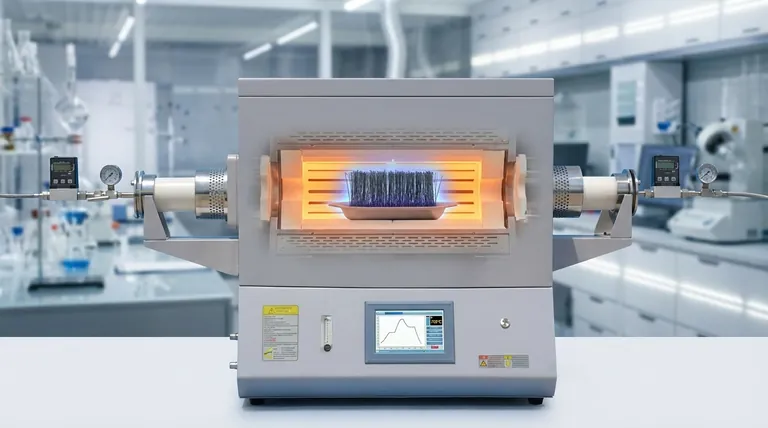
The Critical Role of Thermal Stability
Sensitivity of the CVD Process
The growth of carbon nanotubes via Chemical Vapor Deposition (CVD) is chemically volatile. The reaction kinetics are heavily influenced by the surrounding thermal environment. A tube furnace equipped with a precision control system mitigates this volatility by locking in a stable temperature profile.
Ensuring Uniform Catalyst Reduction
Before nanotubes can grow, the catalyst particles on the substrate must undergo reduction. This step requires a homogeneous thermal field to ensure every particle reacts simultaneously and identically. Without precision control, the reduction process becomes uneven, leading to inconsistent growth sites.
Governing Nucleation Density
The density of the nanotubes—how closely packed they are—is a function of temperature control. A specific, steady temperature triggers the nucleation of carbon atoms at the desired rate. Fluctuations at this stage would result in patchy or sparse coverage, compromising the integrity of the filler.
Direct Impact on Material Properties
Achieving Vertical Orientation
The primary goal in synthesizing these fillers is often high thermal conductivity. To achieve this, the CNTs must grow in a specific vertical orientation. The primary reference indicates that this structural alignment is a direct result of the rigorous temperature control provided by the furnace.
Determining Thermal Conductivity
The physical orientation of the nanotubes creates the pathways for heat transfer. If the temperature wavers, the growth direction becomes random (entangled). Precision heating ensures the vertical alignment necessary to maximize the thermal conductivity of the final CNT/AlN composite.
Understanding the Trade-offs
The Risk of Thermal Gradients
Even minor gradients within the furnace tube can lead to significant variations in material quality. If the temperature is not uniform across the entire length of the growth zone, the resulting composite will exhibit non-uniform properties. This leads to weak interface bonding and unpredictable performance in real-world applications.
Atmosphere Control Requirements
While temperature is the primary variable, the tube furnace must also manage the atmosphere. As noted in supplementary contexts, high-temperature synthesis often requires inert environments (such as nitrogen) to prevent oxidative loss. A precision furnace integrates temperature stability with atmosphere isolation to protect the carbon structures during growth.
Making the Right Choice for Your Goal
To select the correct furnace configuration for your synthesis, align your equipment capabilities with your specific material objectives:
- If your primary focus is maximizing thermal conductivity: Prioritize a furnace with tight PID control to ensure the vertical orientation and high nucleation density of the CNTs.
- If your primary focus is composite density and strength: Ensure the furnace is capable of reaching ultra-high temperatures (up to 1900°C) to facilitate full densification during the sintering phases.
The quality of your temperature control system effectively sets the ceiling for the performance quality of your final composite material.
Summary Table:
| Feature | Requirement for CNT/AlN Synthesis | Impact on Final Composite |
|---|---|---|
| Temperature Stability | Maintain stable ~750°C during CVD | Prevents chemical volatility and ensures uniform growth. |
| Thermal Uniformity | Homogeneous field across growth zone | Guarantees simultaneous catalyst reduction and nucleation. |
| Nucleation Density | Precise PID control | Governs the packing density of nanotubes on the substrate. |
| Structural Control | Rigorous thermal regulation | Enables vertical orientation for peak thermal conductivity. |
| Atmosphere Isolation | Inert environments (e.g., Nitrogen) | Prevents oxidative loss and protects carbon structures. |
Elevate Your Advanced Material Synthesis with KINTEK
Precision is the difference between a random entanglement and high-performance vertical alignment. KINTEK provides the industry-leading R&D and manufacturing expertise required to master complex synthesis like CNT/AlN composite fillers. Our Muffle, Tube, Rotary, Vacuum, and CVD systems are engineered for the rigorous thermal stability and atmosphere control your research demands.
Why choose KINTEK?
- Expert R&D: Systems designed to eliminate thermal gradients and maximize nucleation density.
- Fully Customizable: Tailored high-temp furnaces to meet your unique material specifications.
- Proven Reliability: Robust construction for consistent performance up to 1900°C.
Don't let thermal fluctuations limit your material's potential. Contact KINTEK today to discuss your custom furnace solution and achieve the superior thermal conductivity your project deserves.
References
- Naoyuki Matsumoto, Ken Kokubo. Enhancing the Thermal Conductivity of CNT/AlN/Silicone Rubber Composites by Using CNTs Directly Grown on AlN to Achieve a Reduced Filler Filling Ratio. DOI: 10.3390/nano14060528
This article is also based on technical information from Kintek Furnace Knowledge Base .
Related Products
- 1200℃ Controlled Inert Nitrogen Atmosphere Furnace
- 1400℃ High Temperature Laboratory Tube Furnace with Alumina Tube
- 1700℃ High Temperature Laboratory Tube Furnace with Alumina Tube
- Magnesium Extraction and Purification Condensing Tube Furnace
- Vertical Laboratory Quartz Tube Furnace Tubular Furnace
People Also Ask
- What controlled-atmosphere furnace conditions are required for sintering powder metallurgy copper alloy compacts? Ideal Setup
- What factors should be considered when choosing a controlled atmosphere furnace? Ensure Optimal Performance for Your Materials
- What are the advantages of a controlled atmosphere furnace over tube furnaces? Superior Process Control for Sensitive Materials
- What causes discrepancies between theoretical and experimental grain boundary mobility during ceramic sintering? Explained
- What are the operational considerations for a controlled atmosphere furnace? Master Key Factors for Material Processing



















