
A nitrogen-protected atmosphere is strictly necessary to establish an inert environment that prevents material degradation during the heating process. Without this gas shield, oxygen would react with both the highly crystalline carbon (HCC) and the phosphorus source at the required 650 °C temperature, leading to combustion rather than doping.
Core Takeaway The primary function of nitrogen in this process is to exclude oxygen, thereby inhibiting oxidative combustion and preserving the structural integrity of the carbon lattice. This stable, inert environment is the fundamental prerequisite for achieving precise, in-situ phosphorus doping.
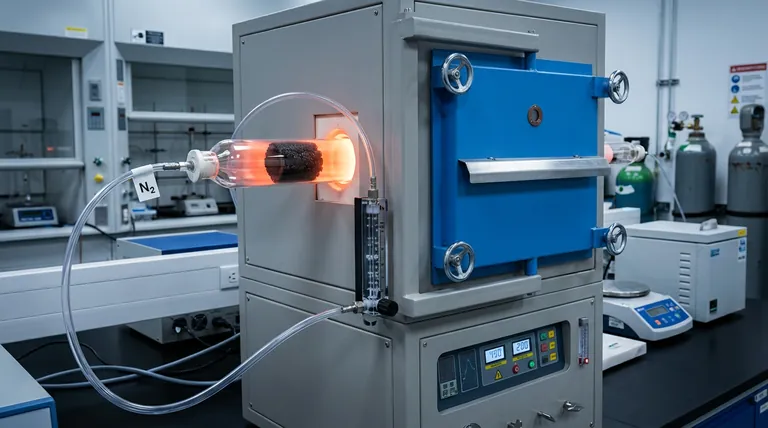
The Critical Role of Inert Gases
Preventing Oxidative Combustion
At temperatures reaching 650 °C and above, carbon materials are highly susceptible to oxidation.
If oxygen is present, the carbon will undergo oxidative combustion, effectively burning the material away.
A continuous nitrogen flow completely excludes oxygen, preventing the carbon from turning into ash or gas (CO2) during the process.
Protecting the Phosphorus Source
The phosphorus source used for doping is equally vulnerable to high-temperature oxidation.
If the phosphorus oxidizes before it can integrate into the carbon, the doping process will fail.
Nitrogen ensures the phosphorus remains chemically available to bond with the carbon lattice rather than reacting with the atmosphere.
Preserving Structural Integrity
Maintaining the Graphitized Structure
High-temperature treatment is intended to modify the carbon's electronic properties, not destroy its physical framework.
The nitrogen atmosphere preserves the structural integrity of graphitized carbon and highly crystalline carbon (HCC).
By preventing surface degradation, the furnace maintains the specific pore structures required for the material's final application.
Controlling In-Situ Doping
Successful doping requires the substitution of carbon atoms with phosphorus atoms within the lattice.
This reaction requires a stable, non-reactive environment to be controlled precisely.
Nitrogen provides the "blank slate" environment that allows this in-situ doping to occur efficiently without interference from atmospheric contaminants.
Operational Trade-offs
Nitrogen vs. Noble Gases
While nitrogen is effective for carbon-phosphorus doping at 650 °C, it is not a "noble" gas like Argon.
At extremely high temperatures (often >1000 °C) or with specific reactive metals, nitrogen can sometimes react to form nitrides.
However, for standard phosphorus doping of carbon, nitrogen offers the best balance of cost-effectiveness and chemical inertness.
Flow Rate Management
A static nitrogen fill is rarely sufficient; the process usually requires a continuous flow.
If the flow rate is too low, back-diffusion of oxygen can occur, compromising the inert environment.
Conversely, an excessively high flow rate might disturb loose powders or cool the sample surface unevenly, affecting the consistency of the thermal field.
Making the Right Choice for Your Goal
To ensure the success of your high-temperature doping process, align your atmosphere control with your specific objectives:
- If your primary focus is Structural Preservation: Ensure a continuous nitrogen flow is established before heating begins to flush all oxygen and prevent early-stage oxidation.
- If your primary focus is Doping Efficiency: Verify that the furnace seals are airtight to maintain a strictly inert environment at 650 °C, ensuring the phosphorus reacts only with the carbon.
The success of high-temperature doping relies not just on heat, but on the absolute exclusion of oxygen to allow precise chemical restructuring.
Summary Table:
| Feature | Role of Nitrogen Atmosphere | Impact of Oxygen Presence |
|---|---|---|
| Material Integrity | Preserves HCC and graphitized carbon structure | Causes oxidative combustion (material turns to ash) |
| Doping Source | Protects phosphorus from premature oxidation | Renders phosphorus source chemically unavailable |
| Doping Type | Enables precise in-situ lattice substitution | Leads to uncontrolled atmospheric contamination |
| Atmosphere Type | Cost-effective inert environment | Highly reactive/combustive environment |
| Heat Stability | Maintains a stable thermal field | Disturbed by exothermic combustion reactions |
Elevate Your Advanced Material Synthesis with KINTEK
Precision in phosphorus doping requires more than just heat—it demands an absolute controlled environment. KINTEK provides high-performance tube, vacuum, and CVD furnace systems specifically engineered to maintain the strict inert atmospheres necessary for carbon research.
Backed by expert R&D and manufacturing, our systems ensure airtight seals and stable gas flow management to prevent oxidation and preserve the integrity of your crystalline structures. Whether you need a standard setup or a customized solution for unique thermal field requirements, we are here to support your breakthrough.
Ready to optimize your doping process? Contact KINTEK today for expert consultation and customized high-temp solutions.
References
- Phosphorus‐Doped Highly Crystalline Carbon for High Platinum Stability and Robust Support in Proton‐Exchange Membrane Fuel Cells. DOI: 10.1002/smtd.202500481
This article is also based on technical information from Kintek Furnace Knowledge Base .
Related Products
- 1200℃ Controlled Inert Nitrogen Atmosphere Furnace
- 1400℃ Controlled Inert Nitrogen Atmosphere Furnace
- 1700℃ Controlled Inert Nitrogen Atmosphere Furnace
- Controlled Inert Nitrogen Hydrogen Atmosphere Furnace
- Mesh Belt Controlled Atmosphere Furnace Inert Nitrogen Atmosphere Furnace
People Also Ask
- What controlled-atmosphere furnace conditions are required for sintering powder metallurgy copper alloy compacts? Ideal Setup
- How Sintering Temp Affects Density & Resistivity of Cu-Oxide Composites
- What are the four main types of controlled atmospheres used in these furnaces? Optimize Your Heat Treatment Processes
- How does a controlled atmosphere furnace prevent oxidation and decarburization? Master Precision Heat Treatment
- How do surface oxide layers on ceramic powders like silicon nitride affect sintering? Master Atmosphere Control



















