
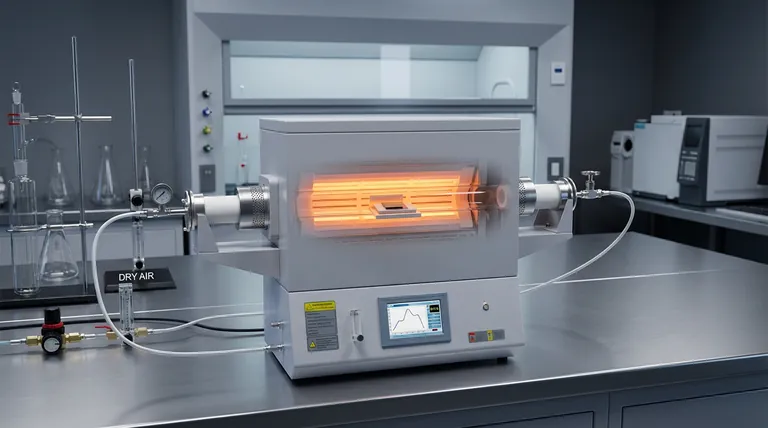
A high-temperature tube furnace serves as the critical control environment for stabilizing and optimizing Ge-doped Zinc Oxide (Ge:ZnO) thin films. It provides a stable thermal setting combined with a controlled flow of dry air to facilitate post-deposition annealing. By processing the films at specific temperatures, such as 523 K (250°C) or 673 K (400°C), the furnace drives essential structural and chemical changes that determine the material's final utility.
Core Takeaway The tube furnace functions not merely as a heater, but as a regulator of defects and crystallinity. Its primary role is to drive film recrystallization and fill oxygen vacancies, which are the two decisive factors in tuning the material's electrical carrier concentration and mobility.
The Mechanics of Structural Enhancement
Facilitating Recrystallization
The deposition process often leaves thin films in a disordered or semi-amorphous state. The tube furnace provides the thermal energy required to overcome the activation energy barrier for atomic rearrangement.
Improving Crystal Quality
Through precise temperature maintenance, the furnace enables the Ge:ZnO film to undergo recrystallization. This transition from a disordered structure to a more ordered crystalline lattice reduces structural imperfections and enhances the overall integrity of the material.
Chemical Regulation and Atmosphere Control
The Role of Dry Air
Unlike processes requiring vacuum or inert gases (like Argon) to prevent oxidation, Ge:ZnO processing specifically leverages a dry air environment. The tube furnace allows for the controlled introduction of this atmosphere during the heating cycle.
Filling Oxygen Vacancies
The presence of oxygen in the annealing environment is chemically active. It helps fill oxygen vacancies—defects where an atom is missing from the lattice site—within the Ge:ZnO film. Controlling these vacancies is crucial because they act as intrinsic donors that heavily influence conductivity.
Tuning Electrical Performance
Regulating Carrier Concentration
The furnace acts as a tuning knob for the film's electronic properties. By filling oxygen vacancies, the process modifies the background carrier concentration, allowing engineers to target specific electrical specifications.
Enhancing Mobility
As the crystal quality improves and grain boundaries potentially settle, the scattering of charge carriers is reduced. This results in improved carrier mobility, making the material more efficient for electronic or optoelectronic applications.
Understanding the Process Sensitivities
Temperature Precision
The specific temperatures mentioned—523 K and 673 K—indicate that this is not a linear "hotter is better" process. The furnace must hold these specific set points accurately. Deviating from these windows can fail to induce the necessary recrystallization or alter the defect density unpredictably.
Atmosphere Dependence
Success relies heavily on the chemical composition of the airflow. Using an inert atmosphere (like Nitrogen or Argon) instead of dry air would fail to replenish the oxygen vacancies, leading to fundamentally different electrical properties than those intended for standard Ge:ZnO applications.
Making the Right Choice for Your Goal
When configuring a tube furnace for Ge:ZnO annealing, align your parameters with your specific material objectives:
- If your primary focus is Structural Integrity: Prioritize the stability of the thermal profile at 523 K or 673 K to ensure complete recrystallization and uniform grain structure.
- If your primary focus is Electrical Tuning: Concentrate on the flow rate and purity of the dry air supply, as the oxygen interaction is the primary lever for adjusting carrier concentration.
Ultimately, the tube furnace transforms the Ge:ZnO film from a raw deposited layer into a functional electronic material by strictly governing its thermodynamic and chemical evolution.
Summary Table:
| Process Parameter | Effect on Ge:ZnO Thin Film | Objective |
|---|---|---|
| Recrystallization | Transforms disordered atoms into an ordered lattice | Enhances structural integrity and crystal quality |
| Dry Air Atmosphere | Fills oxygen vacancies within the lattice | Regulates electrical conductivity and carrier concentration |
| Temperature Control | Precision heating at 523 K or 673 K | Ensures uniform grain growth and mobility enhancement |
| Defect Regulation | Reduces structural imperfections | Optimizes material for optoelectronic applications |
Elevate Your Material Research with KINTEK Precision
Unlock the full potential of your Ge:ZnO thin films with high-performance thermal solutions. Backed by expert R&D and manufacturing, KINTEK offers a comprehensive range of Muffle, Tube, Rotary, Vacuum, and CVD systems, all fully customizable to meet your specific research or production needs.
Whether you require precise atmosphere control for oxygen vacancy filling or ultra-stable temperature profiles for recrystallization, our expert team is ready to design the perfect furnace for your laboratory.
Contact KINTEK today to discuss your unique requirements!
References
- Rafał Knura, Robert P. Socha. Evaluation of the Electronic Properties of Atomic Layer Deposition-Grown Ge-Doped Zinc Oxide Thin Films at Elevated Temperatures. DOI: 10.3390/electronics13030554
This article is also based on technical information from Kintek Furnace Knowledge Base .
Related Products
- 1700℃ High Temperature Laboratory Tube Furnace with Alumina Tube
- 1700℃ Controlled Inert Nitrogen Atmosphere Furnace
- 1400℃ High Temperature Laboratory Tube Furnace with Alumina Tube
- 1400℃ Controlled Inert Nitrogen Atmosphere Furnace
- 1200℃ Controlled Inert Nitrogen Atmosphere Furnace
People Also Ask
- How do high-temperature laboratory tube furnaces ensure environmental stability? Precision Thermal Reduction Tips
- How are high-temperature laboratory tube furnaces applied in long-term vacuum homogenization heat treatments for intermetallic samples?
- How are high-temp tube furnaces used to measure diffusion coefficients per Fick's law? Master Precision Annealing
- How are high-temperature tube furnaces applied in testing ceramic-supported alloy membranes? Insights
- In what scenarios are laboratory high-temperature tube furnaces or muffle furnaces utilized? Study MgTiO3-CaTiO3 Ceramics



















