
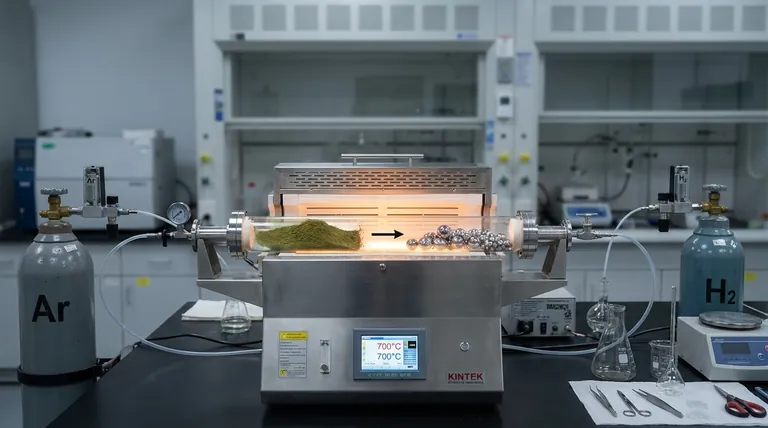
A tube furnace with atmosphere control is mandatory for this process because it provides the strictly regulated reductive environment required to chemically transform the precursor material. Specifically, it enables the introduction of reducing gases, such as hydrogen mixed with argon, to strip oxygen from the Nickel-Iron Layered Double Hydroxide (NiFe LDH) and convert the metal ions into a metallic alloy without them oxidizing at high temperatures.
The core function of this equipment is to maintain a constant reductive atmosphere. This ensures the reduction of metal ions to a zero-valent state, facilitating the formation of a face-centered cubic metal alloy phase while strictly preventing re-oxidation.
The Critical Role of a Reductive Atmosphere
Achieving the Zero-Valent State
The primary chemical goal is to transform the metal ions within the LDH precursor into a zero-valent state.
This chemical reduction cannot occur in normal air. A tube furnace allows for the introduction of a specific gas mixture, typically hydrogen (H2) and argon (Ar) or nitrogen (N2).
The Mechanism of Hydrogen Reduction
Hydrogen acts as the active reducing agent in this process.
By maintaining a concentration (e.g., 5 vol% H2) within the tube, the furnace facilitates a reaction that removes oxygen ligands from the metal precursors. This is the fundamental step in converting the hydroxide structure into a pure metallic alloy.
Precision in Thermal Processing
Controlling the Crystal Structure
The conversion process aims to create a specific face-centered cubic (FCC) metal alloy phase.
To achieve this specific crystalline structure, the material must undergo precise temperature ramping. The tube furnace provides the thermal stability and control necessary to guide the atoms into this dense, stable arrangement.
Preventing High-Temperature Oxidation
At the high temperatures required for alloying, metals are extremely susceptible to reacting with oxygen.
If this process were attempted in an open-air environment, the metals would immediately oxidize rather than forming an alloy. The sealed nature of the tube furnace creates an oxygen-free zone, shielding the newly formed alloy from degradation.
Understanding the Trade-offs
Tube Furnace vs. Muffle Furnace
It is a common error to assume a standard muffle furnace can perform this task.
While muffle furnaces are effective for general heating in air, they lack the ability to control the internal atmosphere precisely. They cannot safely contain the reducing gases (hydrogen) required to strip the oxygen from the NiFe LDH.
Complexity and Safety Implications
Using a tube furnace with combustible gases like hydrogen introduces safety and operational complexity.
Operators must manage gas flow rates and seal integrity meticulously. However, this complexity is the unavoidable cost of achieving the chemical reduction necessary for high-performance catalyst synthesis.
Making the Right Choice for Your Goal
To ensure the successful synthesis of NiFe alloy catalysts, you must align your equipment with your chemical requirements.
- If your primary focus is synthesizing pure metal alloys: You must use a tube furnace with a hydrogen/argon or hydrogen/nitrogen line to ensure complete reduction to the zero-valent state.
- If your primary focus is simple calcination (oxide formation): A standard muffle furnace is sufficient, as you do not need to prevent oxidation or strip oxygen ligands.
Ultimately, the tube furnace is not just a heat source; it is a chemical reactor that dictates the final composition of your catalyst.
Summary Table:
| Feature | Tube Furnace (Atmosphere Control) | Standard Muffle Furnace |
|---|---|---|
| Atmosphere Type | Reductive (H2/Ar) or Inert | Oxidizing (Ambient Air) |
| Chemical Goal | Zero-valent state (Alloy) | Metal Oxide formation |
| Oxygen Exclusion | Complete (Sealed Tube) | None |
| Phase Control | FCC Metal Alloy Phase | Oxide Crystalline Phase |
| Primary Use | Catalyst Synthesis & Alloying | Calcination & Ashing |
Elevate Your Material Synthesis with KINTEK Precision
Successful conversion of NiFe LDH into high-performance alloys requires absolute control over your thermal environment. At KINTEK, we specialize in providing high-performance Tube, Vacuum, and CVD systems designed specifically for sensitive reduction processes.
Our equipment offers:
- Precise Atmosphere Management: Expertly engineered for safe hydrogen and inert gas integration.
- Superior Thermal Uniformity: Ensuring consistent crystalline phase transitions.
- Customizable Solutions: Tailored configurations for your unique R&D and manufacturing requirements.
Don't compromise your catalyst purity with inadequate heating. Contact our expert engineering team today to find the perfect customizable furnace for your laboratory needs.
Visual Guide

References
- Yifan Gu, Yi Feng. A Novel Cyclized Polyacrylonitrile Binder Strategy for Efficient Oxygen Evolution Reaction Catalysts. DOI: 10.3390/polym17182477
This article is also based on technical information from Kintek Furnace Knowledge Base .
Related Products
- 1200℃ Controlled Inert Nitrogen Atmosphere Furnace
- Mesh Belt Controlled Atmosphere Furnace Inert Nitrogen Atmosphere Furnace
- Controlled Inert Nitrogen Hydrogen Atmosphere Furnace
- 1700℃ Controlled Inert Nitrogen Atmosphere Furnace
- Slide PECVD Tube Furnace with Liquid Gasifier PECVD Machine
People Also Ask
- What controlled-atmosphere furnace conditions are required for sintering powder metallurgy copper alloy compacts? Ideal Setup
- What Roles Do a Controlled Atmosphere Furnace and Oil Quenching Tank Play in AISI 5140 Steel Heat Treatment?
- What factors should be considered when choosing a controlled atmosphere furnace? Ensure Optimal Performance for Your Materials
- Why is a controlled atmosphere furnace required for 316L debinding? Ensure Structural Integrity & Zero Cracks
- What are the operational advantages of using a controlled atmosphere furnace? Boost Quality and Efficiency in Heat Treatment



















