
A laboratory vacuum oven is strictly necessary for drying degraded LTGP samples because it eliminates the risk of secondary atmospheric reactions while removing moisture at safe, low temperatures. Specifically, it prevents the sample surface from reacting with carbon dioxide in the air, which would otherwise form lithium carbonate impurities and falsify the results of subsequent surface analyses.
Core Takeaway Atmospheric drying introduces artifacts—such as oxidation, surface crusts, and carbonate contaminants—that obscure the true effects of experimental erosion. A vacuum oven isolates the sample from these variables, ensuring that data gathered from XRD or SEM analysis reflects the material’s intrinsic properties rather than the drying process itself.
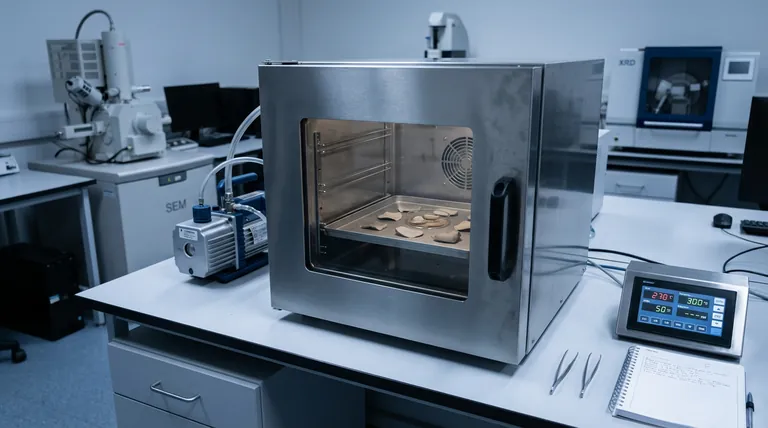
Preserving Chemical Purity
The primary function of the vacuum oven in this context is to act as a shield against chemical contamination during the transition from liquid immersion to dry analysis.
Preventing Secondary Carbonation
When LTGP samples are exposed to air while wet, the lithium components on the surface are highly susceptible to reacting with atmospheric carbon dioxide.
This reaction generates lithium carbonate impurities. If these impurities form, they overlay the actual sample surface, masking the true chemical state of the material.
Ensuring Analytical Validity
For techniques like X-Ray Diffraction (XRD) or Scanning Electron Microscopy (SEM), data integrity is paramount.
You need to observe the morphology and phases resulting specifically from alkaline liquid erosion.
By removing the atmosphere, the vacuum oven ensures that any degradation observed is a result of your experiment, not a secondary artifact created during the drying phase.
Protecting Physical Structure
Beyond chemical composition, the physical architecture of the sample must remain unaltered. High heat and atmospheric pressure can mechanically damage degraded samples.
Avoiding Thermal Degradation
Degraded samples are often fragile. Standard drying requires heat that might accelerate decomposition or oxidation.
Vacuum ovens lower the pressure within the chamber, which significantly depresses the boiling point of solvents like water or ethanol.
This allows for rapid, effective drying at low temperatures, preserving heat-sensitive structures from thermal shock.
Eliminating Surface Hardening
Atmospheric drying often causes solvents to evaporate from the surface first, creating a hard "crust."
This crust traps internal moisture and distorts the sample's geometry.
Vacuum drying promotes uniform evaporation, preventing surface hardening and ensuring the internal structure remains open and representative.
Optimizing for Porosity Analysis
If your analysis includes surface area testing (BET) or pore size distribution, vacuum drying is non-negotiable.
clearing Micropores
Solvent molecules often become adsorbed deep within ultra-fine micropores or clustered powder structures.
Atmospheric drying lacks the "pull" to extract these molecules effectively.
The negative pressure of a vacuum oven thoroughly degasses these pores, preventing adsorbed substances from blocking them and causing significant deviations in porosity data.
Common Pitfalls to Avoid
While vacuum drying is superior, it requires precise operation to yield the best results.
Incomplete Degassing
Simply lowering the pressure is not enough; the process requires time to evacuate moisture trapped in deep clusters.
Rushing this step can leave residual solvent, which may outgas during high-vacuum SEM imaging, destabilizing the electron beam.
Temperature Mismanagement
Even under vacuum, setting the temperature too high can damage delicate organic coatings or interfaces.
Always operate at the lowest effective temperature (e.g., around 60°C for many composites) to maintain structural integrity while relying on the vacuum to drive evaporation.
Making the Right Choice for Your Goal
The specific drying protocol should align with the analytical technique you intend to use next.
- If your primary focus is Phase Identification (XRD): Prioritize vacuum levels that strictly exclude air to prevent the formation of lithium carbonate peaks that confuse the diffractogram.
- If your primary focus is Morphological Imaging (SEM): Ensure the drying cycle is long enough to prevent surface hardening, which can look like experimental erosion but is actually a drying artifact.
- If your primary focus is Porosity (BET): Utilize the vacuum to deep-clean micropores, ensuring that adsorbed solvents do not skew surface area calculations.
Use the vacuum oven not just to dry your sample, but to freeze its state at the precise moment your experiment ended.
Summary Table:
| Feature | Atmospheric Drying Risk | Vacuum Oven Benefit |
|---|---|---|
| Chemical Purity | Forms lithium carbonate impurities | Eliminates atmospheric reactions |
| Thermal Safety | Risk of oxidation/decomposition | Low-temp drying via boiling point depression |
| Physical Structure | Surface hardening & crust formation | Uniform evaporation; preserves morphology |
| Porosity Accuracy | Trapped solvents in micropores | Complete degassing for BET/surface area |
| Data Validity | Introduces artifacts and false peaks | Reflects material's intrinsic properties |
Protect Your Research Integrity with KINTEK
Don't let drying artifacts compromise your surface analysis. Backed by expert R&D and manufacturing, KINTEK offers high-performance Vacuum Ovens specifically designed to protect sensitive samples like LTGP from carbonation and thermal shock. Whether you need precise temperature control or custom configurations for CVD and high-temp processing, our lab systems are tailored to your unique research needs.
Ready to upgrade your lab's drying precision? Contact us today to find your custom solution!
References
- Benjamin X. Lam, Gerbrand Ceder. Degradation Mechanism of Phosphate‐Based Li‐NASICON Conductors in Alkaline Environment. DOI: 10.1002/aenm.202403596
This article is also based on technical information from Kintek Furnace Knowledge Base .
Related Products
- High Pressure Laboratory Vacuum Tube Furnace
- Laboratory Vacuum Tilt Rotary Tube Furnace Rotating Tube Furnace
- Vacuum Heat Treat Sintering and Brazing Furnace
- Laboratory Muffle Oven Furnace with Bottom Lifting
- 1200℃ Muffle Oven Furnace for Laboratory
People Also Ask
- What role does a high vacuum tube furnace play in Co-Al sintering? Master High-Purity Porous Material Synthesis
- What are the different types of tube furnaces available? Find the Perfect Fit for Your Lab's Needs
- What are the main advantages of vacuum tube furnaces in the market? Achieve Purity and Precision in Material Processing
- What is the role of a vacuum tube furnace during the final thermal treatment stage of Fe3O4@CSAC catalysts?
- Why is a laboratory tube furnace necessary for BiVO4/RGO synthesis? Achieve Precise Nano-Structure Control



















