
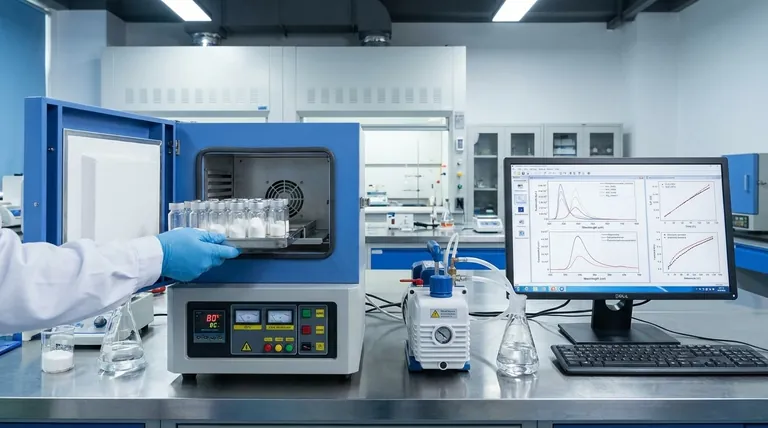
A laboratory vacuum drying oven is indispensable for processing sensitive nano metal-organic framework (MOF) materials like nLn-bdc. By significantly reducing the system pressure, the oven forces residual washing solvents—specifically ethanol—to evaporate rapidly at much lower temperatures than standard atmospheric drying would require.
By decoupling evaporation from high heat, vacuum drying preserves the delicate crystalline structure of nano MOFs. This process is the only reliable way to ensure the material's pores remain open and active for subsequent photoluminescence and electrical property measurements.
Preserving Structural Integrity
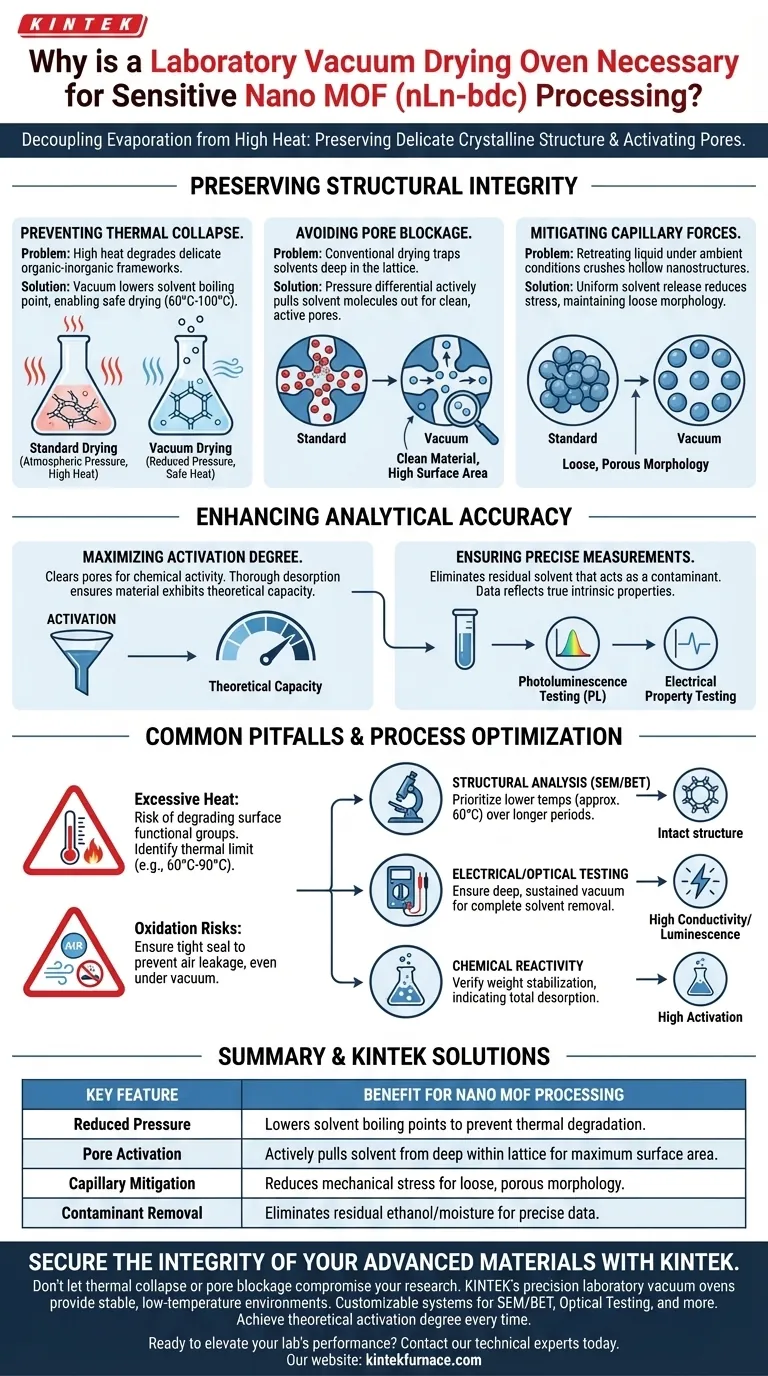
Preventing Thermal Collapse
The primary danger to nano MOF materials like nLn-bdc is heat sensitivity. High temperatures required to dry these materials at normal air pressure can cause the delicate organic-inorganic framework to collapse or degrade.
By lowering the pressure, the vacuum oven lowers the boiling point of solvents. This allows you to remove moisture and ethanol at safe temperatures (often between 60°C and 100°C), ensuring the skeletal structure remains intact.
Avoiding Pore Blockage
For an MOF to function, its pores must be empty. Conventional drying often leaves trapped solvent molecules deep within the lattice.
Vacuum drying creates a pressure differential that actively pulls these solvent molecules out of the pores. This prevents pore blockage, resulting in a "clean" material with a high surface area available for interaction.
Mitigating Capillary Forces
When solvents evaporate from nanostructures under ambient conditions, the retreating liquid can create strong capillary forces. These forces are often strong enough to crush hollow nanostructures or cause agglomeration.
The vacuum environment facilitates a more uniform release of solvents. This reduces the mechanical stress on the material, maintaining the loose, porous morphology required for optimal performance.
Enhancing Analytical Accuracy
Maximizing Activation Degree
"Activation" refers to the process of clearing the pores to make the MOF chemically active. A material that retains solvent is considered partially inactive.
The thorough removal of physically adsorbed molecules via vacuum drying maximizes the activation degree. This ensures that the material exhibits its theoretical capacity during application.
Ensuring Precise Measurements
Analytical techniques such as photoluminescence and electrical property testing are highly sensitive to impurities. Residual solvent acts as a contaminant that can skew results.
Vacuum drying eliminates these artifacts. It ensures that the data you collect reflects the true intrinsic properties of the nLn-bdc framework, rather than the noise of trapped ethanol or moisture.
Common Pitfalls to Avoid
The Risk of Excessive Heat
While vacuum allows for lower temperatures, it does not make the material immune to heat. Even under vacuum, setting the oven temperature too high can still degrade surface functional groups.
You must identify the specific thermal limit of your MOF (e.g., nLn-bdc) and set the vacuum oven well below this threshold. The references suggest ranges between 60°C and 90°C are often optimal for similar precursors.
Oxidation Risks
Although vacuum drying significantly reduces oxygen presence, it may not create a completely anaerobic environment depending on the pump quality.
If your material is extremely sensitive to oxidation, rely on the vacuum primarily to lower the boiling point, but ensure the seal is tight to prevent continuous air leakage during the drying cycle.
Optimizing the Process for Your Goals
To get the most out of your nLn-bdc processing, tailor your approach based on your specific testing requirements:
- If your primary focus is Structural Analysis (SEM/BET): Prioritize lower temperatures (approx. 60°C) over longer periods to prevent any morphological collapse or agglomeration.
- If your primary focus is Electrical/Optical Testing: Ensure a deep, sustained vacuum to guarantee the complete removal of all solvent molecules that could interfere with conductivity or luminescence.
- If your primary focus is Chemical Reactivity: Focus on the "activation" aspect by verifying that the final weight stabilizes, indicating total solvent desorption.
Vacuum drying is not just a drying step; it is a critical preservation technique that defines the quality of your final data.
Summary Table:
| Key Feature | Benefit for Nano MOF (nLn-bdc) Processing |
|---|---|
| Reduced Pressure | Lowers solvent boiling points to prevent thermal degradation of organic frameworks. |
| Pore Activation | Actively pulls solvent molecules from deep within the lattice to maximize surface area. |
| Capillary Mitigation | Reduces mechanical stress during evaporation to maintain loose, porous morphology. |
| Contaminant Removal | Eliminates residual ethanol/moisture for precise photoluminescence and electrical testing. |
Secure the Integrity of Your Advanced Materials with KINTEK
Don't let thermal collapse or pore blockage compromise your research data. KINTEK’s precision laboratory vacuum ovens are engineered to provide the stable, low-temperature environments essential for sensitive nano-materials like MOFs.
Backed by expert R&D and manufacturing, KINTEK offers a comprehensive range of Muffle, Tube, Rotary, Vacuum, and CVD systems, along with other lab high-temp furnaces—all fully customizable to meet your unique experimental needs. Whether you are focused on SEM/BET analysis or complex optical testing, our technology ensures your materials achieve their theoretical activation degree every time.
Ready to elevate your lab's performance? Contact our technical experts today to find the perfect customized heating solution for your application.
Visual Guide
References
- Moritz Maxeiner, Klaus Müller‐Buschbaum. NanoMOF‐Based Multilevel Anti‐Counterfeiting by a Combination of Visible and Invisible Photoluminescence and Conductivity. DOI: 10.1002/adfm.202500794
This article is also based on technical information from Kintek Furnace Knowledge Base .
Related Products
- 1200℃ Muffle Oven Furnace for Laboratory
- 1400℃ Muffle Oven Furnace for Laboratory
- High Temperature Muffle Oven Furnace for Laboratory Debinding and Pre Sintering
- Laboratory Muffle Oven Furnace with Bottom Lifting
- 1700℃ High Temperature Muffle Oven Furnace for Laboratory
People Also Ask
- What is the primary function of a high-temperature laboratory muffle furnace in chemical synthesis? Achieve Precision.
- How does a high-temperature laboratory muffle furnace affect material properties? Transform Anodic Oxide Films Fast
- How is a laboratory muffle furnace used in 3D-printed PP-CF cross-linking? Achieve Thermal Stability at 150 °C
- How is a laboratory high-temperature muffle furnace used to evaluate porous Co-Al materials? Precision Thermal Analysis
- What is the role of a laboratory high-temperature muffle furnace in iron analysis? Key to Precise Sample Mineralization








