
High-temperature laboratory furnace systems are primarily categorized into five distinct architectural types: Muffle furnaces, Tube furnaces, Rotary furnaces, Vacuum systems, and Chemical Vapor Deposition (CVD) systems. These specialized instruments are engineered to handle a broad spectrum of thermal processing and material synthesis tasks, bridging the gap between fundamental research and industrial manufacturing.
Core Takeaway The selection of a furnace system is not just about temperature capacity, but about the specific engineering required for your material; Muffle and Tube furnaces offer standard thermal processing, while specialized systems like Rotary, Vacuum, and CVD are designed for complex material synthesis and atmosphere control.
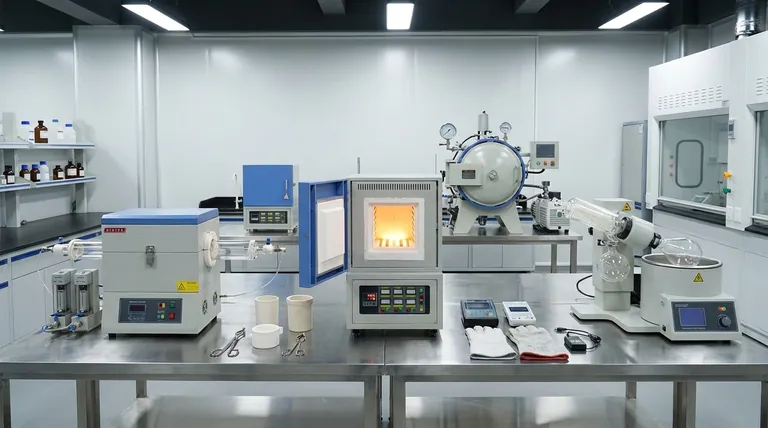
Categorizing Furnace Architectures
The available systems can be classified based on their engineering design and intended application utility.
Standard Thermal Processing
Muffle furnaces serve as the workhorse for general high-temperature applications. They are designed to isolate the material from the fuel and combustion byproducts, ensuring a clean heating environment.
Tube furnaces offer a different geometry, typically allowing for precise temperature uniformity along a cylindrical heating zone. These are often utilized when specific atmospheric controls or flow-through processing is required.
Dynamic Material Handling
Rotary furnaces introduce mechanical motion to the thermal process. By rotating the vessel during heating, these systems ensure continuous mixing of materials.
This dynamic action is critical for uniformity in processing granular materials or powders, preventing agglomeration that might occur in static furnaces.
Advanced Synthesis and Atmosphere Control
Vacuum systems allow for processing in the absence of air or other gases. This is essential for preventing oxidation or for processes that require a pristine, contaminant-free environment.
Chemical Vapor Deposition (CVD) systems represent a highly specialized category of furnace. These are engineered specifically for material synthesis, where thin films or coatings are deposited onto a substrate through chemical reactions in the vapor phase.
Understanding Operational Trade-offs
Selecting the correct system requires balancing the complexity of the equipment with the necessities of your research or production goals.
Complexity vs. Application
While a Muffle furnace is generally simpler and suitable for a wide range of basic heating tasks, it lacks the sophisticated atmosphere control of a CVD system.
Conversely, utilizing a complex Vacuum or CVD system for simple drying or calcination tasks would be an inefficient use of resources and introduce unnecessary maintenance overhead.
Static vs. Dynamic Processing
Choosing between static systems (like Tube or Muffle) and dynamic systems (like Rotary) represents a trade-off between material handling needs and mechanical complexity.
Static systems are robust and excellent for solid blocks or samples that do not require agitation, whereas Rotary furnaces are necessary for powders but introduce moving parts that may require distinct maintenance protocols.
Making the Right Choice for Your Goal
To ensure operational efficiency and data integrity, you must align the furnace architecture with your specific processing requirements.
- If your primary focus is general heating or drying: Prioritize Muffle furnaces for their ability to handle standard thermal processing requirements efficiently.
- If your primary focus is processing powders or granular materials: Consider Rotary furnaces to ensure uniform heating and mixing during the thermal cycle.
- If your primary focus is creating thin films or coatings: Utilize Chemical Vapor Deposition (CVD) systems which are specifically engineered for this type of material synthesis.
- If your primary focus is preventing oxidation or contamination: Select Vacuum systems or Tube furnaces that allow for strict control over the processing atmosphere.
The most effective laboratory setup matches the engineering of the furnace directly to the physical and chemical needs of the material being synthesized.
Summary Table:
| Furnace Type | Material Handling | Key Advantage | Best Application |
|---|---|---|---|
| Muffle | Static | Isolated clean heating | General heating & drying |
| Tube | Static/Flow | Precise atmosphere control | Continuous flow processing |
| Rotary | Dynamic | Continuous mixing | Powders & granular materials |
| Vacuum | Static | Prevents oxidation | Contaminant-free environments |
| CVD | Vapor Phase | Thin film synthesis | Advanced coatings & layers |
Optimize Your Thermal Processing with KINTEK
Don't let the wrong equipment limit your research potential. Whether you are conducting fundamental studies or scaling industrial material synthesis, KINTEK provides the precision engineering you need.
Backed by expert R&D and world-class manufacturing, we offer a comprehensive range of Muffle, Tube, Rotary, Vacuum, and CVD systems. Our lab high-temp furnaces are fully customizable to meet your unique thermal profiles and atmospheric requirements.
Ready to elevate your lab’s efficiency? Contact our technical experts today to find the perfect furnace solution for your specific application.
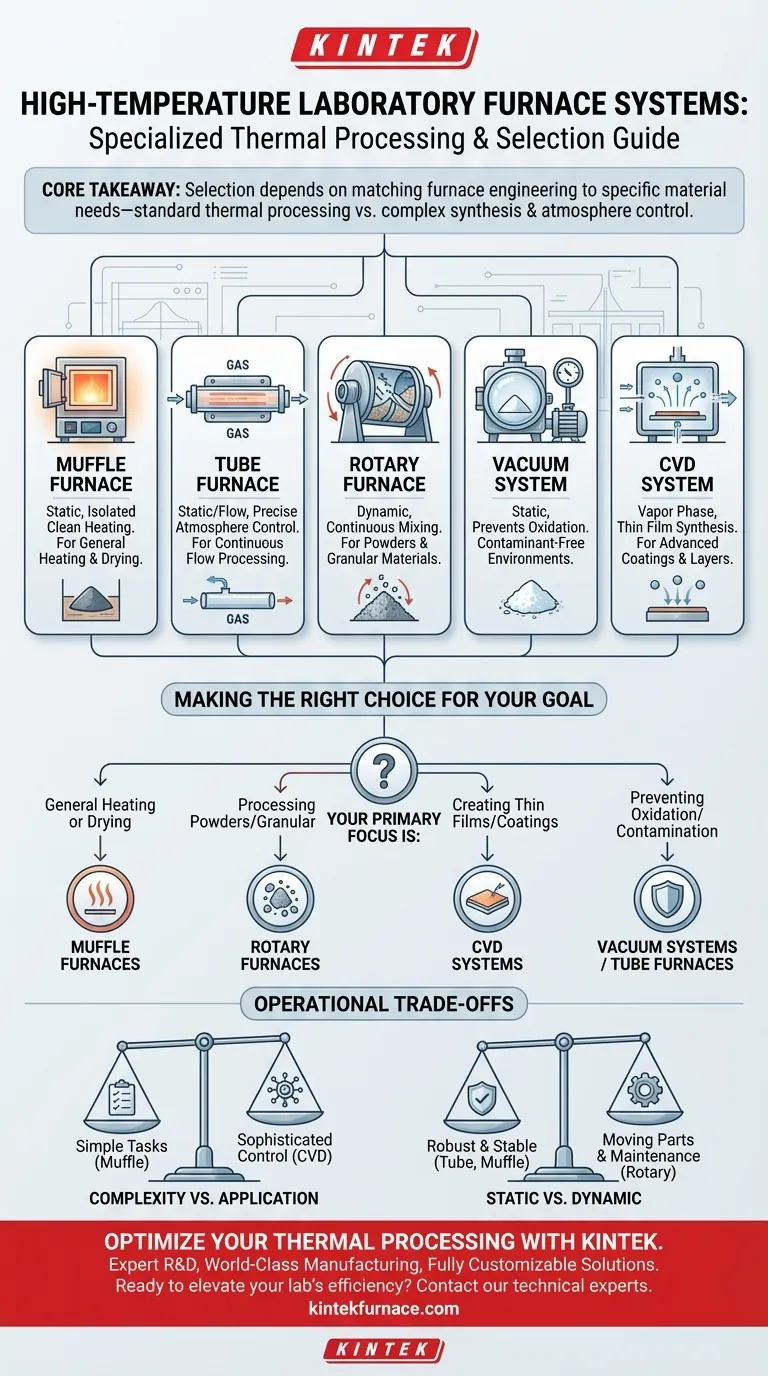
Visual Guide
References
- Manaswini Sahoo, G. Allodi. Ubiquitous Order‐Disorder Transition in the Mn Antisite Sublattice of the (MnBi<sub>2</sub>Te<sub>4</sub>)(Bi<sub>2</sub>Te<sub>3</sub>)<sub><i>n</i></sub> Magnetic Topological Insulators. DOI: 10.1002/advs.202402753
This article is also based on technical information from Kintek Furnace Knowledge Base .
Related Products
- 1400℃ High Temperature Laboratory Tube Furnace with Alumina Tube
- 1700℃ High Temperature Laboratory Tube Furnace with Alumina Tube
- 1800℃ High Temperature Muffle Oven Furnace for Laboratory
- 1700℃ High Temperature Muffle Oven Furnace for Laboratory
- 1200℃ Muffle Oven Furnace for Laboratory
People Also Ask
- How are high-temperature laboratory tube furnaces applied in long-term vacuum homogenization heat treatments for intermetallic samples?
- How do high-temperature laboratory tube furnaces ensure environmental stability? Precision Thermal Reduction Tips
- How are high-temp tube furnaces used to measure diffusion coefficients per Fick's law? Master Precision Annealing
- How are high-temperature tube furnaces applied in testing ceramic-supported alloy membranes? Insights
- How does a laboratory high-temperature tube furnace contribute to the conversion of electrospun fibers? Expert Insights



















