
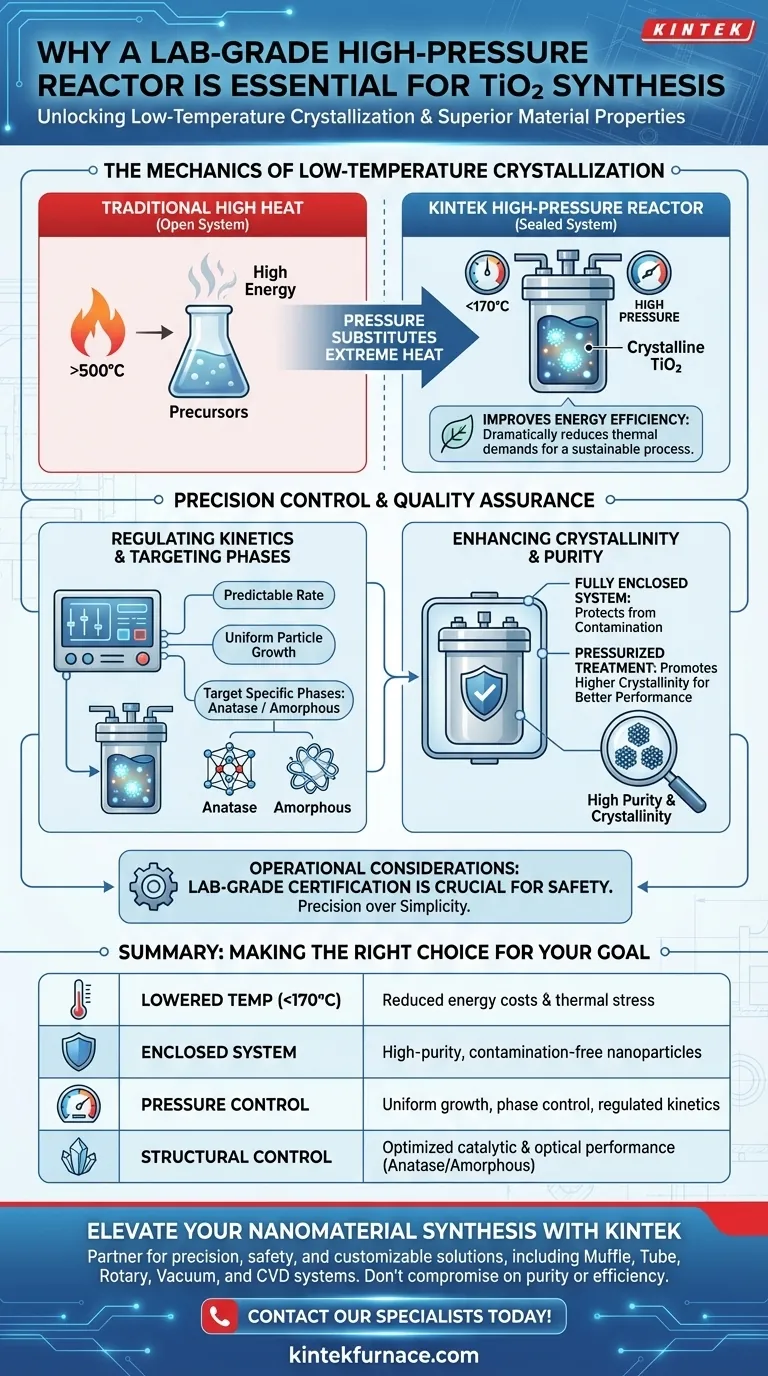
A laboratory-grade high-pressure reactor is the indispensable tool for accessing the specific thermodynamic conditions required to crystallize titanium precursors effectively. By providing a controlled pressure environment, this equipment enables synthesis at temperatures significantly lower than traditional methods—often below 170°C. This capability is essential for managing reaction kinetics to produce high-purity, crystalline TiO2 nanoparticles without the excessive energy demands of solid-state processing.
By leveraging a sealed, pressurized environment, these reactors decouple crystallization from high heat, allowing for the precise synthesis of specific TiO2 phases with superior purity and energy efficiency.

The Mechanics of Low-Temperature Crystallization
Utilizing Pressure to Lower Thermal Demands
The primary function of the high-pressure reactor is to substitute extreme heat with pressure.
In an open system, crystallization often requires intense thermal energy. However, within a sealed reactor, the elevated pressure allows titanium precursors to crystallize at temperatures below 170°C.
Improving Energy Efficiency
This dramatic reduction in processing temperature represents a significant shift from traditional solid-state synthesis.
By operating effectively at lower temperatures, the reactor minimizes the overall energy consumption of the process. This makes the hydrothermal or rotating autoclave method far more sustainable than high-heat alternatives.
Precision Control Over Material Properties
Regulating Reaction Kinetics
Achieving a high-quality nanomaterial requires strict command over how fast the reaction proceeds.
The enclosed system of a laboratory-grade reactor provides precise control over reaction kinetics. This ensures the chemical transformation occurs at a predictable rate, which is vital for uniform particle growth.
Targeting Specific Crystalline Phases
Titanium dioxide (TiO2) can exist in different structural forms, which determine its utility.
The controlled environment allows you to steer the synthesis toward specific desired phases, such as amorphous or anatase TiO2. Without the containment and pressure of this specific reactor, isolating these specific phases becomes incredibly difficult.
Purity and Quality Assurance
Enhancing Crystallinity
The ultimate goal of using a high-pressure reactor is to improve the internal structure of the nanoparticle.
The pressurized treatment directly promotes higher crystallinity in the final product. A highly crystalline structure is often essential for the catalytic or optical performance of TiO2.
Ensuring Product Purity
Contamination is a major risk in open-air synthesis methods.
Because the reactor operates as a fully enclosed system, it protects the reaction from external contaminants. This isolation guarantees a higher purity level in the final TiO2 nanoparticles.
Operational Considerations and Trade-offs
The Necessity of Laboratory-Grade Equipment
While the benefits are clear, it is crucial to recognize that standard vessels cannot substitute for this equipment.
Attempting to replicate these conditions in non-rated vessels poses severe safety risks due to the pressure involved. Laboratory-grade certification ensures the vessel can safely sustain the internal pressures required to drive the kinetics at low temperatures.
Complexity vs. Simplicity
Using a high-pressure reactor adds a layer of operational complexity compared to simple precipitation methods.
However, this complexity is the "cost" of accessing superior material properties. If you prioritize simple, ambient-pressure equipment, you sacrifice the ability to achieve high crystallinity at low temperatures.
Making the Right Choice for Your Goal
To maximize the effectiveness of your TiO2 synthesis, align your equipment choice with your specific research or production targets:
- If your primary focus is Energy Efficiency: Utilize the reactor to exploit the ability to crystallize precursors at temperatures below 170°C, significantly cutting thermal costs.
- If your primary focus is Phase Purity: Leverage the controlled pressure environment to target specific phases like anatase, ensuring the material meets precise structural specifications.
Ultimately, the high-pressure reactor is not just a vessel, but a precision instrument that grants you control over the fundamental physics of TiO2 crystallization.
Summary Table:
| Feature | Benefit for TiO2 Synthesis | Impact on Final Product |
|---|---|---|
| Lowered Temperature | Crystallization below 170°C | Reduced energy costs and thermal stress |
| Enclosed System | Contamination-free environment | High-purity crystalline nanoparticles |
| Pressure Control | Regulation of reaction kinetics | Uniform particle growth and phase control |
| Structural Control | Targeting Anatase or Amorphous phases | Optimized catalytic and optical performance |
Elevate Your Nanomaterial Synthesis with KINTEK
Precision is non-negotiable when crystallizing TiO2 phases. Backed by expert R&D and manufacturing, KINTEK offers a comprehensive range of Muffle, Tube, Rotary, Vacuum, and CVD systems, alongside specialized laboratory-grade high-pressure reactors—all fully customizable to meet your unique research needs.
Don't compromise on safety or material purity. Partner with KINTEK to access the thermal and pressure control necessary for superior crystallinity and energy efficiency.
Contact our specialists today to find the perfect solution for your lab!
Visual Guide
References
- A. C. W. W. M. N. Peshala Koswatta, Atula S. D. Sandanayaka. Boosting Solar Cell Efficiency: Enhancing Dye-Sensitized Solar Cell Performance with Carbon Quantum Dots and Titanium Dioxide Nanostructures from Sri Lankan Ilmenite. DOI: 10.1021/acsomega.5c02272
This article is also based on technical information from Kintek Furnace Knowledge Base .
Related Products
- High Pressure Laboratory Vacuum Tube Furnace
- 9MPa Air Pressure Vacuum Heat Treat and Sintering Furnace
- Custom Made Versatile CVD Tube Furnace Chemical Vapor Deposition CVD Equipment Machine
- MPCVD Machine System Reactor Bell-jar Resonator for Lab and Diamond Growth
- Vacuum Hot Press Furnace Machine Heated Vacuum Press
People Also Ask
- What role does a high vacuum tube furnace play in Co-Al sintering? Master High-Purity Porous Material Synthesis
- What are the different types of tube furnaces available? Find the Perfect Fit for Your Lab's Needs
- What are the main advantages of vacuum tube furnaces in the market? Achieve Purity and Precision in Material Processing
- What is the role of a vacuum tube furnace during the final thermal treatment stage of Fe3O4@CSAC catalysts?
- What conditions do tube furnaces provide for Au-Seeded TiO2 nanowires? Master Precision Thermal Synthesis



















