
A high-temperature tube furnace provides the critical thermal and chemical environment necessary to prepare substrates for high-quality graphene synthesis. Specifically, it subjects copper foil substrates to extreme heat (around 1040°C) within a controlled atmosphere of argon and hydrogen to engineer the surface at a microscopic level before growth begins.
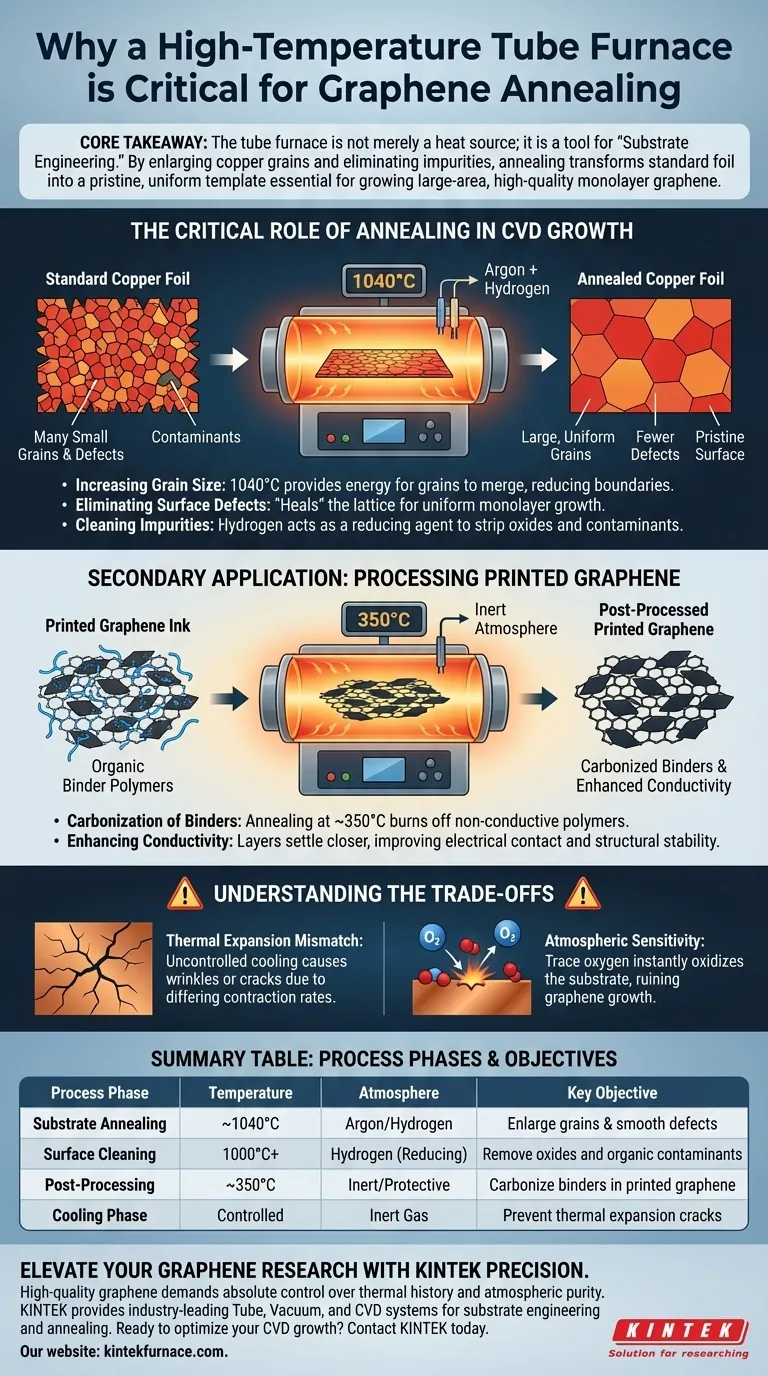
Core Takeaway The tube furnace is not merely a heat source; it is a tool for "substrate engineering." By enlarging copper grains and eliminating impurities, annealing transforms standard foil into a pristine, uniform template essential for growing large-area, high-quality monolayer graphene.

The Critical Role of Annealing in CVD Growth
The primary function of the tube furnace in Chemical Vapor Deposition (CVD) is to prepare the copper foil substrate. Since graphene is atomically thin, the quality of the substrate directly dictates the quality of the final material.
Increasing Grain Size
Standard copper foil consists of many small crystallographic "grains" with numerous boundaries.
Annealing at 1040°C provides the energy needed for these small grains to merge and grow larger.
This results in a surface with fewer grain boundaries, reducing defects in the graphene layer that eventually grows on top of it.
Eliminating Surface Defects
Raw copper foil often contains microscopic physical imperfections and dislocations.
The high-temperature treatment effectively "heals" the metal lattice, smoothing out these irregularities.
A smoother surface ensures that the graphene creates a uniform, continuous monolayer rather than a fragmented or multi-layered structure.
Cleaning Impurities
Copper surfaces are prone to oxidation and contamination from organic particles.
The tube furnace allows for a precise mix of gases, typically argon and hydrogen.
The hydrogen acts as a reducing agent, stripping away oxygen and cleaning impurities from the surface to ensure a pure chemical interface for growth.
Secondary Application: Processing Printed Graphene
While the primary application involves CVD growth, tube furnaces are also required for post-processing printed graphene structures.
Carbonization of Binders
Printed graphene inks often contain organic copolymer binders to maintain structure during printing.
Annealing at lower temperatures (around 350°C) in a protective atmosphere burns off or carbonizes these non-conductive binders.
Enhancing Conductivity
Once the excess organic components are decomposed, the graphene layers can settle closer together.
This improves the physical contact between layers, significantly boosting the macroscopic electrical conductivity and structural stability of the 3D-printed object.
Understanding the Trade-offs
While annealing is essential, it introduces specific variables that must be managed to avoid process failure.
Thermal Expansion Mismatch
Heating copper to 1040°C causes significant expansion.
If the cooling phase is not controlled precisely, the difference in contraction rates between the graphene and the copper can lead to wrinkles or cracks in the final graphene sheet.
Atmospheric Sensitivity
The "protective atmosphere" is unforgiving.
Even trace amounts of oxygen leaking into the tube furnace during the high-temperature phase can instantly oxidize the copper, ruining the substrate and preventing graphene growth entirely.
Making the Right Choice for Your Goal
The specific requirements for your tube furnace annealing process depend heavily on your fabrication method.
- If your primary focus is High-Quality CVD Growth: Prioritize a furnace capable of reaching 1040°C with precise hydrogen flow control to maximize copper grain size and surface purity.
- If your primary focus is Printed Graphene Electronics: Focus on a furnace with stable control at lower temperatures (350°C) to effectively remove binders without damaging the printed structure.
Success in graphene production is ultimately defined by how well you control the thermal history of your substrate.
Summary Table:
| Process Phase | Temperature | Atmosphere | Key Objective |
|---|---|---|---|
| Substrate Annealing | ~1040°C | Argon/Hydrogen | Enlarge copper grains & smooth surface defects |
| Surface Cleaning | 1000°C+ | Hydrogen (Reducing) | Remove oxides and organic contaminants |
| Post-Processing | ~350°C | Inert/Protective | Carbonize binders in printed graphene inks |
| Cooling Phase | Controlled | Inert Gas | Prevent thermal expansion cracks & wrinkles |
Elevate Your Graphene Research with KINTEK Precision
High-quality graphene synthesis demands absolute control over thermal history and atmospheric purity. KINTEK provides industry-leading Tube, Vacuum, and CVD systems designed to meet the rigorous demands of substrate engineering and annealing.
Whether you are focusing on maximizing copper grain size at 1040°C or carbonizing binders for printed electronics, our customizable high-temperature furnaces deliver the uniformity and gas precision your lab requires.
Ready to optimize your CVD growth? Contact KINTEK today to discuss how our expert R&D and manufacturing can support your unique material synthesis needs.
Visual Guide
References
- Gour Mohan Das, Mika Pettersson. Near‐Field Optical Nanopatterning of Graphene. DOI: 10.1002/smsc.202500184
This article is also based on technical information from Kintek Furnace Knowledge Base .
Related Products
- 2200 ℃ Graphite Vacuum Heat Treat Furnace
- 1700℃ High Temperature Laboratory Tube Furnace with Alumina Tube
- 1400℃ High Temperature Laboratory Tube Furnace with Alumina Tube
- 1200℃ Split Tube Furnace Laboratory Quartz Tube Furnace with Quartz Tube
- High Temperature Muffle Oven Furnace for Laboratory Debinding and Pre Sintering
People Also Ask
- Why are vacuum heat treating furnaces essential for aerospace? Ensure Superior Material Integrity for High-Stakes Applications
- What is the primary application of vacuum heat treating furnaces in aerospace? Enhance Component Performance with Precision
- How does vacuum heat treating work in terms of temperature and time control? Master Precise Material Transformations
- How does a vacuum heat treating furnace improve the condition of metal alloys? Achieve Superior Metal Performance
- What is the process of vacuum heat treating? Achieve Superior Metallurgical Properties



















