
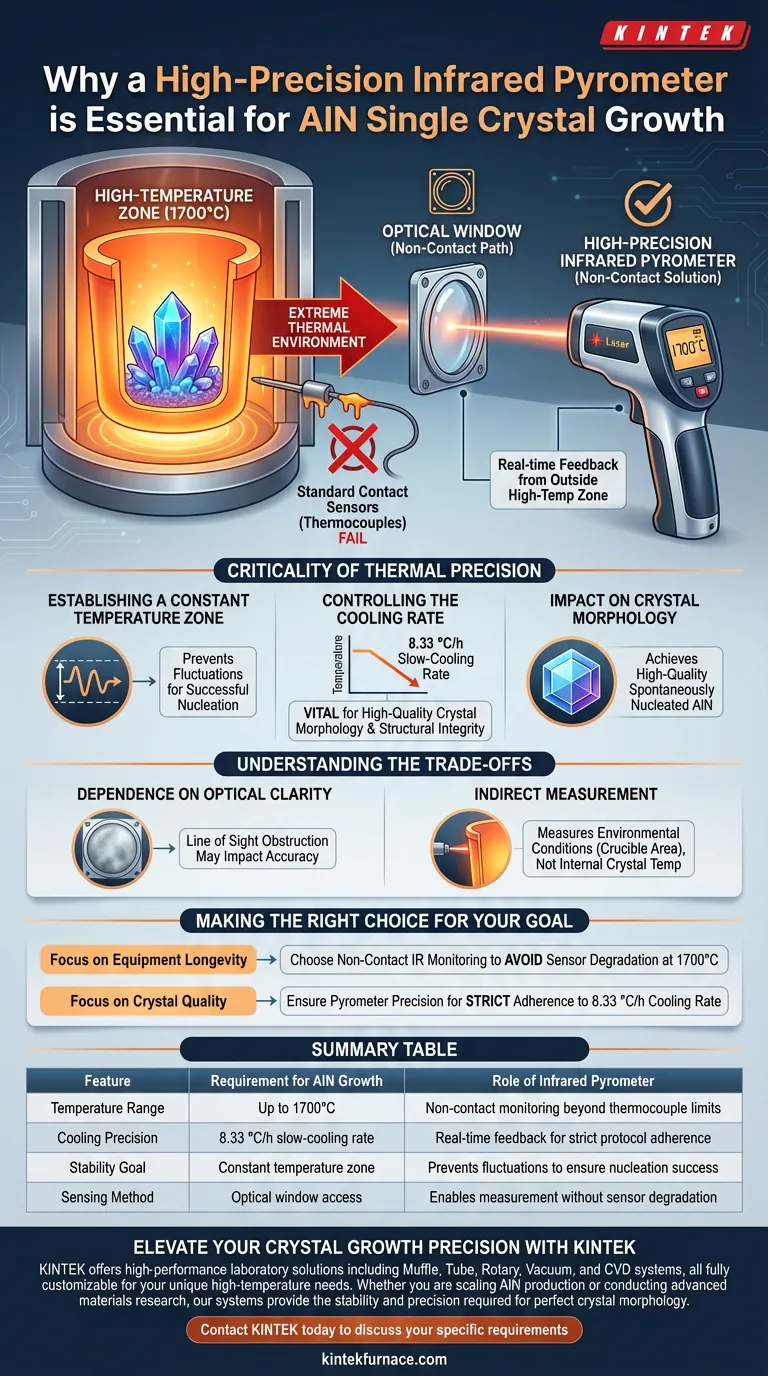
Extreme thermal environments demand non-contact solutions. In the synthesis of Aluminum Nitride (AlN) single crystals, process temperatures reach 1700°C, rendering standard contact sensors like thermocouples unusable due to the harsh conditions. A high-precision infrared pyrometer is the only viable instrument to monitor the crucible through an optical window, ensuring the strict thermal stability required for successful crystallization.
Success in AlN growth hinges on maintaining a precise constant temperature zone within a hostile 1700°C environment. The infrared pyrometer provides the necessary real-time, non-contact feedback to execute critical slow-cooling protocols, directly determining the final crystal quality.
Overcoming Physical Limitations
The 1700°C Barrier
Standard contact measurement tools fail in the extreme heat required for AlN growth. Conventional thermocouples cannot withstand direct contact with the growth environment at 1700°C.
The Optical Solution
To bypass the limitations of physical contact, the system utilizes an optical window. This allows the high-precision infrared pyrometer to monitor the crucible area in real-time from outside the high-temperature zone.
The Criticality of Thermal Precision
Establishing a Constant Temperature Zone
The growth of single crystals requires an incredibly stable environment. The pyrometer ensures the experiment remains within a precise constant temperature zone, preventing fluctuations that could disrupt nucleation.
Controlling the Cooling Rate
The most critical phase of the process is the cooling stage. The pyrometer provides the data necessary to maintain a specific slow cooling rate of 8.33 °C/h.
Impact on Crystal Morphology
This strict adherence to the slow cooling rate is not arbitrary. It is vital for achieving high-quality crystal morphology in spontaneously nucleated AlN, ensuring the structural integrity of the final product.
Understanding the Trade-offs
Dependence on Optical Clarity
Because the measurement relies on an optical window, the system is dependent on a clear line of sight. Any obstruction or clouding of the window could potentially impact the accuracy of the temperature reading.
Indirect Measurement
The pyrometer monitors the crucible area, rather than the crystal itself. Operators must understand that they are measuring the environmental conditions surrounding the growth, rather than the internal temperature of the crystal.
Making the Right Choice for Your Goal
To optimize your AlN growth setup, prioritize your instrumentation based on your specific operational needs:
- If your primary focus is Equipment Longevity: Choose non-contact infrared monitoring to avoid the degradation and failure common with physical sensors at 1700°C.
- If your primary focus is Crystal Quality: Ensure your pyrometer offers enough precision to strictly enforce the 8.33 °C/h cooling rate, as this dictates the final morphology.
Precision monitoring is the bridge between a volatile high-temperature environment and a perfect crystalline structure.
Summary Table:
| Feature | Requirement for AlN Growth | Role of Infrared Pyrometer |
|---|---|---|
| Temperature Range | Up to 1700°C | Non-contact monitoring beyond thermocouple limits |
| Cooling Precision | 8.33 °C/h slow-cooling rate | Real-time feedback for strict protocol adherence |
| Stability Goal | Constant temperature zone | Prevents fluctuations to ensure nucleation success |
| Sensing Method | Optical window access | Enables measurement without sensor degradation |
Elevate Your Crystal Growth Precision with KINTEK
High-quality Aluminum Nitride (AlN) crystals require rigorous thermal control that standard equipment simply cannot provide. Backed by expert R&D and manufacturing, KINTEK offers high-performance laboratory solutions including Muffle, Tube, Rotary, Vacuum, and CVD systems, all fully customizable for your unique high-temperature needs.
Whether you are scaling AlN production or conducting advanced materials research, our systems provide the stability and precision required for perfect crystal morphology. Contact KINTEK today to discuss your specific requirements with our technical team and discover how our customizable furnaces can optimize your laboratory results.
Visual Guide
References
- Xiaochun Tao, Zhanggui Hu. Growth of Spontaneous Nucleation AlN Crystals by Al-Base Alloy Evaporation in Nitrogen Atmosphere. DOI: 10.3390/cryst14040331
This article is also based on technical information from Kintek Furnace Knowledge Base .
Related Products
People Also Ask
- What are the essential components of an MPCVD reactor system? Build a Pristine Environment for High-Purity Materials
- How does pressure affect the MPCVD growth process? Master Plasma Control for Superior Film Quality
- How do carbon-containing groups contribute to diamond growth in the MPCVD method? Unlock High-Quality Diamond Synthesis
- Why is temperature control important in the MPCVD growth process? Ensure High-Quality, Reliable Diamond Film Deposition
- What are the key components of an MPCVD system? Unlock High-Purity Crystal Growth
