
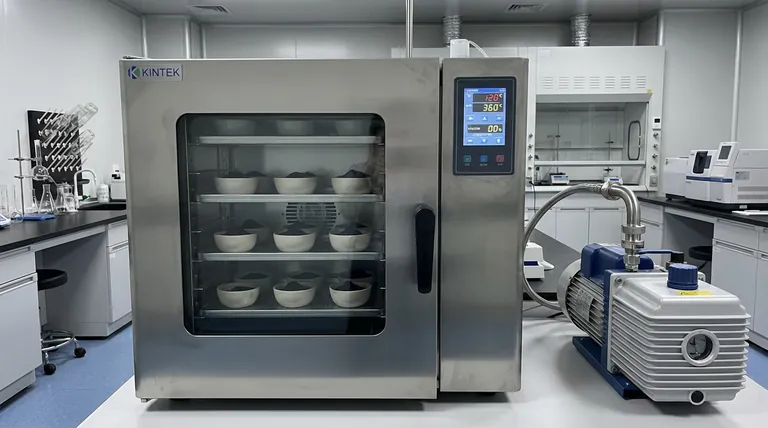
The use of a constant temperature vacuum drying oven is critical for processing SnO2@C structural materials to completely remove residual solvents without compromising the material's delicate architecture. By lowering the boiling point of solvents through reduced pressure, this method allows for effective dehydration at lower temperatures, preventing the structural collapse often associated with high-heat drying.
The drying phase is not just about moisture removal; it is a structural preservation step. Proper vacuum drying prevents the agglomeration of SnO2 nanoparticles, ensuring the material retains the high porosity and surface area required for superior electrochemical performance.
Preserving Micro-Nanostructure Integrity
Preventing Nanoparticle Agglomeration
The primary risk during the drying of SnO2@C composites is the agglomeration of SnO2 nanoparticles.
If dried at high temperatures or without a vacuum, the thermal energy can cause these nanoparticles to cluster together.
Vacuum drying operates effectively at low temperatures, significantly reducing the kinetic energy that drives this aggregation. This keeps the nanoparticles dispersed and preserves the specific surface area of the material.
Protecting Micro-Mesoporous Distribution
The electrochemical activity of an electrode material is heavily dependent on its micro-mesoporous distribution.
These pores act as channels for ion transport.
Vacuum drying ensures that solvents are evacuated from these deep pores gently. This avoids the high capillary forces and rapid vaporization associated with standard heat drying, which can collapse or block these critical pathways.
Optimizing for Downstream Applications
Ensuring Electrochemical Activity
The ultimate goal of synthesizing SnO2@C is often for use as an electrode material.
The preservation of the porous structure directly correlates to electrochemical activity.
By maintaining an open, un-collapsed structure, the material allows for better electrolyte penetration and ion diffusion during battery cycling.
Preparing for High-Temperature Steps
While the primary goal is solvent removal, this step also prepares the material for subsequent processing.
Removing moisture and solvents now prevents structural damage during later stages, such as carbonization.
If moisture remains trapped, rapid vaporization during high-temperature treatment can cause the internal pressure to fracture the material's framework.
Understanding the Trade-offs
Vacuum Drying vs. Blast Drying
It is important to distinguish why a vacuum oven is chosen over a standard blast drying oven for this specific application.
Blast drying ovens rely on hot air circulation. While effective for robust solid samples or simple biomass drying where speed is a priority, the higher temperatures required can be detrimental to nanostructures.
Vacuum ovens prioritize structural fidelity over speed. The process is slower and requires specialized equipment to maintain pressure, but it provides the gentle environment necessary for delicate nanocomposites like SnO2@C.
Precision vs. Throughput
Using a vacuum oven limits the volume of material you can process compared to open-air methods.
However, this trade-off is necessary for product purity.
Vacuum drying creates a controlled environment that minimizes oxidation and contamination, ensuring that the final weight and composition of the material are accurate for yield calculations and performance testing.
Making the Right Choice for Your Goal
To maximize the performance of your SnO2@C materials, align your drying protocol with your specific objectives:
- If your primary focus is Electrochemical Performance: Prioritize low-temperature vacuum drying to prevent SnO2 agglomeration and maximize active surface area.
- If your primary focus is Structural Stability: Ensure complete solvent removal under vacuum to prevent pore collapse or cracking during subsequent high-temperature carbonization.
Summary: The constant temperature vacuum drying oven is the definitive tool for decoupling solvent removal from thermal damage, ensuring your SnO2@C synthesis results in a high-performance, porous electrode material.
Summary Table:
| Feature | Vacuum Drying Oven | Standard Blast Drying Oven |
|---|---|---|
| Mechanism | Low pressure / Low temperature | Hot air circulation / High heat |
| Structural Impact | Prevents pore collapse & aggregation | Risk of nanoparticle clustering |
| Surface Area | High retention of specific surface area | Reduced due to thermal stress |
| Best For | Delicate SnO2@C nanocomposites | Robust, non-porous solid samples |
| Atmosphere | Controlled/Vacuum (Minimizes oxidation) | Atmospheric (Higher contamination risk) |
Elevate Your Nanomaterial Research with KINTEK
Precise thermal processing is the difference between a collapsed structure and a high-performance electrode. KINTEK provides industry-leading laboratory solutions, including high-precision Vacuum Drying Ovens, Muffle, Tube, and CVD systems, specifically engineered to preserve delicate micro-nanostructures like SnO2@C.
Why choose KINTEK?
- Expert R&D: Our equipment is designed for advanced material synthesis and electrochemical research.
- Total Customization: We tailor high-temperature and vacuum solutions to your specific laboratory requirements.
- Structural Integrity: Achieve complete solvent removal without compromising porosity or surface area.
Contact our technical team today to find your perfect furnace solution!
References
- Yujie Wang, Shufa Zhu. Hydrothermal synthesis and electrochemical properties of Sn-based peanut shell biochar electrode materials. DOI: 10.1039/d3ra08655k
This article is also based on technical information from Kintek Furnace Knowledge Base .
Related Products
- Vacuum Heat Treat Sintering Furnace Molybdenum Wire Vacuum Sintering Furnace
- 1700℃ High Temperature Muffle Oven Furnace for Laboratory
- 2200 ℃ Tungsten Vacuum Heat Treat and Sintering Furnace
- 1200℃ Muffle Oven Furnace for Laboratory
- High Temperature Muffle Oven Furnace for Laboratory Debinding and Pre Sintering
People Also Ask
- What are the main structural components of a vacuum sintering furnace? Unlock Precision in High-Temperature Processing
- What are the key components of a vacuum sintering furnace? Essential Parts for Precision Material Processing
- How does vacuum sintering improve dimensional tolerances? Achieve Uniform Shrinkage and Precision
- What is the purpose of setting a mid-temperature dwell stage? Eliminate Defects in Vacuum Sintering
- How does vacuum sintering contribute to cost reduction in material processing? Lower Expenses with Superior Parts










