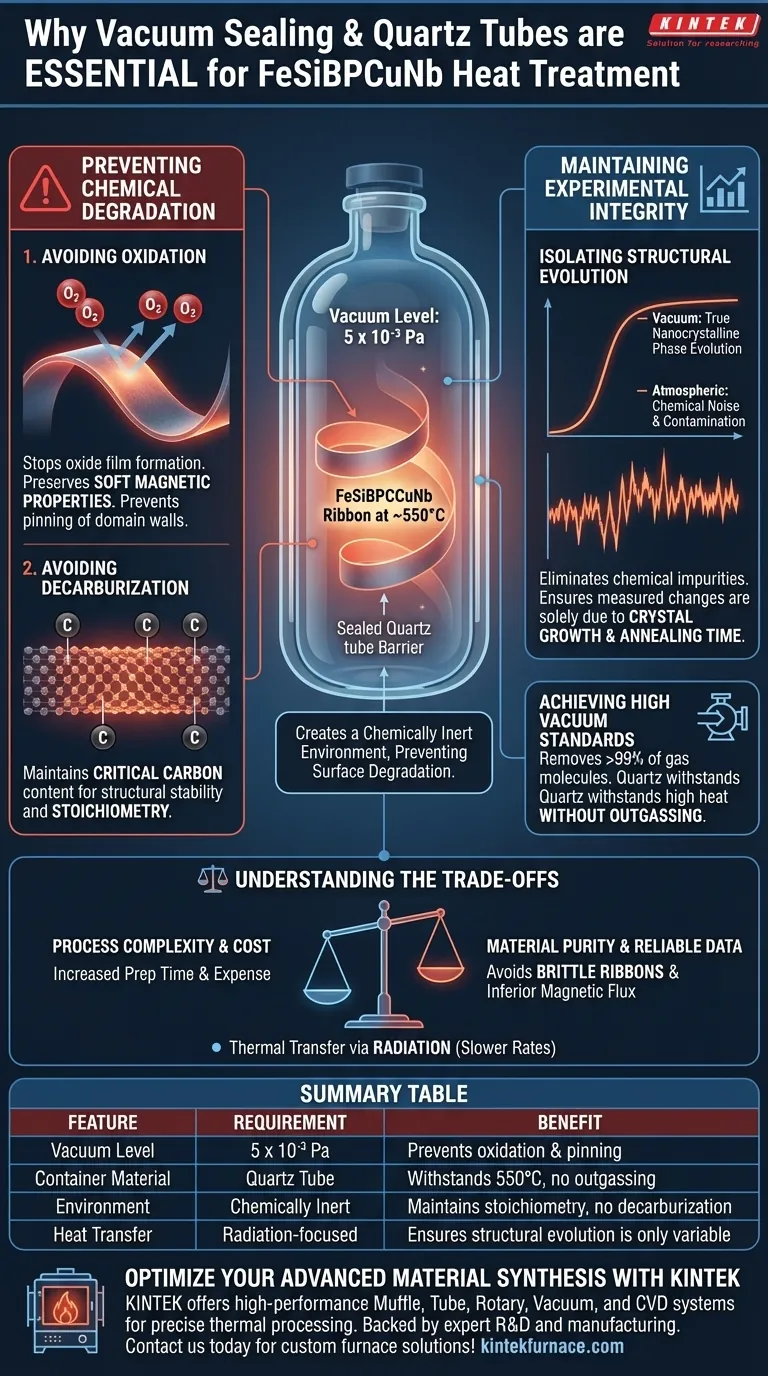
Vacuum sealing techniques and quartz tube containers are essential for the heat treatment of FeSiBPCCuNb amorphous ribbons because they create a chemically inert environment that prevents surface degradation. By achieving a vacuum level of 5 x 10⁻³ Pa, this setup isolates the alloy from atmospheric oxygen and moisture during high-temperature annealing (typically around 550 °C). This protection ensures that the resulting magnetic and structural data reflect the true properties of the material rather than the effects of oxidation or decarburization.
The combination of vacuum sealing and quartz containment acts as a controlled micro-environment, shielding the alloy’s sensitive chemical composition from external interference to ensure repeatable and accurate experimental results.
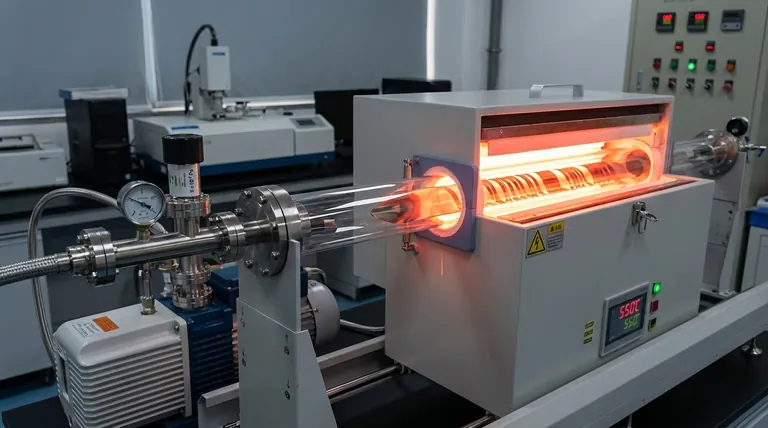
Preventing Chemical Degradation at High Temperatures
The Risk of Surface Oxidation
At annealing temperatures such as 550 °C, iron-based amorphous ribbons are highly reactive to even trace amounts of oxygen.
Vacuum sealing prevents the formation of oxide films on the ribbon surface, which can act as pinning sites for magnetic domain walls.
If these films are allowed to form, the soft magnetic properties of the FeSiBPCCuNb alloy would be significantly compromised.
Avoiding Decarburization
The presence of carbon in these specific alloys is critical for their structural stability and glass-forming ability.
Exposure to an uncontrolled atmosphere at high heat can lead to decarburization, where carbon is lost from the surface layers of the ribbon.
Quartz tube containers provide a stable, non-reactive vessel that maintains the alloy's stoichiometry throughout the heating and cooling cycles.
Maintaining the Integrity of Experimental Data
Isolating Structural Evolution
The primary goal of heat-treating FeSiBPCCuNb is to study how annealing time affects its nanocrystalline structure.
Without a vacuum, chemical impurities would introduce "noise" into the data, making it impossible to tell if a change in performance is due to crystal growth or chemical contamination.
The inert environment ensures that the evolution of the amorphous-to-nanocrystalline phase remains the only variable being measured.
Achieving High Vacuum Standards
A vacuum level of 5 x 10⁻³ Pa is specifically targeted to provide a high degree of protection.
This level of evacuation removes the vast majority of gas molecules that could collide with and react with the ribbon surface.
Using quartz is vital because it can withstand these high temperatures without outgassing or melting, which would otherwise ruin the vacuum integrity.
Understanding the Trade-offs
Process Complexity vs. Material Purity
Utilizing vacuum sealing and quartz tubes significantly increases the preparation time and cost of each experiment.
While this complexity is a barrier, the trade-off is necessary because atmospheric annealing often results in brittle ribbons with inferior magnetic flux density.
For high-performance alloys like FeSiBPCCuNb, skipping these steps usually leads to data that is unreliable or irreproducible.
Thermal Transfer Limitations
In a vacuum, heat is transferred primarily through radiation rather than convection.
This can lead to slower heating rates or potential thermal gradients across the ribbon samples if not monitored carefully.
Researchers must balance the need for a pure environment with the challenge of ensuring uniform temperature distribution within the quartz tube.
How to Apply This to Your Project
When determining the necessity of vacuum environments for your specific alloy heat treatments, consider your final performance requirements.
- If your primary focus is fundamental research: Always utilize vacuum sealing at 5 x 10⁻³ Pa to ensure your structural analysis is free from chemical interference.
- If your primary focus is optimizing magnetic permeability: Use quartz containment to prevent surface oxide layers that would otherwise impede domain wall motion.
- If your primary focus is industrial scaling: Evaluate whether an inert gas purge (like high-purity Argon) can provide "good enough" protection compared to the higher cost of a full vacuum seal.
Maintaining a rigorous vacuum environment is the only way to ensure that your alloy’s performance is a true reflection of its engineered microstructure.
Summary Table:
| Feature | Requirement/Standard | Benefit for FeSiBPCCuNb |
|---|---|---|
| Vacuum Level | 5 x 10⁻³ Pa | Prevents surface oxidation and domain wall pinning |
| Container Material | Quartz Tube | Withstands high heat (550°C) without outgassing |
| Environment | Chemically Inert | Maintains stoichiometry and prevents decarburization |
| Heat Transfer | Radiation-focused | Ensures structural evolution is the only variable measured |
Optimize Your Advanced Material Synthesis with KINTEK
Precise thermal processing is critical for the evolution of high-performance nanocrystalline structures. Backed by expert R&D and manufacturing, KINTEK offers high-performance Muffle, Tube, Rotary, Vacuum, and CVD systems, all customizable for your unique research or industrial needs. Whether you are treating Fe-based amorphous ribbons or developing next-gen alloys, our equipment provides the vacuum integrity and temperature uniformity you require.
Ready to elevate your lab's capabilities? Contact us today to find your custom furnace solution!
Visual Guide
References
- Xi Huang, Wenlong Zhu. Effects of Annealing Time on the Structure Characteristics and Magnetic Properties of FeSiBPCCuNb Amorphous Ribbons. DOI: 10.3390/coatings15010050
This article is also based on technical information from Kintek Furnace Knowledge Base .
Related Products
- High Pressure Laboratory Vacuum Tube Furnace
- Vacuum Sealed Continuous Working Rotary Tube Furnace Rotating Tube Furnace
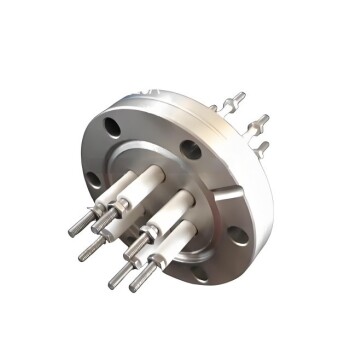
- CF KF Flange Vacuum Electrode Feedthrough Lead Sealing Assembly for Vacuum Systems
- Vertical Laboratory Quartz Tube Furnace Tubular Furnace
- Multi Zone Laboratory Quartz Tube Furnace Tubular Furnace
People Also Ask
- What role does a high vacuum tube furnace play in Co-Al sintering? Master High-Purity Porous Material Synthesis
- What are the different types of tube furnaces available? Find the Perfect Fit for Your Lab's Needs
- What are the main advantages of vacuum tube furnaces in the market? Achieve Purity and Precision in Material Processing
- What is the role of a vacuum tube furnace during the final thermal treatment stage of Fe3O4@CSAC catalysts?
- What parameters must be controlled when calcining freeze-dried oxide precursors in a laboratory tube furnace? A Guide